2018 · Nishimaki — Effects of Molecular Hydrogen Assessed by an Animal Model and a Randomized Clinical Study on Mild Cognitive Impairment
Super-Abstract
In a randomized double-blind placebo-controlled trial with 73 patients with mild cognitive impairment (MCI), H₂-water did not improve overall cognitive scores — but a specific genetic subgroup (APOE4 carriers) showed significant improvement. Parallel animal data in an oxidative stress dementia model supported the biological plausibility. (Current Alzheimer Research, 2018.)
Commentary
This study combines a mouse model experiment with a human RCT — an unusual but informative dual approach. The animal part is clear: H₂-water reduced oxidative stress markers, slowed memory decline, and extended lifespan in transgenic mice with enhanced oxidative stress. The human part is more nuanced. In the overall cohort of 73 MCI patients, H₂-water (approximately 300 mL/day for one year) did not produce a statistically significant improvement on the ADAS-cog cognitive scale compared to placebo. However, a subgroup analysis of APOE4 genotype carriers showed a significant improvement in both total ADAS-cog score and the word recall subscale. APOE4 is the strongest known genetic risk factor for Alzheimer's disease, and APOE4 carriers tend to experience higher oxidative stress — which would fit mechanistically with a targeted H₂ antioxidant effect. This is a biologically plausible subgroup finding, but it must be regarded as hypothesis-generating only: subgroup analyses without pre-registration are prone to false positives and cannot support clinical recommendations on their own.
Key quotes
- „although there was no significant difference between the H2- and control groups in ADAS-cog score after 1 year, carriers of the apolipoprotein E4 (APOE4) genotype in the H2-group were improved significantly on total ADAS-cog score and word recall task score“ — the honest summary: null result overall, but a significant subgroup signal in APOE4 carriers
- „Oxidative stress is one of the causative factors in the pathogenesis of neurodegenerative diseases including mild cognitive impairment (MCI) and dementia.“ — the mechanistic rationale: why an antioxidant intervention is biologically plausible in MCI
- „H2-water may have a potential for suppressing dementia in an oxidative stress model and in the APOE4 carriers with MCI.“ — cautious conclusion — appropriately hedged
Our assessment
A methodologically solid RCT with an honest null result in the primary analysis. The APOE4 subgroup finding is intriguing and biologically plausible but must not be overinterpreted — it was not a pre-specified primary outcome and represents a subgroup of a 73-person trial. Limitations: dose of H₂-water is low (~300 mL/day at unspecified concentration — far below doses used in some other trials); one year is a meaningful follow-up but Alzheimer's progression is slow and longer studies would be more informative; APOE4 subgroup analysis is exploratory. This study contributes important nuance: H₂ may not be uniformly beneficial across all cognitive impairment patients — genetic predisposition to oxidative stress may be a key moderator.
Study design
- Type: randomized, double-blind, placebo-controlled trial (human component) + transgenic mouse model (animal component) · n (human): 73 MCI patients · H₂ delivery: H₂-water drinking (~300 mL/day)
- Duration: 1 year · Primary outcome: ADAS-cog score change
- Result: no significant difference in ADAS-cog between groups overall; APOE4 carriers in H₂ group showed significant improvement in total ADAS-cog and word recall subscale; animal data showed reduced oxidative stress and slowed neurodegeneration
Abstract
BACKGROUND: Oxidative stress is one of the causative factors in the pathogenesis of neurodegenerative diseases including mild cognitive impairment (MCI) and dementia. We previously reported that molecular hydrogen (H2) acts as a therapeutic and preventive antioxidant. OBJECTIVE: We assess the effects of drinking H2-water (water infused with H2) on oxidative stress model mice and subjects with MCI. METHODS: Transgenic mice expressing a dominant-negative form of aldehyde dehydrogenase 2 were used as a dementia model. The mice with enhanced oxidative stress were allowed to drink H2-water. For a randomized double-blind placebo-controlled clinical study, 73 subjects with MCI drank ~300 mL of H2-water (H2-group) or placebo water (control group) per day, and the Alzheimer's Disease Assessment Scale-cognitive subscale (ADAS-cog) scores were determined after 1 year. RESULTS: In mice, drinking H2-water decreased oxidative stress markers and suppressed the decline of memory impairment and neurodegeneration. Moreover, the mean lifespan in the H2-water group was longer than that of the control group. In MCI subjects, although there was no significant difference between the H2- and control groups in ADAS-cog score after 1 year, carriers of the apolipoprotein E4 (APOE4) genotype in the H2-group were improved significantly on total ADAS-cog score and word recall task score (one of the sub-scores in the ADAS-cog score). CONCLUSION: H2-water may have a potential for suppressing dementia in an oxidative stress model and in the APOE4 carriers with MCI.
Source & links
Screenshot of the PubMed page
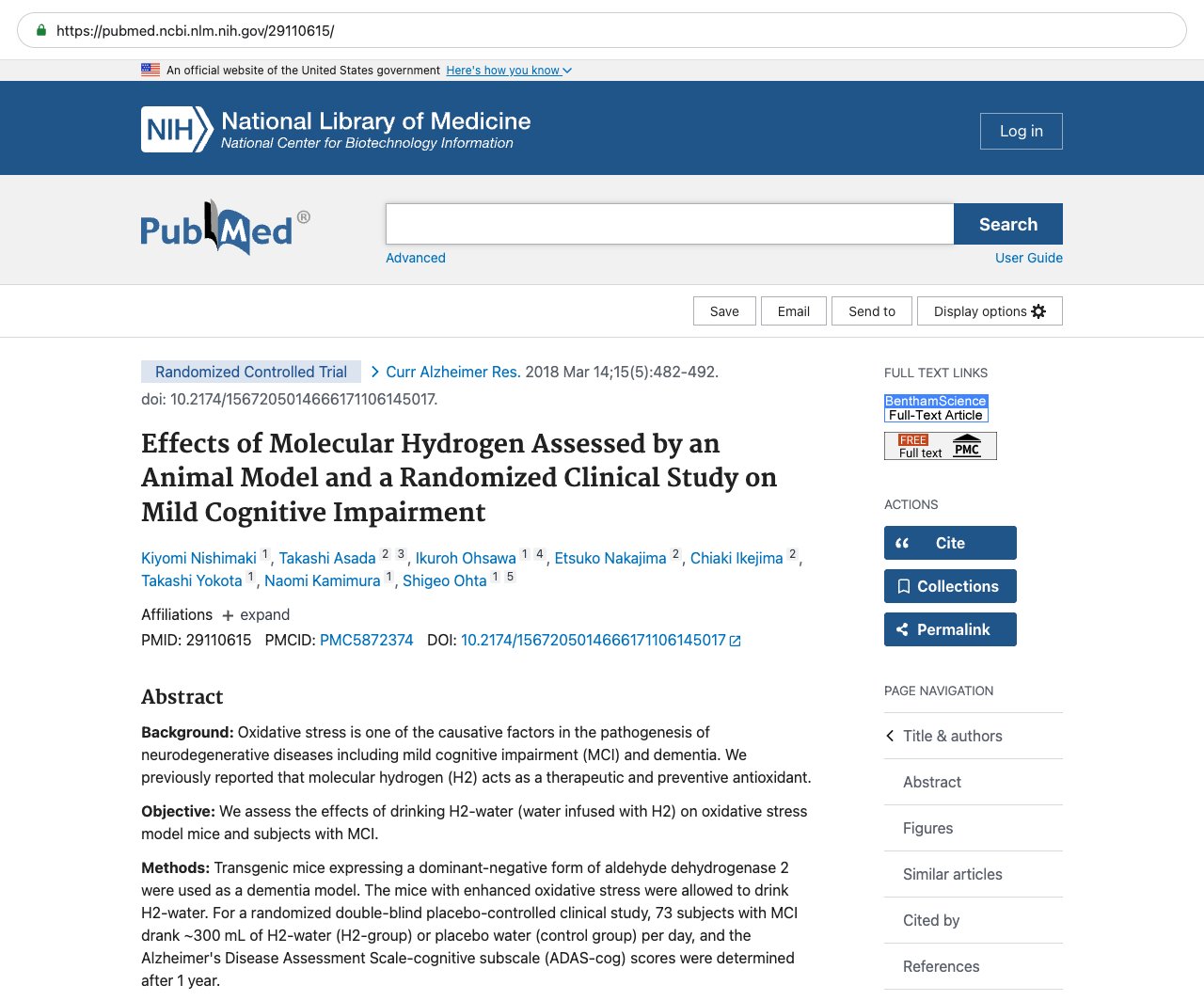
This page mirrors the published abstract (© the authors / publisher) for reference and citation. The canonical source is the PubMed record linked above. This is not medical advice.