2017 · Han — Hydrogen Treatment Protects against Cell Death and Senescence Induced by Oxidative Damage
Super-Abstract
In mouse embryonic fibroblast cell cultures, nanoparticle hydrogen water suppressed hydroxyurea-induced reactive oxygen species (ROS) production, reduced signs of cellular ageing (β-galactosidase accumulation), and promoted cell proliferation. This is an in-vitro study on cell cultures — findings have not been tested in living animals or humans.
Commentary
Cellular senescence — the state where cells stop dividing and accumulate ageing markers — is driven in part by oxidative stress and reactive oxygen species. This study used a nanoparticle hydrogen formulation, which the authors describe as more stable than conventional dissolved hydrogen water (which loses H₂ concentration over time). Mouse embryonic fibroblasts were stressed with hydroxyurea to induce ROS and senescence. Treatment with nanoparticle hydrogen water reduced ROS, suppressed the accumulation of β-galactosidase (a classic senescence marker), inhibited the appearance of abnormal nuclei, and promoted cell proliferation. The effect was more pronounced under hydroxyurea-induced oxidative stress than under basal conditions. The main novelty claim — nanoparticle stability — lacks direct comparison data in this paper. The extrapolation to human anti-ageing applications is highly speculative at this stage; results in a mouse embryonic cell line cannot predict what happens in complex human tissues.
Key quotes
- „The accumulation of β-galactosidase in the cytoplasm and the appearance of abnormal nuclei were inhibited by daily treatment of cells with hydrogen water.“ — the two key cellular senescence markers suppressed by hydrogen water
- „When the aging process was accelerated by hydroxyurea-induced oxidative stress, the effect of hydrogen water was even more remarkable.“ — the protective effect is stronger when oxidative stress is high
- „Nanoparticle hydrogen water is potentially a potent anti-aging agent.“ — the authors' own characterisation — speculative, as this is a cell-culture study only
Our assessment
This is an in-vitro study in mouse embryonic fibroblasts — results cannot be directly transferred to humans. The anti-senescence findings are consistent with H₂'s known antioxidant properties and add mechanistic depth. However, important limitations apply: the cell line is embryonic and thus atypical of adult human ageing; no animal experiments are included; the nanoparticle formulation's superior stability is asserted but not comparatively proven in this paper; and no pharmacokinetic data on nanoparticle H₂ in living organisms are provided. The term „anti-aging agent“ in the conclusion is speculative given the in-vitro scope.
Study design
- Type: in-vitro study · Model: mouse embryonic fibroblasts (C57BL/6, day 12.5), hydroxyurea-induced oxidative stress/senescence · H₂ delivery: nanoparticle hydrogen water
- Outcome: reduced ROS; suppressed β-galactosidase accumulation and abnormal nuclei; promoted cell proliferation; effects amplified under hydroxyurea-induced stress
Abstract
Hydrogen has potential for preventive and therapeutic applications as an antioxidant. However, micro- and macroparticles of hydrogen in water disappear easily over time. In order to eliminate reactive oxygen species (ROS) related with the aging process, we used functional water containing nanoparticle hydrogen. Nanoparticle hydrogen does not disappear easily and collapse under water after long periods of time. We used murine embryonic fibroblasts that were isolated from 12.5-day embryos of C57BL/6 mice. We investigated the ability of nanoparticle hydrogen in water to suppress hydroxyurea-induced ROS production, cytotoxicity, and the accumulation of β-galactosidase (an indicator of aging), and promote cell proliferation. The accumulation of β-galactosidase in the cytoplasm and the appearance of abnormal nuclei were inhibited by daily treatment of cells with hydrogen water. When the aging process was accelerated by hydroxyurea-induced oxidative stress, the effect of hydrogen water was even more remarkable. Thus, this study showed the antioxidant and anti-senescence effects of hydrogen water. Nanoparticle hydrogen water is potentially a potent anti-aging agent.
Source & links
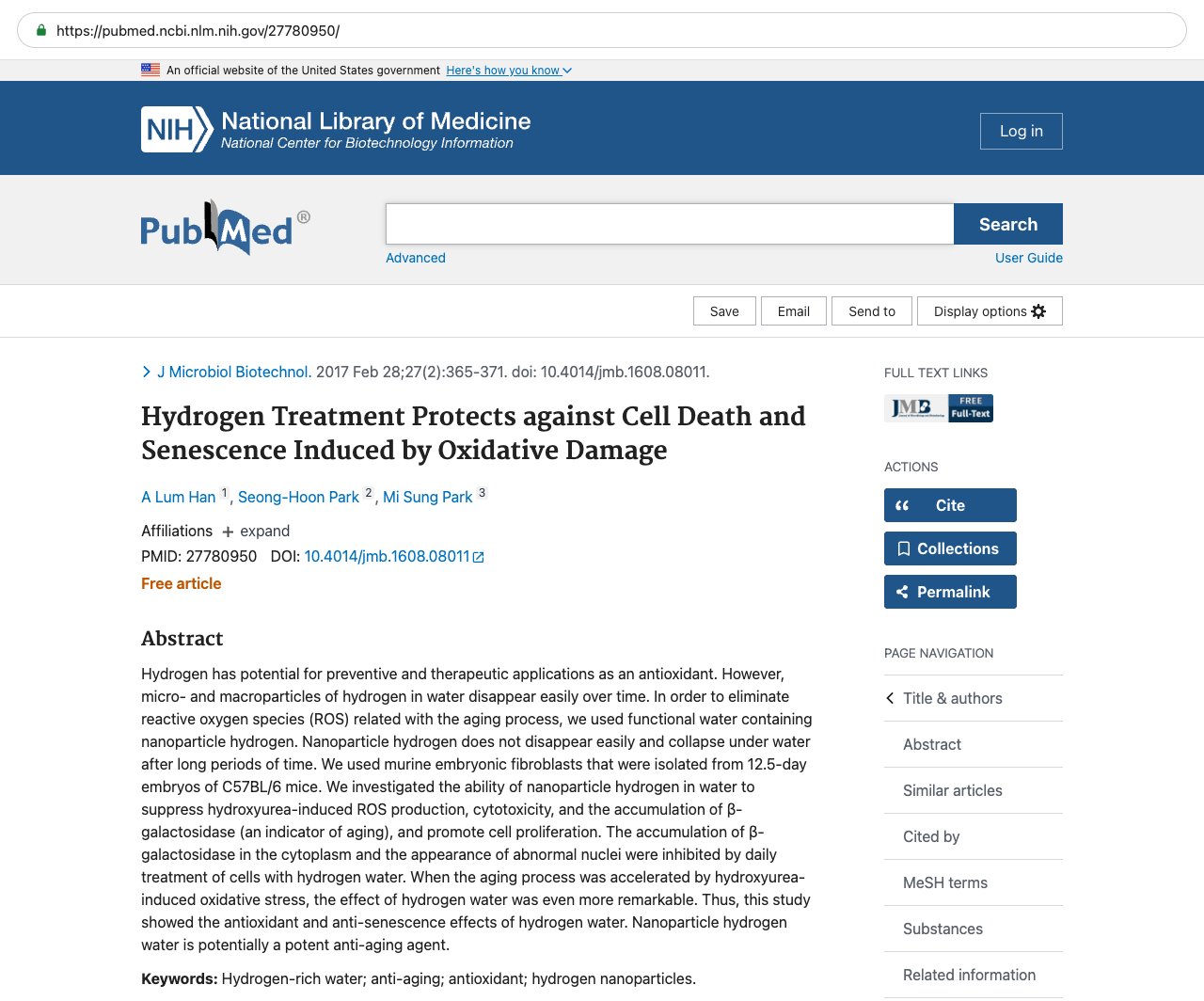
Screenshot of the PubMed page
This page mirrors the published abstract (© the authors / publisher) for reference and citation. The canonical source is the PubMed record linked above. This is not medical advice.