2018 · Morris — The putative role of oxidative stress and inflammation in the pathophysiology of sleep dysfunction across neuropsychiatric disorders
Super-Abstract
This review proposes that oxidative stress, neuroinflammation, and mitochondrial dysfunction are shared drivers of sleep disturbances in chronic fatigue syndrome, bipolar disorder, and multiple sclerosis. Molecular hydrogen is mentioned among novel therapeutic candidates targeting these pathways alongside melatonin. This is a theoretical framework paper, not a clinical H₂ study. (Sleep Medicine Reviews, 2018.)
Commentary
Morris and colleagues construct a heuristic model linking immune activation, oxidative and nitrosative stress, and glial cell activity to disrupted sleep and circadian rhythms in neuro-immune disorders. The paper is a broad theoretical synthesis, not an H₂ intervention study. Molecular hydrogen appears only briefly as one of several speculative therapeutic targets — the authors note its potential to address oxidative and nitrosative pathways but do not review any H₂ sleep trials. The value for the H₂ field is limited but notable: it situates H₂ within a serious academic discussion of neuro-immune mechanisms, which may guide future research directions.
Key quotes
- „We conclude that novel therapeutic targets exploring immune and oxidative & nitrosative pathways (p.e. melatonin and molecular hydrogen) hold promise in alleviating sleep and circadian dysfunction in these disorders.“ — the only explicit mention of molecular hydrogen — as a candidate, not a tested therapy
- „Activated glial cells may secrete pro-inflammatory cytokines (for example, interleukin-1 beta and tumour necrosis factor alpha), nitric oxide and gliotransmitters, which may influence the expression of key circadian regulators.“ — proposed mechanism linking neuroinflammation to circadian disruption
- „Sleep disruption may further aggravate oxidative and nitrosative, peripheral immune activation, and (neuro) inflammation across these disorders in a vicious pathophysiological loop.“ — the self-reinforcing cycle that the authors propose to break with antioxidant strategies
Our assessment
This paper does not test H₂ in any experiment — it is a theoretical review that mentions molecular hydrogen as a plausible candidate within a broader redox-inflammation framework. Its relevance to H₂ research is indirect: it provides mechanistic context for why antioxidant strategies might help sleep in neuro-immune disease, but offers no clinical data. Readers should not interpret this as evidence that H₂ improves sleep in any of the three disorders. The review itself has the usual limitations of narrative overviews: no systematic search strategy, no effect sizes, risk of confirmation bias in the causal model proposed.
Study design
- Type: narrative/theoretical review · n: n/a (conceptual model + literature citations) · H₂ delivery: not tested — mentioned as theoretical candidate only
- Result: heuristic framework proposed; H₂ cited as one of several antioxidant/anti-inflammatory candidates alongside melatonin; no H₂ efficacy data presented
Abstract
Sleep and circadian abnormalities are prevalent and burdensome manifestations of diverse neuro-immune diseases, and may aggravate the course of several neuropsychiatric disorders. The underlying pathophysiology of sleep abnormalities across neuropsychiatric disorders remains unclear, and may involve the inter-play of several clinical variables and mechanistic pathways. In this review, we propose a heuristic framework in which reciprocal interactions of immune, oxidative and nitrosative stress, and mitochondrial pathways may drive sleep abnormalities across potentially neuroprogressive disorders. Specifically, it is proposed that systemic inflammation may activate microglial cells and astrocytes in brain regions involved in sleep and circadian regulation. Activated glial cells may secrete pro-inflammatory cytokines (for example, interleukin-1 beta and tumour necrosis factor alpha), nitric oxide and gliotransmitters, which may influence the expression of key circadian regulators (e.g., the Circadian Locomotor Output Cycles Kaput (CLOCK) gene). Furthermore, sleep disruption may further aggravate oxidative and nitrosative, peripheral immune activation, and (neuro) inflammation across these disorders in a vicious pathophysiological loop. This review will focus on chronic fatigue syndrome, bipolar disorder, and multiple sclerosis as exemplars of neuro-immune disorders. We conclude that novel therapeutic targets exploring immune and oxidative & nitrosative pathways (p.e. melatonin and molecular hydrogen) hold promise in alleviating sleep and circadian dysfunction in these disorders.
Source & links
Screenshot of the PubMed page
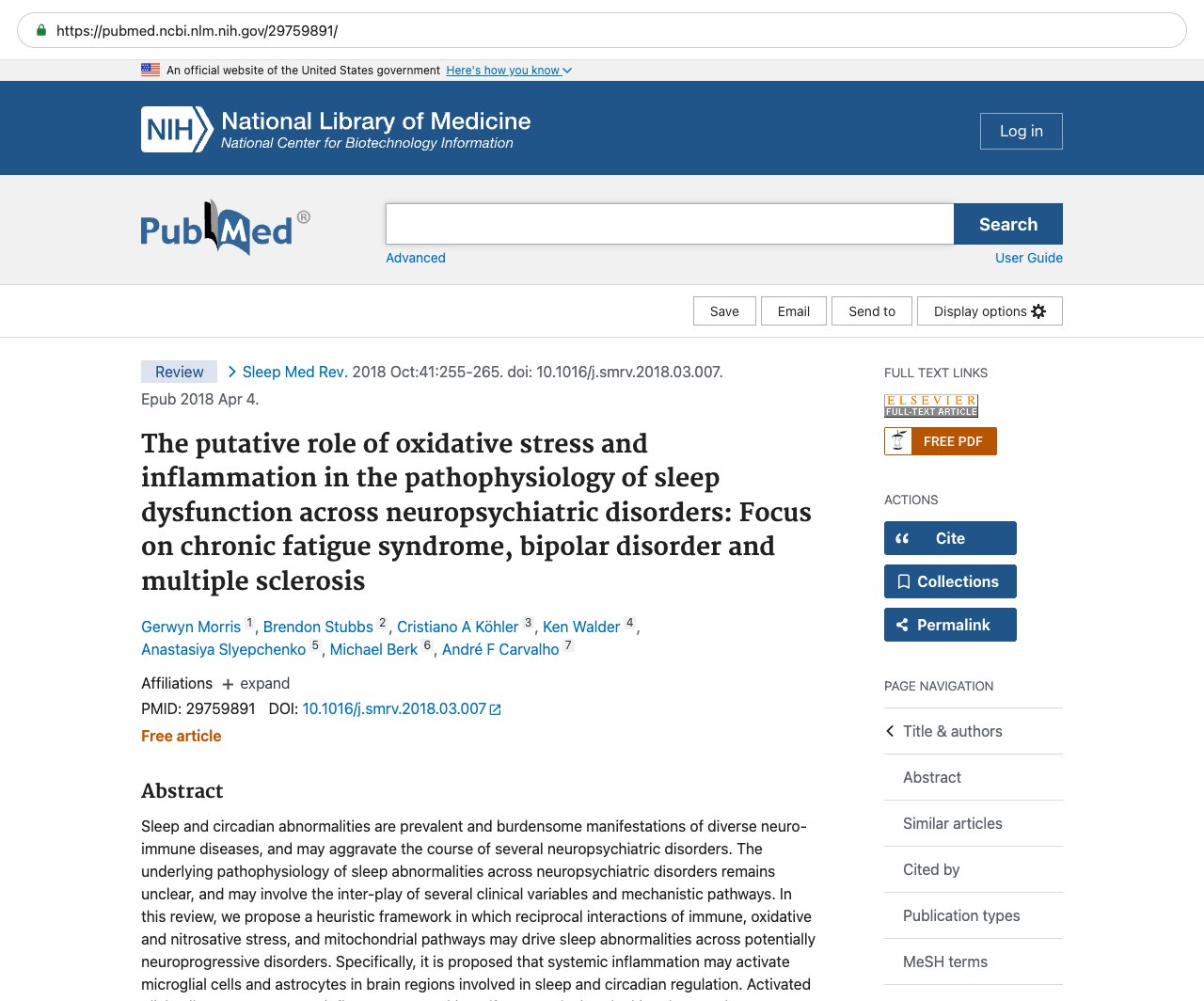
This page mirrors the published abstract (© the authors / publisher) for reference and citation. The canonical source is the PubMed record linked above. This is not medical advice.