2025 · Zajac — Molecular Hydrogen in the Treatment of Respiratory Diseases
Super-Abstract
This review compiles twenty years of research on molecular hydrogen in respiratory medicine, covering allergies, asthma, COPD, pulmonary fibrosis, lung injury, respiratory infections, and lung cancer. H₂'s antioxidant, anti-inflammatory, and anti-apoptotic mechanisms are mapped against each condition; most evidence remains preclinical. (International Journal of Molecular Sciences, 2025.)
Commentary
Respiratory diseases share oxidative stress and dysregulated inflammation as common pathological denominators — precisely the processes that H₂ has been most studied for. This review is notable for its scope: it moves systematically through allergies, asthma, COPD, pulmonary fibrosis, acute lung injury (including ARDS and ventilator-induced injury), lung cancer, and respiratory infections (including COVID-19). The authors describe the basic biological mechanisms — selective radical scavenging, modulation of NF-κB and Nrf2, anti-apoptotic signalling — and then trace how these apply to each condition. The breadth is a strength but also a limitation: depth varies considerably across conditions, with more robust preclinical evidence for acute lung injury and less for conditions like allergic rhinitis. The review also touches on sports medicine (exercise-induced oxidative stress in the lungs) — a relatively novel niche for H₂ research.
Key quotes
- „Molecular hydrogen is gaining increasing attention as an antioxidant, anti-inflammatory, and antiapoptotic agent.“ — the three core biological properties that underpin all respiratory applications reviewed
- „the present review aims to provide a consistent summary of the findings of the last twenty years on the use of molecular hydrogen in major respiratory diseases“ — explicit statement of scope: twenty years of literature, systematically covered
- „Once considered an inert gas, it reveals current therapeutic potential among others in inflammatory diseases, cancer, and sports medicine, among others.“ — the paradigm shift: from inert gas to biologically active molecule
Our assessment
This is a narrative literature review, not a meta-analysis or clinical trial. It provides a useful map of the H₂ respiratory research landscape across twenty years but does not pool effect sizes or apply formal quality assessment to individual studies. The evidence base is overwhelmingly preclinical (animal models, cell lines), with limited human trial data, particularly for chronic conditions. No single respiratory indication has yet accumulated sufficient clinical trial evidence to support H₂ as a standard treatment. The review serves as a research orientation tool, not a basis for clinical recommendations.
Study design
- Type: narrative review (20-year literature scope) · n: n/a (literature synthesis) · H₂ delivery: inhalation and hydrogen-rich water, as used in cited source studies across different respiratory disease models
- Result: narrative synthesis across allergies, asthma, COPD, pulmonary fibrosis, acute lung injury, lung cancer, and respiratory infections; H₂ mechanism (antioxidant, anti-inflammatory, anti-apoptotic) mapped to each condition; evidence predominantly preclinical; calls for further clinical trials
Abstract
Molecular hydrogen is gaining increasing attention as an antioxidant, anti-inflammatory, and antiapoptotic agent. Once considered an inert gas, it reveals current therapeutic potential among others in inflammatory diseases, cancer, and sports medicine, among others. The present review aims to provide a consistent summary of the findings of the last twenty years on the use of molecular hydrogen in major respiratory diseases, including allergies, asthma, COPD, pulmonary fibrosis, lung injury of various origins, as well as cancer and infections of the respiratory tract. In addition, the basic mechanisms through which molecular hydrogen exercises its biological activity on the respiratory system are described.
Source & links
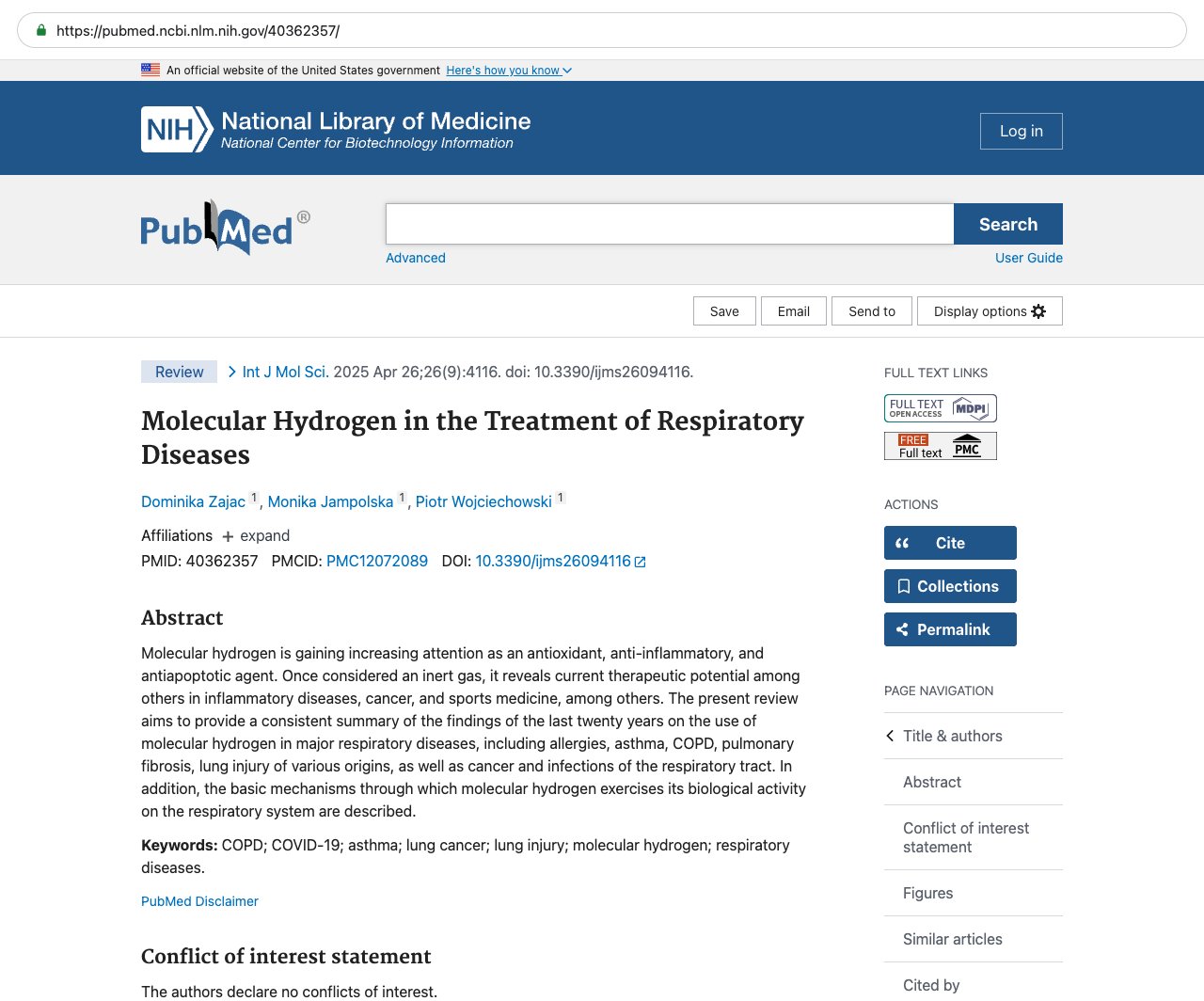
Screenshot of the PubMed page
This page mirrors the published abstract (© the authors / publisher) for reference and citation. The canonical source is the PubMed record linked above. This is not medical advice.