2025 · Todorović — Hydrogen as an Innovative Nootropic in Health and Disease
Super-Abstract
Molecular hydrogen may improve executive function, alertness, and memory — this review surveys current evidence for H₂ as a nootropic (cognitive enhancer) in healthy individuals and in patients with neurodegenerative disorders, circadian disruption, and cancer. While findings from a handful of clinical trials are encouraging, the authors stress that evidence remains limited and further investigation is essential. (Nutrition and Health, 2025.)
Commentary
The concept of a nootropic — a substance that safely enhances cognition — is appealing but crowded with unsubstantiated claims. Todorović et al. attempt a sober assessment of where H₂ stands as a candidate nootropic. H₂'s antioxidant and anti-inflammatory mechanisms are plausible routes to neuroprotection, given that oxidative stress and neuroinflammation underlie both age-related cognitive decline and many neurological diseases. The review is candid that only a handful of human studies have been conducted, with heterogeneous populations and outcome measures. The included trial data hint at improvements in executive function and alertness — across healthy young adults, elderly individuals, shift workers with disrupted circadian rhythms, and cancer patients. However, effect sizes, blinding quality, and long-term safety data are not systematically reported. The review is best read as a research agenda rather than a clinical recommendation.
Key quotes
- „Despite the growing interest in H2 as a potential therapeutic agent, the evidence regarding its potential as a nootropic remains limited.“ — the authors' own candid assessment of the evidence base
- „Current evidence suggests that H2 improves executive function, alertness and memory in several clinical trials, from healthy young and elderly individuals to individuals with altered circadian rhythms, neurodegenerative disorders, and cancer.“ — summary of the populations in which cognitive effects have been observed
- „Further investigations are needed to confirm the potential positive effects of dihydrogen as a nootropic agent in both health and disease.“ — the authors' conclusion on the research gap
Our assessment
This review covers an interesting and underexplored application of H₂, but its evidence base is thin. Only a small number of human trials are available, and the review acknowledges this directly. The mechanistic rationale is plausible, but cognitive endpoints are notoriously difficult to measure and prone to placebo effects. No strong clinical recommendation can be derived from this review. It is valuable as a signal and as a map of where future rigorous trials should focus.
Study design
- Type: narrative review · n: n/a (literature analysis, includes a small number of clinical trials) · H₂ delivery: various (H₂-rich water, inhalation — from cited studies)
- Result: no pooled effect sizes; directional evidence from a limited number of clinical trials suggests cognitive benefits (executive function, alertness, memory) in diverse populations; animal and cellular studies support neuroprotective mechanisms; authors emphasise that the evidence is still limited
Abstract
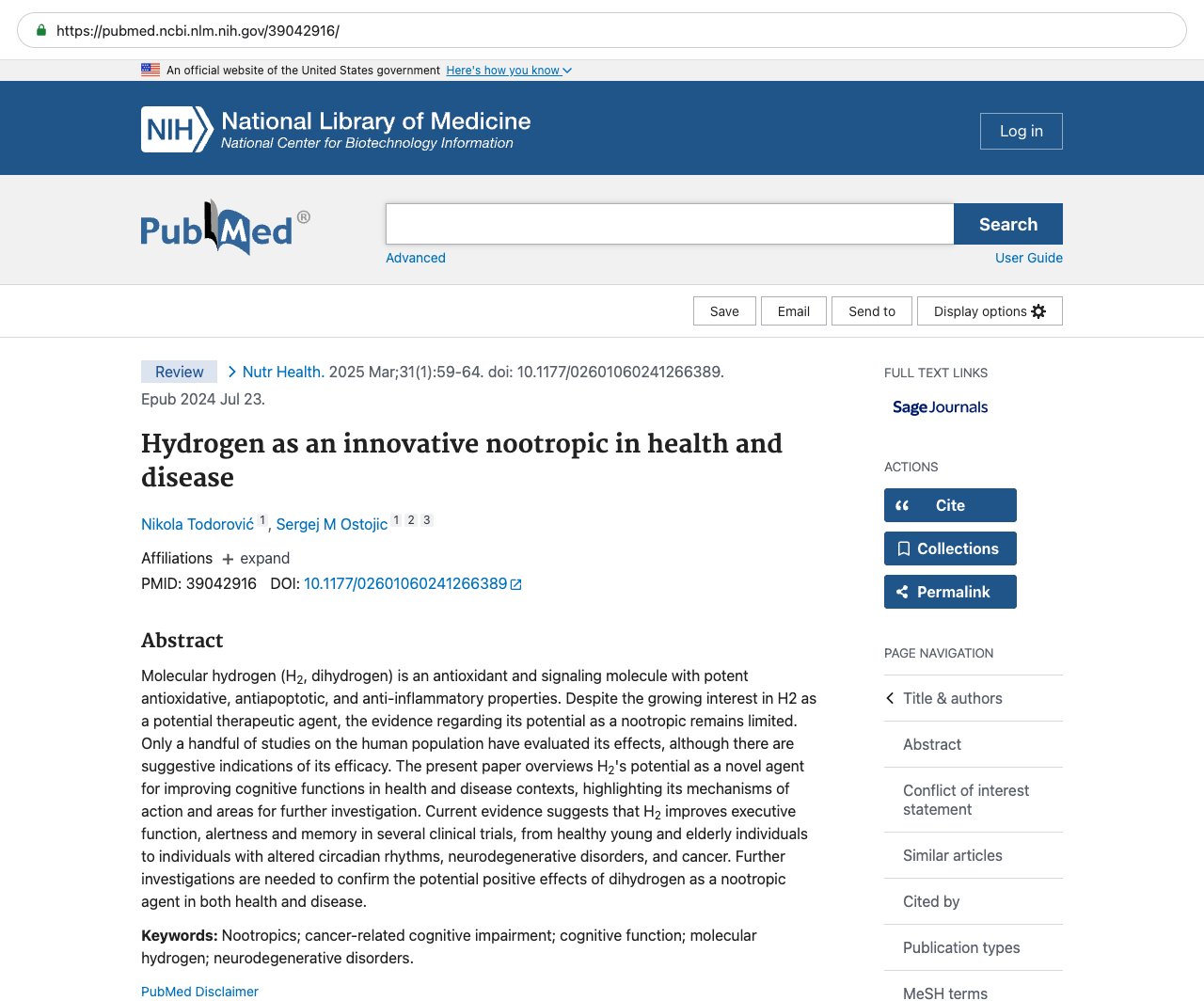
Molecular hydrogen (H2, dihydrogen) is an antioxidant and signaling molecule with potent antioxidative, antiapoptotic, and anti-inflammatory properties. Despite the growing interest in H2 as a potential therapeutic agent, the evidence regarding its potential as a nootropic remains limited. Only a handful of studies on the human population have evaluated its effects, although there are suggestive indications of its efficacy. The present paper overviews H2's potential as a novel agent for improving cognitive functions in health and disease contexts, highlighting its mechanisms of action and areas for further investigation. Current evidence suggests that H2 improves executive function, alertness and memory in several clinical trials, from healthy young and elderly individuals to individuals with altered circadian rhythms, neurodegenerative disorders, and cancer. Further investigations are needed to confirm the potential positive effects of dihydrogen as a nootropic agent in both health and disease.
Source & links
Screenshot of the PubMed page
This page mirrors the published abstract (© the authors / publisher) for reference and citation. The canonical source is the PubMed record linked above. This is not medical advice.