2019 · Morris — Myalgic encephalomyelitis/chronic fatigue syndrome: From pathophysiological insights to novel therapeutic opportunities.
Super-Abstract
This review maps the multiple pathophysiological abnormalities described in ME/CFS — including chronic inflammation, oxidative and nitrosative stress, gut barrier disruption, and mitochondrial dysfunction — and identifies several candidate therapeutic agents, among them molecular hydrogen, that target these pathways. The paper does not present new experimental data; it synthesises existing evidence and frames hydrogen as one of several „promising yet preliminary“ options for this poorly-treated condition.
Commentary
Myalgic encephalomyelitis/chronic fatigue syndrome (ME/CFS) is a complex, debilitating, and poorly understood condition with very limited evidence-based treatments. This review by Morris and colleagues provides a comprehensive pathophysiology map and then evaluates therapeutics that might address the identified abnormalities. Molecular hydrogen is listed alongside coenzyme Q10, melatonin, curcumin, and N-acetylcysteine — all agents with antioxidant or mitochondria-supporting properties. The authors are honest: the data for these agents are „promising yet preliminary.“ No H₂-specific clinical trial in ME/CFS is cited; the basis for including H₂ is its preclinical and general clinical evidence in oxidative stress conditions. ME/CFS patients typically report worsening with graded exercise, which underscores how different this condition is from typical fatigue states and how carefully any intervention must be evaluated. This review is primarily hypothesis-generating for the ME/CFS context.
Key quotes
- „The presence of a multiplicity of pathophysiological abnormalities in at least the subgroup of people with ME/CFS diagnosed with the current international consensus 'Fukuda' criteria, points to numerous potential therapeutic targets.“ — ME/CFS is biologically complex — many pathways are dysregulated
- „Such abnormalities include extensive data showing that at least a subgroup has a pro-inflammatory state, increased oxidative and nitrosative stress, disruption of gut mucosal barriers and mitochondrial dysfunction together with dysregulated bioenergetics.“ — the pathophysiological profile that makes H₂'s antioxidant/anti-inflammatory properties relevant
- „These data are promising yet preliminary, suggesting hopeful avenues to address this major unmet burden of illness.“ — honest assessment by authors: not proven, only promising
Our assessment
This is a narrative review — not a clinical trial or experimental study. Molecular hydrogen is one of several candidate agents discussed in the context of ME/CFS pathophysiology; no H₂-specific clinical trial in ME/CFS patients is cited. Limitations: narrative reviews can be selective; no pooled effect data; ME/CFS is a heterogeneous condition and any generalisation is difficult. The authors themselves call the evidence „preliminary.“ This review supports the biological plausibility of H₂ for ME/CFS-relevant pathways, but no clinical conclusions about H₂ treatment for ME/CFS can be drawn from a review alone.
Study design
- Type: narrative review · Scope: ME/CFS pathophysiology and therapeutic candidates including H₂ · H₂ delivery reviewed: not specified (general antioxidant/bioenergetics context)
- Outcome: no pooled effect sizes; molecular hydrogen identified as one of several „promising yet preliminary“ therapeutic candidates targeting oxidative stress, inflammation, and mitochondrial dysfunction in ME/CFS
Abstract
Myalgic encephalomyelitis (ME) or chronic fatigue syndrome (CFS) is a common and disabling condition with a paucity of effective and evidence-based therapies, reflecting a major unmet need. Cognitive behavioural therapy and graded exercise are of modest benefit for only some ME/CFS patients, and many sufferers report aggravation of symptoms of fatigue with exercise. The presence of a multiplicity of pathophysiological abnormalities in at least the subgroup of people with ME/CFS diagnosed with the current international consensus "Fukuda" criteria, points to numerous potential therapeutic targets. Such abnormalities include extensive data showing that at least a subgroup has a pro-inflammatory state, increased oxidative and nitrosative stress, disruption of gut mucosal barriers and mitochondrial dysfunction together with dysregulated bioenergetics. In this paper, these pathways are summarised, and data regarding promising therapeutic options that target these pathways are highlighted; they include coenzyme Q10, melatonin, curcumin, molecular hydrogen and N-acetylcysteine. These data are promising yet preliminary, suggesting hopeful avenues to address this major unmet burden of illness.
Source & links
Screenshot of the PubMed page
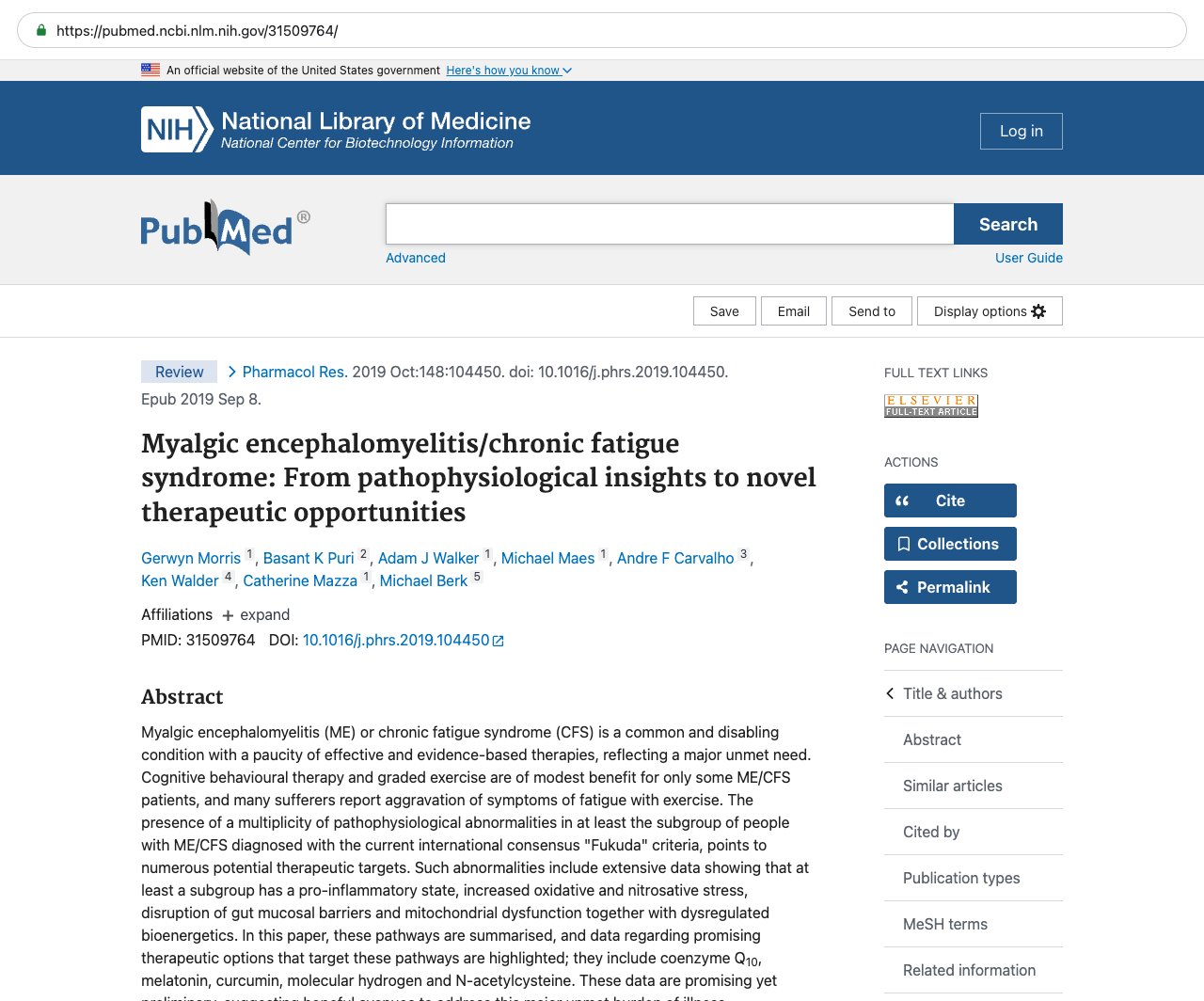
This page mirrors the published abstract (© the authors / publisher) for reference and citation. The canonical source is the PubMed record linked above. This is not medical advice.