2014 · Nazreen et al. — Thiazolidine-2,4-diones derivatives as PPAR-γ agonists: synthesis, molecular docking, in vitro and in vivo antidiabetic activity with hepatotoxicity risk evaluation.
Super-Abstract
This in-vitro and animal pharmacology study synthesised new thiazolidinedione-chromone compounds as potential antidiabetic agents — using hydrogen gas as a chemical reducing agent in the synthesis process, not as a therapeutic substance. The most active compounds lowered blood glucose comparably to pioglitazone with less hepatotoxic risk.
Commentary
This is a medicinal chemistry study focused on developing new PPAR-γ agonists (a class of antidiabetic drugs). Hydrogen gas was used in a standard catalytic hydrogenation step (with Pd/C) during the Knoevenagel condensation synthesis — a routine chemistry procedure. The biological target is PPAR-γ, not hydrogen itself. While the paper investigates anti-diabetic pharmacology and even evaluates hepatotoxicity, it is entirely unrelated to molecular hydrogen as a bioactive agent for human consumption. The antidiabetic activity of compounds 5c and 5e in rodents is promising in the context of antidiabetic drug discovery, but this is not H₂ medicine research.
Key quotes
- „A library of conjugates of chromones and 2,4-thiazolidinedione has been synthesized by Knoevenagel condensation followed by reduction using hydrogen gas and Pd/C as a catalyst.“ — H₂ used as a chemical reagent in drug synthesis — not as therapy
- „Compound 5e exhibited potent PPAR-γ transactivation of 48.72% in comparison to pioglitazone (62.48%).“ — pharmacological potency of the synthesised compound
- „Compounds 5e and 5c did not cause any damage to the liver and may be considered as promising candidates for the development of new antidiabetic agents.“ — favourable hepatotoxicity profile
Our assessment
This is an in-vitro and animal pharmacology/medicinal chemistry study. Hydrogen gas appears only as a synthetic reagent — not as a bioactive substance under investigation. The paper is entirely unrelated to molecular hydrogen therapy or supplementation. Its findings are relevant to antidiabetic drug development, not to H₂ medicine.
Study design
- Type: in-vitro + animal study (medicinal chemistry) · Model: cell-based PPAR-γ transactivation assay + diabetic rodent model · H₂ role: chemical reducing agent in Knoevenagel synthesis (Pd/C catalyst) — not therapeutic
- Result: compound 5e showed 48.72 % PPAR-γ transactivation vs. pioglitazone 62.48 %; compounds 5e/5c reduced blood glucose and showed no hepatotoxicity; no H₂ therapeutic endpoints
Abstract
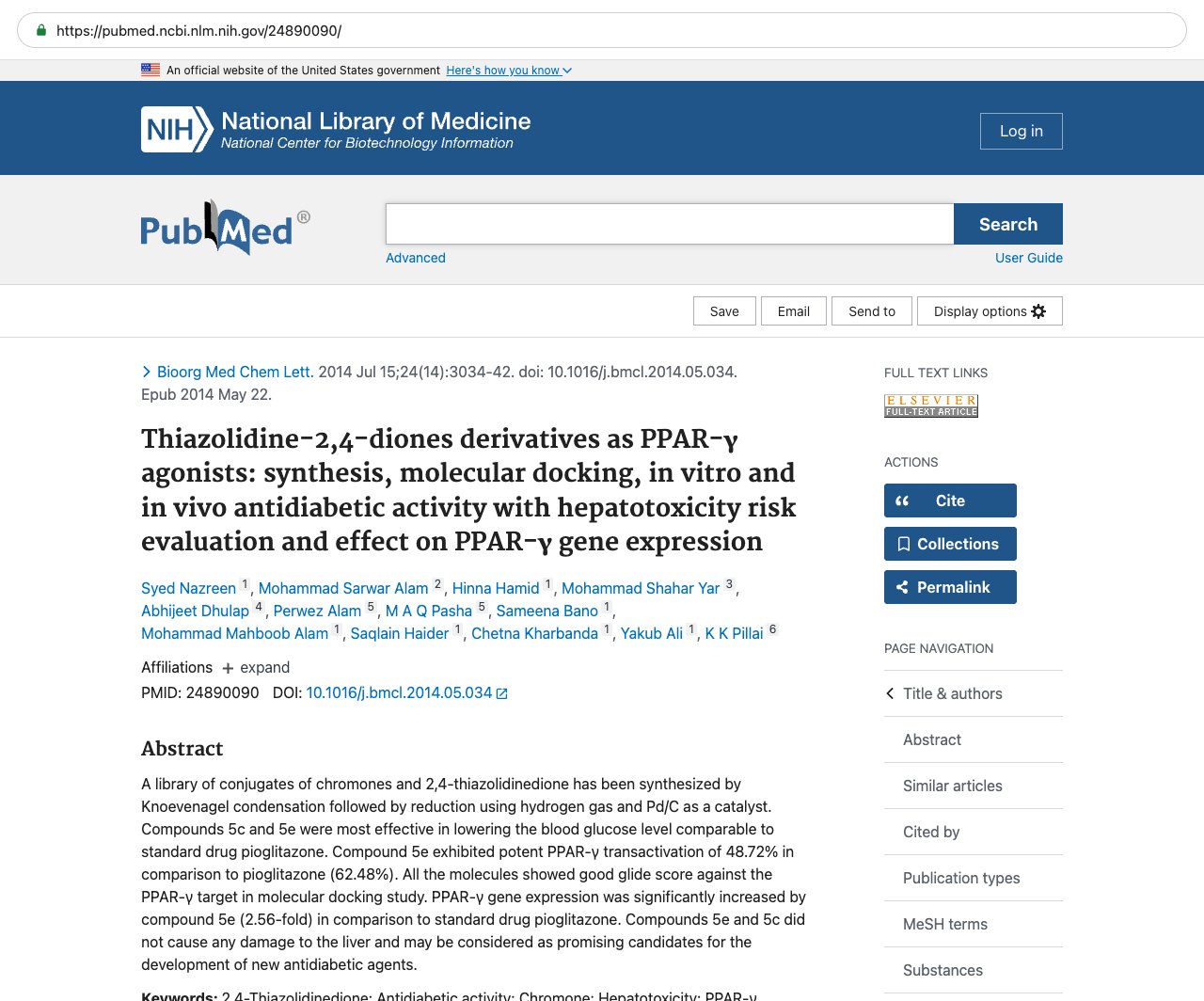
A library of conjugates of chromones and 2,4-thiazolidinedione has been synthesized by Knoevenagel condensation followed by reduction using hydrogen gas and Pd/C as a catalyst. Compounds 5c and 5e were most effective in lowering the blood glucose level comparable to standard drug pioglitazone. Compound 5e exhibited potent PPAR-γ transactivation of 48.72% in comparison to pioglitazone (62.48%). All the molecules showed good glide score against the PPAR-γ target in molecular docking study. PPAR-γ gene expression was significantly increased by compound 5e (2.56-fold) in comparison to standard drug pioglitazone. Compounds 5e and 5c did not cause any damage to the liver and may be considered as promising candidates for the development of new antidiabetic agents.
Source & links
Screenshot of the PubMed page
This page mirrors the published abstract (© the authors / publisher) for reference and citation. The canonical source is the PubMed record linked above. This is not medical advice.