2026 Current reviews in clinical and experimental pharmacology Pilot / Observational Human H₂ therapy Drinking (HRW) Fundamentals / Safety
2026 · Nedeljkovic et al. — Post-Ingestion Blood Hydrogen Kinetics Following Oral Hydrogen-Rich Water Intake in Healthy Adults: A Pilot Pharmacokinetic Study
Super-Abstract
In twelve healthy adults, one dose of hydrogen-rich water raised blood hydrogen from 0.25 μg/L at baseline to a mean peak of 0.83 μg/L, reached 42.9 minutes after drinking. Levels were significantly above baseline at 15, 60 and 90 minutes, varied considerably between individuals and did not differ between men and women. The study had no control group, and the abstract does not state the volume or hydrogen concentration of the water. (Current Reviews in Clinical and Experimental Pharmacology, 2026.)
Commentary
Human pharmacokinetic data for hydrogen are limited, particularly for hydrogen-rich water. This pilot study enrolled twelve healthy adults (mean age 28.8 years, mean BMI 23.4 kg/m², 50% women). After an overnight fast, each participant drank a single dose of hydrogen-rich water. The abstract does not report the volume of water or its hydrogen concentration. Blood samples were taken at baseline and at several time points up to 120 minutes after drinking, and hydrogen was measured with a Clark-type microsensor. The authors calculated peak concentration (Cmax), time to peak (Tmax), elimination half-life and total exposure (area under the curve, AUC) by non-compartmental analysis, and tested changes over time with linear mixed-effects models. There was no control group and no comparison drink, and the abstract does not mention adverse events.
Key quotes
- „Peak concentration (Cmax) reached 0.83 ± 0.18 μg/L at 42.9 ± 8.4 minutes (Tmax).“ — the core measurement: how high and how fast blood levels rose
- „Observed concentrations approached proposed minimal effective levels but were not sustained, raising questions about optimal dosing strategies.“ — the authors' caveat: proposed effective levels were approached only briefly
- „HRW ingestion produces detectable and biologically relevant increases in blood hydrogen levels.“ — the authors' conclusion; biological effects were not measured in this study
Our assessment
This pilot study provides a first set of blood hydrogen values after drinking hydrogen-rich water. It shows that hydrogen from the water reaches the blood, with a rise that peaked on average within the first hour and followed a biphasic pattern. It cannot show any health effect, because only hydrogen concentrations were measured. The authors call the increase “biologically relevant” with reference to proposed minimal effective levels, which the measured concentrations approached but did not sustain. Limitations: only twelve healthy young adults took part. The single dose is not described by volume or concentration, and there was no control drink. Sampling ended at 120 minutes, while the reported half-life of 144.8 minutes is longer than that window, so the half-life and the total exposure rest on extrapolation. Values differed markedly between individuals, and the abstract gives no information on adverse events.
Study design
- Type: pilot pharmacokinetic study, single group, not randomised · n: twelve healthy adults (50% women, mean age 28.8 years) · H₂ delivery: one dose of hydrogen-rich water after an overnight fast, volume and concentration not reported in the abstract
- Comparator: none. Changes were compared with each participant's baseline value
- Result: baseline 0.25 ± 0.05 μg/L, Cmax 0.83 ± 0.18 μg/L at a Tmax of 42.9 ± 8.4 minutes, elimination half-life 144.8 ± 41.7 minutes, AUC₀-∞ 128.6 ± 27.1 μg/L·min. Levels significantly above baseline at 15, 60 and 90 minutes, no sex differences
Abstract
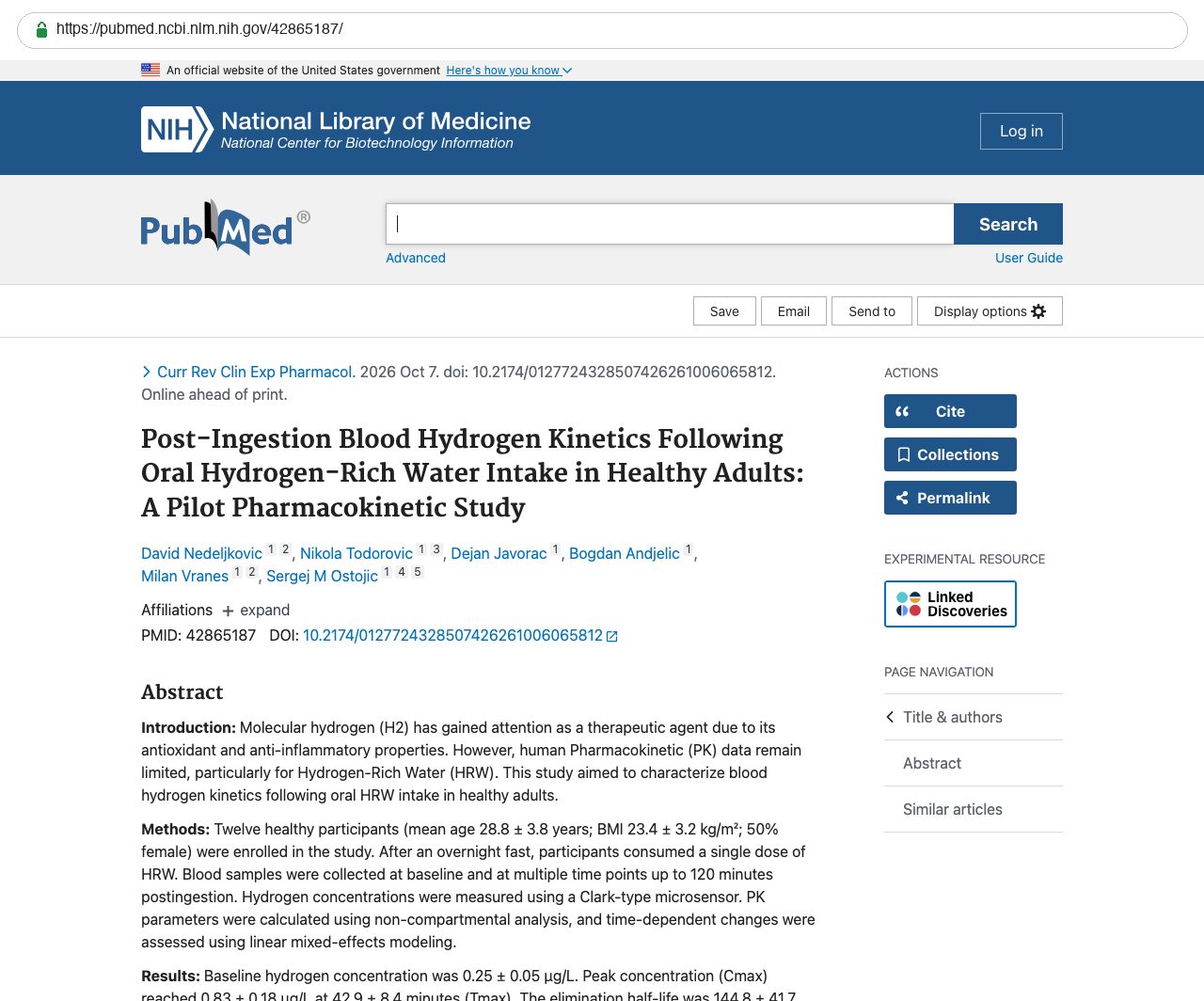
INTRODUCTION: Molecular hydrogen (H2) has gained attention as a therapeutic agent due to its antioxidant and anti-inflammatory properties. However, human Pharmacokinetic (PK) data remain limited, particularly for Hydrogen-Rich Water (HRW). This study aimed to characterize blood hydrogen kinetics following oral HRW intake in healthy adults. METHODS: Twelve healthy participants (mean age 28.8 ± 3.8 years; BMI 23.4 ± 3.2 kg/m²; 50% female) were enrolled in the study. After an overnight fast, participants consumed a single dose of HRW. Blood samples were collected at baseline and at multiple time points up to 120 minutes postingestion. Hydrogen concentrations were measured using a Clark-type microsensor. PK parameters were calculated using non-compartmental analysis, and time-dependent changes were assessed using linear mixed-effects modeling. RESULTS: Baseline hydrogen concentration was 0.25 ± 0.05 μg/L. Peak concentration (Cmax) reached 0.83 ± 0.18 μg/L at 42.9 ± 8.4 minutes (Tmax). The elimination half-life was 144.8 ± 41.7 minutes, and total systemic exposure (AUC₀-∞) was 128.6 ± 27.1 μg/L·min. Hydrogen levels were significantly elevated at 15, 60, and 90 minutes compared to baseline. Notable inter-individual variability was observed, and no sex-related differences were detected. DISCUSSION: Oral HRW intake resulted in measurable systemic hydrogen exposure, with a biphasic concentration pattern, suggesting rapid absorption possibly followed by redistribution. Observed concentrations approached proposed minimal effective levels but were not sustained, raising questions about optimal dosing strategies. CONCLUSION: HRW ingestion produces detectable and biologically relevant increases in blood hydrogen levels. These findings support HRW as a viable route of H2 administration and provide a foundation for future studies investigating dosing, kinetics, and therapeutic applications.
Source & links
Screenshot of the PubMed page
This page mirrors the published abstract (© the authors / publisher) for reference and citation. The canonical source is the PubMed record linked above. This is not medical advice.