2023 International journal of molecular sciences Pilot / Observational Human H₂ therapy TabletsDrinking (HRW)
2023 · Sumbalová — The Effect of Adjuvant Therapy with Molecular Hydrogen on Endogenous Coenzyme Q10 Levels and Platelet Mitochondrial Bioenergetics in Patients with Non-Alcoholic Fatty Liver Disease.
Super-Abstract
In patients with non-alcoholic fatty liver disease (NAFLD), eight weeks of hydrogen-rich water improved platelet mitochondrial energy production, raised coenzyme Q10 levels in platelets, and reduced oxidative stress markers — while placebo showed no significant changes. This small RCT supports the idea that H₂ can target mitochondrial dysfunction, a key driver of metabolic liver disease. (International Journal of Molecular Sciences, 2023.)
Commentary
NAFLD is a condition in which excess fat accumulates in the liver without alcohol as a cause — it ranges from simple steatosis to non-alcoholic steatohepatitis (NASH) and can progress to cirrhosis. A key feature of NAFLD is mitochondrial dysfunction: the liver's energy factories are impaired, and this is reflected in abnormal platelet mitochondrial bioenergetics (platelets are often used as a convenient proxy for systemic mitochondrial health). The authors enrolled 30 NAFLD patients and 15 healthy controls. The H₂ group (n=17) drank hydrogen-rich water at >4 mg/L H₂ three times 330 mL per day for 8 weeks; the placebo group (n=13) drank water with CO₂-producing tablets. The NAFLD patients had measurably worse mitochondrial function at baseline compared to healthy controls: lower CoQ10, higher leak respiration, and lower oxidative phosphorylation capacity. After 8 weeks, the H₂ group showed increased CoQ10 in platelets, decreased TBARS (a lipid peroxidation marker indicating oxidative stress), and improved OXPHOS efficiency. The placebo group showed no significant change. While the sample size is small and longer follow-up would be needed to confirm clinical liver outcomes, the mechanistic signals are coherent and the study is methodologically solid for its size.
Key quotes
- „After 8 weeks of adjuvant therapy with HRW, the concentration of CoQ10 in platelets increased, plasma TBARS decreased, and the efficiency of OXPHOS improved, while in the P group, the changes were non-significant.“ — the key result: H₂ improved all three measured parameters while placebo did not
- „The patients with NAFLD had lower concentrations of CoQ10-TOTAL in the blood, plasma, and platelets vs. the control group.“ — establishing the baseline deficit: NAFLD patients have impaired CoQ10 status
- „The application of H2 appears to be a new treatment strategy for targeted therapy of mitochondrial disorders.“ — cautious but positive framing from the authors
Our assessment
This is one of the more mechanistically rigorous small RCTs in the H₂ field. The combination of CoQ10, TBARS, and high-resolution respirometry gives a multi-parameter picture of mitochondrial health. The H₂ dose used (>4 mg/L, 3×330 mL/day) is at the higher end of what is achievable with tablets. Limitations: small sample (n=30, with unequal allocation 17:13); adjuvant design (patients continued standard of care); no liver biopsy or imaging endpoints; 8 weeks may be too short to see structural liver changes; the authors themselves call for longer and larger studies. The elevated baseline TBARS in the H₂ group versus placebo also warrants attention as a potential confound. Overall: promising mechanistic evidence warranting a larger trial.
Study design
- Type: randomised controlled trial (adjuvant design) · n: 30 NAFLD patients (17 H₂, 13 placebo) + 15 healthy controls · H₂ delivery: tablets producing >4 mg/L H₂ in water, 3×330 mL/day for 8 weeks
- Result: H₂ group: CoQ10 in platelets ↑, plasma TBARS ↓, OXPHOS efficiency ↑ · Placebo group: no significant changes · Baseline: NAFLD patients had lower CoQ10, higher CI-LEAK, lower OXPHOS and ET capacity vs. healthy controls
Abstract
Molecular hydrogen (H2) has been recognized as a novel medical gas with antioxidant and anti-inflammatory effects. Non-alcoholic fatty liver disease (NAFLD) is a liver pathology with increased fat accumulation in liver tissue caused by factors other than alcohol consumption. Platelet mitochondrial function is considered to reflect systemic mitochondrial health. We studied the effect of adjuvant therapy with hydrogen-rich water (HRW) on coenzyme Q10 (CoQ10) content and platelet mitochondrial bioenergetics in patients with NAFLD. A total of 30 patients with NAFLD and 15 healthy volunteers were included in this clinical trial. A total of 17 patients (H2 group) drank water three × 330 mL/day with tablets producing HRW (>4 mg/L H2) for 8 weeks, and 13 patients (P group) drank water with placebo tablets producing CO2. The concentration of CoQ10-TOTAL was determined by the HPLC method, the parameter of oxidative stress, thiobarbituric acid reactive substances (TBARS), by the spectrophotometric method, and mitochondrial bioenergetics in platelets isolated from whole blood by high-resolution respirometry. The patients with NAFLD had lower concentrations of CoQ10-TOTAL in the blood, plasma, and platelets vs. the control group. Mitochondrial CI-linked LEAK respiration was higher, and CI-linked oxidative phosphorylation (OXPHOS) and CII-linked electron transfer (ET) capacities were lower vs. the control group. Plasma TBARS concentrations were higher in the H2 group. After 8 weeks of adjuvant therapy with HRW, the concentration of CoQ10 in platelets increased, plasma TBARS decreased, and the efficiency of OXPHOS improved, while in the P group, the changes were non-significant. Long-term supplementation with HRW could be a promising strategy for the acceleration of health recovery in patients with NAFLD. The application of H2 appears to be a new treatment strategy for targeted therapy of mitochondrial disorders. Additional and longer-term studies are needed to confirm and elucidate the exact mechanisms of the mitochondria-targeted effects of H2 therapy in patients with NAFLD.
Source & links
Screenshot of the PubMed page
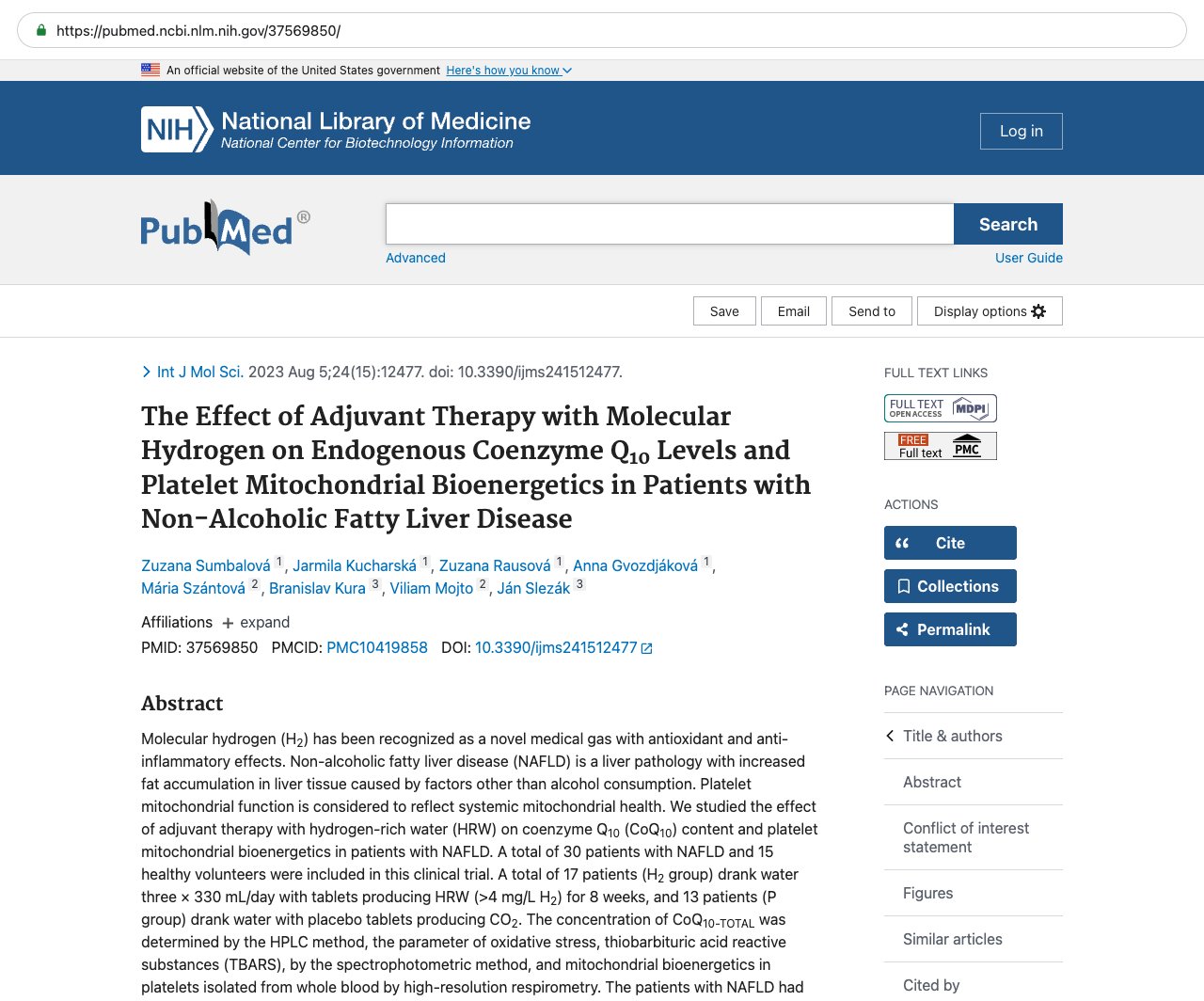
This page mirrors the published abstract (© the authors / publisher) for reference and citation. The canonical source is the PubMed record linked above. This is not medical advice.