2025 · Tu et al. — Immunomodulatory Effects of Molecular Hydrogen Therapy in Systemic Lupus Erythematosus With Pericarditis and Pleuritis: A Case Report
Super-Abstract
A 49-year-old woman with systemic lupus erythematosus complicated by pericarditis and pleuritis received hydrogen-rich water as an adjuvant in October 2024; serial immunophenotyping over the following weeks revealed a decreasing trend in Tr1 cells and an increasing trend in naïve regulatory T cells, transitional B cells, and Fas-expressing B cell subsets. (In Vivo, 2025.)
Commentary
This report adds another case to the growing Taiwanese series on hydrogen therapy in autoimmune disease, this time focusing specifically on the cardiovascular and serosal complications of SLE — pericarditis and pleuritis — which carry significant morbidity. The immunophenotyping approach parallels the other reports in this series (PMIDs 41482388, 41167678, 41482402), but the cell populations highlighted here differ: the decrease in Tr1 (type 1 regulatory T) cells and the increase in naïve Tregs and transitional B cells paint a picture of immune repertoire remodelling. Tr1 cells suppress inflammation but can also suppress protective immunity, so their decrease is not straightforwardly good or bad — context matters. The clinical narrative (recurrent exacerbations prior to H₂, improvement after) is consistent but uncontrolled. What is missing from this report — like others in the series — is a clear description of concurrent medications during the H₂ period, quantitative clinical endpoints (e.g., echocardiographic pericardial effusion size), and follow-up duration.
Key quotes
- „decreasing trend of Tr1 cells and increasing trend of naïve Treg cells, B cell subsets expressing Fas, and transitional B cells following molecular hydrogen therapy.“ — the specific immunological shifts documented — remodelling rather than global suppression
- „Molecular hydrogen supplementation was introduced as an adjuvant therapy.“ — hydrogen added on top of existing immunomodulatory therapy
- „Further investigation into its clinical efficacy and safety is necessary for the development of treatment guidelines.“ — authors' appropriate call for controlled evidence before clinical guidance
Our assessment
Single case report within a coherent series. Contributes a new immunological fingerprint (Tr1 ↓, naïve Treg ↑, transitional B ↑) that is distinct from but complementary to findings in companion reports. Limitations: n = 1, observational and uncontrolled, concurrent SLE therapies not fully detailed, no quantitative clinical outcomes (e.g., effusion resolution on imaging), short observation window from October 2024. The aggregation of multiple cases with overlapping immunological signals from this group is its main scientific value — no single case is conclusive.
Study design
- Type: case report · n: 1 (49-year-old Taiwanese woman, SLE with pericarditis + pleuritis + multi-organ impairment) · H₂ delivery: hydrogen-rich water (drinking), from October 2024
- Result: Tr1 cells ↓; naïve Treg cells ↑; transitional B cells ↑; B cell subsets expressing Fas ↑
- Clinical context: recurrent disease exacerbations prior to H₂; qualitative improvement reported after initiation; no quantitative clinical endpoint data
Abstract
BACKGROUND/AIM: Pericarditis is a common cardiovascular complication associated with systemic lupus erythematosus (SLE). Oxidative stress plays a significant role in disease pathology. Molecular hydrogen has emerged as a promising therapeutic option with its antioxidant, anti-inflammatory, and antiapoptotic properties. While prior studies have demonstrated its cardioprotective effects, research on its immunomodulatory potential in autoimmune diseases remains limited; therefore, this article presents a case study with SLE experiencing pericarditis and pleuritis, receiving hydrogen therapy in October 2024 as part of an effort to evaluate its potential in modulating immune responses and alleviating disease symptoms. CASE REPORT: This is the case of a 49-year-old Taiwanese female diagnosed with SLE, alongside pericarditis, pleuritis, and multi-organ impairments. Despite initial treatment and intermittent follow-ups, the patient experienced recurrent disease exacerbations, which was managed with immunomodulatory therapies. In October 2024, molecular hydrogen supplementation was introduced as an adjuvant therapy. Immunophenotypic analysis revealed dynamic changes in the percentages of immune cells, with decreasing trend of Tr1 cells and increasing trend of naïve Treg cells, B cell subsets expressing Fas, and transitional B cells following molecular hydrogen therapy. CONCLUSION: Molecular hydrogen therapy had potential to modulate immune markers in this case study. Further investigation into its clinical efficacy and safety is necessary for the development of treatment guidelines.
Source & links
Screenshot of the PubMed page
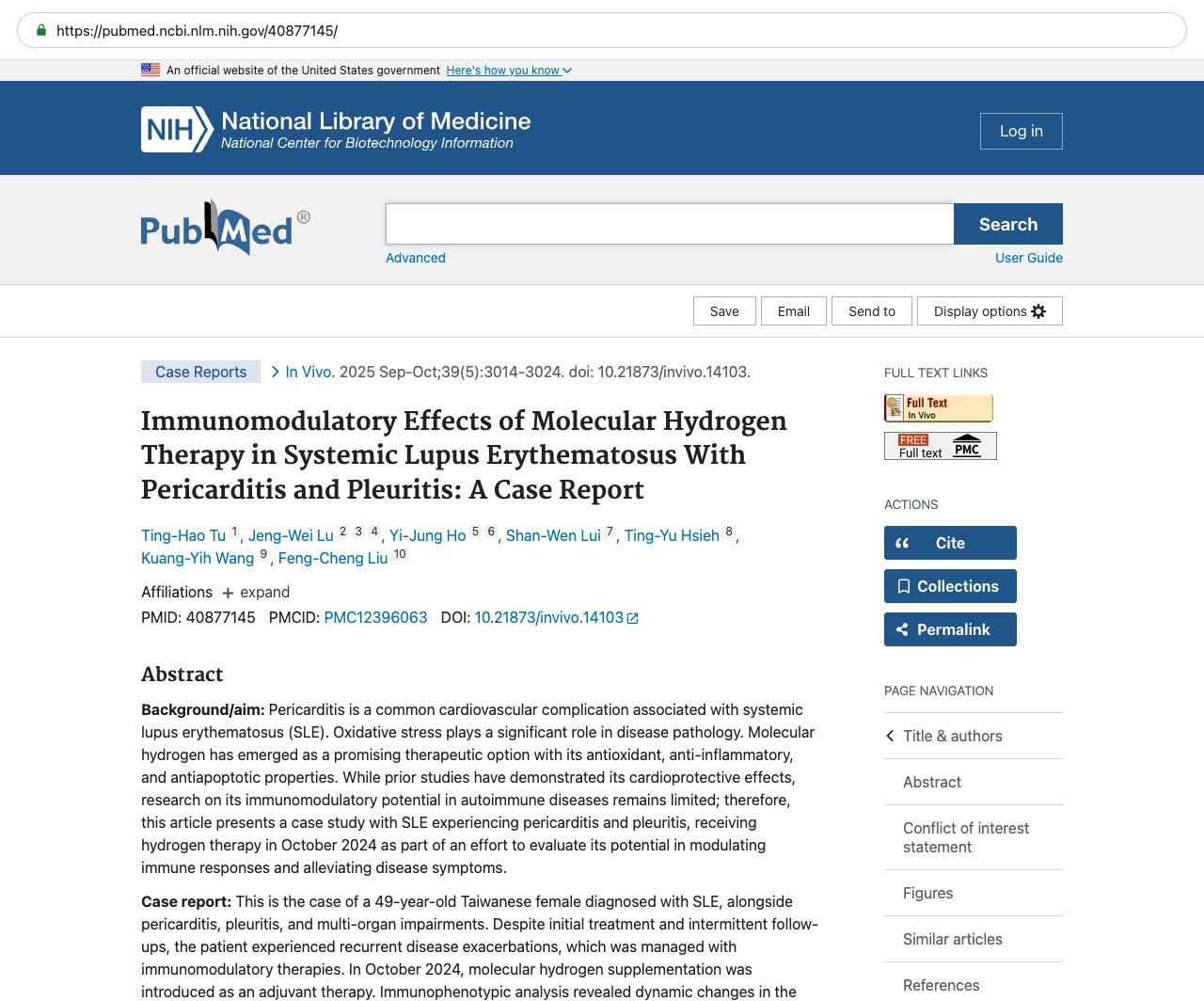
This page mirrors the published abstract (© the authors / publisher) for reference and citation. The canonical source is the PubMed record linked above. This is not medical advice.