2024 · Meng — Hydrogen Therapy Reverses Cancer-Associated Fibroblasts Phenotypes and Remodels Stromal Microenvironment to Stimulate Systematic Anti-Tumor Immunity.
Super-Abstract
In cell and animal cancer models, a magnesium-based H₂-releasing implant reversed the immune-suppressive behaviour of cancer-associated fibroblasts, turning „cold“ tumors that resist the immune system into „hot“ ones that attract cancer-fighting T cells. The approach simultaneously killed tumor cells directly and activated systemic anti-tumor immunity. (Advanced Science, 2024.)
Commentary
Cancer-associated fibroblasts (CAFs) are a key component of the tumor microenvironment that promote tumor growth and suppress immune responses. This study used a magnesium system coated with CaCO₃ nanoparticles (Mg-CaCO₃) as a controlled, tumor-microenvironment-responsive H₂ source. The CaCO₃ coating dissolves in the acidic tumor milieu, exposing magnesium which reacts with water to generate H₂. In cell experiments, H₂ treatment reduced intracellular ROS in CAFs and shifted them from tumor-promoting to immune-permissive phenotypes, also enhancing CD4+ T cell activity. In bilateral mouse tumor models (4T1 „cold“ and MC38 „hot“ tumors), implanted Mg-CaCO₃ significantly suppressed tumor growth and stimulated systemic anti-tumor immunity, with the „cold“ tumors becoming immunologically responsive. The concept is mechanistically sophisticated and the dual-action (direct tumor killing + immune remodelling) is novel. However, all evidence is from cell lines and mouse models — no human data exist.
Key quotes
- „hydrogen treatment can alleviate intracellular reactive oxygen species of CAFs and reshape CAFs' tumor-promoting and immune-suppressive phenotypes.“ — the core finding: H₂ reprogrammes the fibroblasts that help tumors evade the immune system
- „Mg-CaCO3 can significantly suppress tumor growth, turn the 'cold' primary tumor into 'hot', and stimulate systematic anti-tumor immunity.“ — the in-vivo result in mouse models: immune-cold tumors became immune-responsive
- „This hydrogen therapy system reverses immune suppressive phenotypes of CAFs, thus providing a systematic anti-tumor immune stimulating strategy by remodeling tumor stromal microenvironment.“ — the authors' conclusion: a new mechanistic strategy for tumor immunotherapy — preclinical only
Our assessment
This is an in-vitro and preclinical animal study. The mechanistic strategy — using H₂ to reprogram immune-suppressive fibroblasts in the tumor microenvironment — is novel and scientifically compelling. However, all results come from cell cultures and mouse tumor models, which frequently fail to translate to human cancer outcomes. CAF biology in human tumors is considerably more complex than in mouse models. No human safety or efficacy data exist. This is exploratory preclinical cancer research, not clinical evidence.
Study design
- Type: in-vitro + preclinical animal study · Model: CAF cell cultures + bilateral mouse tumor implantation models (4T1 triple-negative breast, MC38 colon) · H₂ delivery: Mg-CaCO₃ nanoparticle system — tumor-pH-responsive H₂ release from implanted magnesium
- Result: H₂ reduced ROS in CAFs, reversed pro-tumor/immune-suppressive CAF phenotypes; enhanced CD4+ T cell activity; suppressed tumor growth; converted „cold“ 4T1 tumors to immunologically active — mouse models only, no human data
Abstract
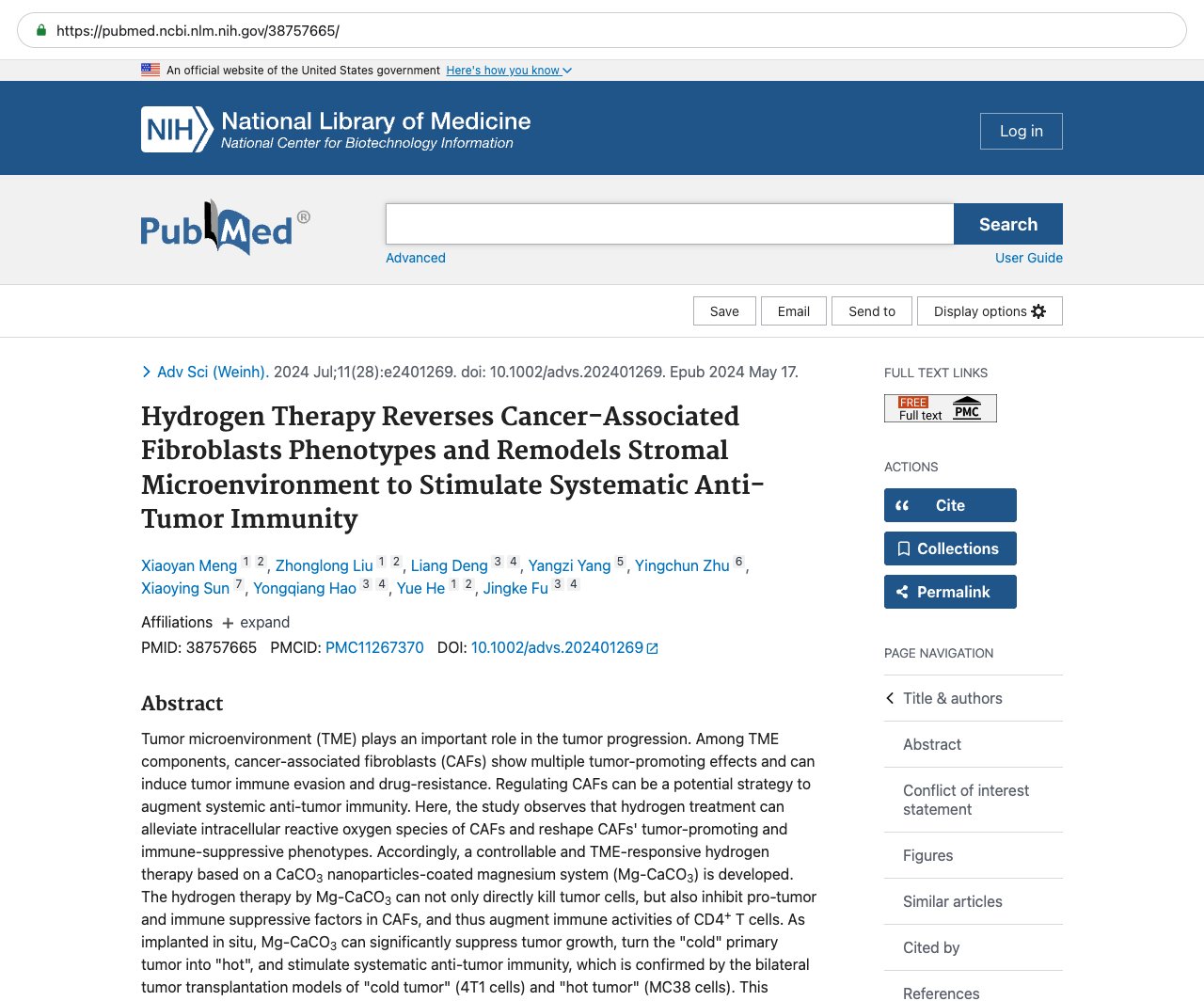
Tumor microenvironment (TME) plays an important role in the tumor progression. Among TME components, cancer-associated fibroblasts (CAFs) show multiple tumor-promoting effects and can induce tumor immune evasion and drug-resistance. Regulating CAFs can be a potential strategy to augment systemic anti-tumor immunity. Here, the study observes that hydrogen treatment can alleviate intracellular reactive oxygen species of CAFs and reshape CAFs' tumor-promoting and immune-suppressive phenotypes. Accordingly, a controllable and TME-responsive hydrogen therapy based on a CaCO3 nanoparticles-coated magnesium system (Mg-CaCO3) is developed. The hydrogen therapy by Mg-CaCO3 can not only directly kill tumor cells, but also inhibit pro-tumor and immune suppressive factors in CAFs, and thus augment immune activities of CD4+ T cells. As implanted in situ, Mg-CaCO3 can significantly suppress tumor growth, turn the "cold" primary tumor into "hot", and stimulate systematic anti-tumor immunity, which is confirmed by the bilateral tumor transplantation models of "cold tumor" (4T1 cells) and "hot tumor" (MC38 cells). This hydrogen therapy system reverses immune suppressive phenotypes of CAFs, thus providing a systematic anti-tumor immune stimulating strategy by remodeling tumor stromal microenvironment.
Source & links
Screenshot of the PubMed page
This page mirrors the published abstract (© the authors / publisher) for reference and citation. The canonical source is the PubMed record linked above. This is not medical advice.