2015 · Nkamga et al. — Diversity of human-associated Methanobrevibacter smithii isolates revealed by multispacer sequence typing.
Super-Abstract
A new genotyping method (multispacer sequence typing, MST) applied to Methanobrevibacter smithii — the main hydrogen-consuming archaeon in the human gut — revealed 15 distinct genetic variants among isolates from oral cavity and gut of 12 individuals. Multiple genotypes can coexist in a single person at the same anatomical site. This is a microbiology / sequencing study; it does not investigate therapeutic molecular hydrogen (H₂).
Commentary
Methanobrevibacter smithii is the dominant methanogenic archaeon in the human microbiome. Its ecological role is to consume the molecular hydrogen (H₂) produced by anaerobic bacterial fermentation in the gut, converting it to methane (CH₄). This reduces H₂ partial pressure and makes fermentation thermodynamically more efficient — a process called interspecies hydrogen transfer. This study's contribution is methodological: it develops a sequence-based typing tool (MST using four intergenic spacer regions) to discriminate genetic variants within M. smithii, which previously could only be identified to species level by 16S rRNA. Applied to 22 isolates from 12 individuals (oral and gut sites), MST revealed 15 genotypes with high discriminatory power (index 0.942). The connection to molecular H₂ medicine is indirect: M. smithii consumes gut H₂, so its genetic diversity could theoretically affect the balance of endogenous gut H₂ available for systemic antioxidant effects — but this link is speculative and not the study's focus.
Key quotes
- „Methanobrevibacter smithii is the main archaea in human, detoxifying molecular hydrogen resulting from anaerobic bacteria fermentations into gaseous methane.“ — the biological role of M. smithii: it consumes gut-produced H₂ and converts it to methane
- „Multiple genotypes were identified in some individuals at the same anatomical site.“ — key microbiological finding: intra-individual diversity of M. smithii is greater than expected
- „MST will allow studying population dynamics of M. smithii and tracing its circulation between individuals and their environment.“ — the practical application: a new tool for microbial epidemiology and ecology
Our assessment
A solid microbiology methods study that develops a useful genotyping tool for the gut archaeome. The H₂ connection is biological background (M. smithii metabolises gut H₂) rather than a therapeutic investigation. This study does not examine whether consuming gut H₂ before M. smithii can act on human health, nor does it test any H₂ therapy. It is relevant to microbiome research and archaeal population genetics; its presence in H₂ therapy databases reflects the broader research ecosystem around endogenous H₂ metabolism.
Study design
- Type: in-vitro microbiological genotyping study · Model: 22 M. smithii isolates from 12 individuals (oral cavity + gut) · H₂ relevance: indirect background — M. smithii is a H₂-consuming gut archaeon; no therapeutic H₂ intervention
- Method: multispacer sequence typing (MST) using 4 intergenic spacer regions; PCR amplification + Sanger sequencing · Result: 15 genotypes identified, discrimination index 0.942; multiple genotypes per individual and per site; genotypes found in both oral and gut niches
Abstract
Methanobrevibacter smithii is the main archaea in human, detoxifying molecular hydrogen resulting from anaerobic bacteria fermentations into gaseous methane. Its identification relies on gene sequencing, but no method is available to discriminate among genetic variants of M. smithii. Here, we developed a multispacer sequence typing (MST) for genotyping the genetic variants of M. smithii. Four intergenic spacers recovered from the M. smithii reference genome were PCR amplified and sequenced in three M. smithii reference strains and in a collection of 22 M. smithii isolates from the oral cavity in two individuals and the gut of 10 additional individuals. Sequencing yielded 216 genetic polymorphisms including 89 single nucleotide polymorphisms (41.2 %), 83 insertions (38.4 %), and 44 deletions (20.4 %). Combining these genetic polymorphisms yielded 15 genotypes with an index of discrimination of 0.942 (confidence interval 0.9-0.984; P < 0.05). Five M. smithii isolates made from the oral cavity yielded five different genotypes; seven gut isolates yielded nine different genotypes; genotypes MST5 and MST6 were found both in the oral cavity and the gut. Multiple genotypes were identified in some individuals at the same anatomical site. MST is a sequencing-based method which discriminates several genetic variants within M. smithii. Individuals may harbor several contemporary genetic variants of M. smithii in the oral cavity and gut. MST will allow studying population dynamics of M. smithii and tracing its circulation between individuals and their environment.
Source & links
Screenshot of the PubMed page
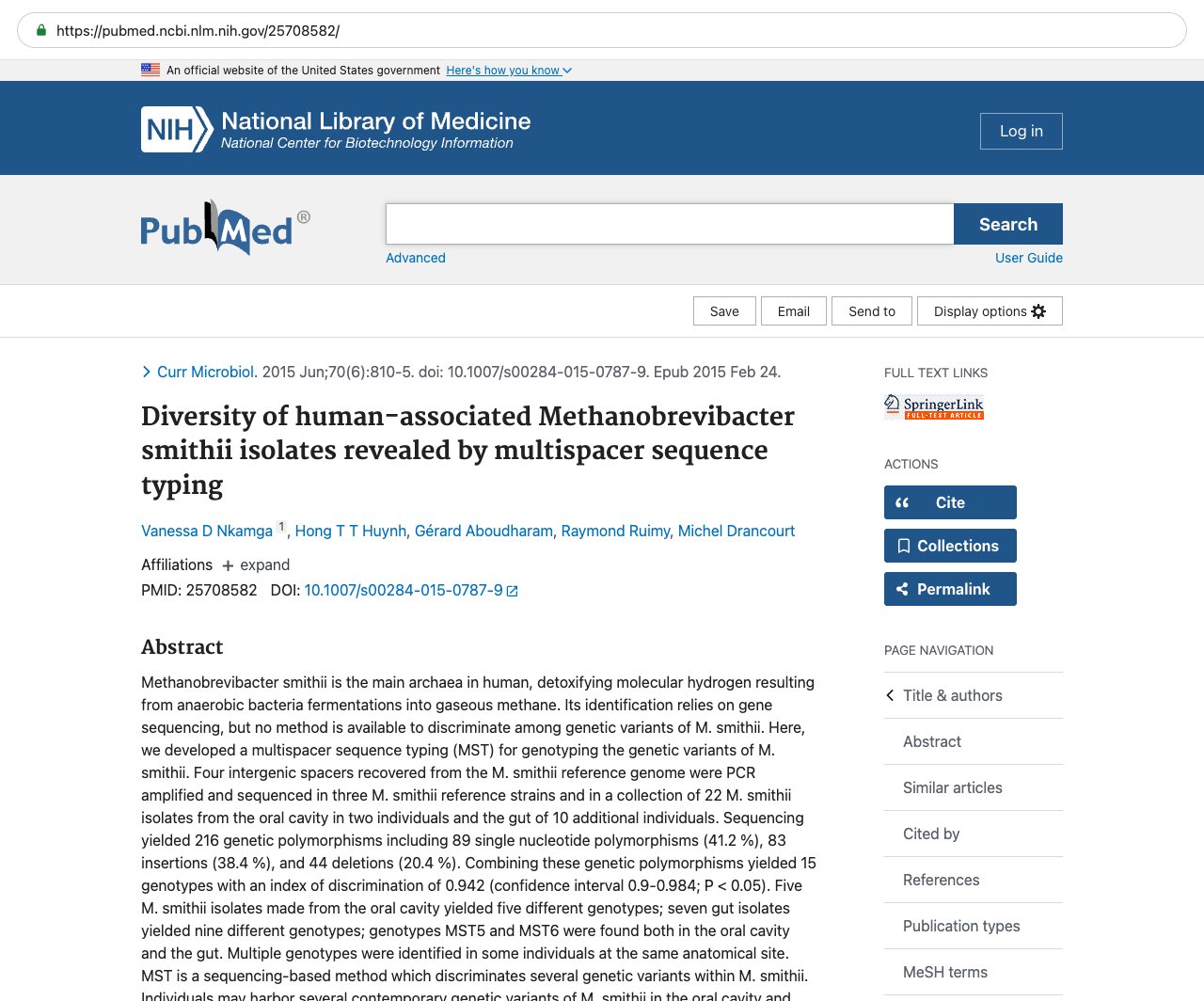
This page mirrors the published abstract (© the authors / publisher) for reference and citation. The canonical source is the PubMed record linked above. This is not medical advice.