2018 · Nobela — Efficient discrimination of natural stereoisomers of chicoric acid, an HIV-1 integrase inhibitor
Super-Abstract
This in-vitro chemistry study identifies and distinguishes two stereoisomers of chicoric acid — a plant-derived HIV-1 integrase inhibitor — using LC-MS, UV isomerisation, molecular dynamics, and quantum-chemical calculations. The mention of hydrogen in this paper refers exclusively to intramolecular hydrogen bonding within the chicoric acid molecule, not to molecular hydrogen (H₂) as a therapeutic gas. This study has no direct relevance to H₂ therapy research. (Journal of Photochemistry and Photobiology B: Biology, 2018.)
Commentary
Nobela and colleagues develop an analytical chemistry method to tell apart RR-chicoric acid (from Sonchus oleraceus) and RS-chicoric acid (from Bidens pilosa) — two stereoisomers of a known plant antioxidant with anti-HIV properties. DFT quantum calculations reveal that the RR form is stabilised by intramolecular hydrogen bonds, making it more stable and a better HIV-1 integrase inhibitor. The “hydrogen” here is conventional chemistry — the bonding interaction between a hydrogen atom and an electronegative atom within the molecule — and has no connection to molecular hydrogen gas (H₂). This paper appears in an H₂-medicine database likely due to keyword indexing; its actual content is analytical phytochemistry and computational HIV drug research.
Key quotes
- „DFT results demonstrated the RR-CA molecule was more stable than RS-CA due to the stabilizing force of intra-molecular hydrogen bonding.“ — the specific use of “hydrogen” in this paper: intramolecular H-bonds within chicoric acid, not H₂ gas
- „Differences in the HIV-1 integrase enzyme binding modes were observed, with the RR-CA being a more potent inhibitor than the RS-CA molecule.“ — key biological finding: stereoisomer shape matters for HIV inhibition
- „The results highlight the significance of plant metabolite structural complexity from both chemical and biological perspectives.“ — the paper's core message — structural chemistry determines biological activity
Our assessment
This paper is not a molecular hydrogen (H₂) therapy study. The hydrogen referenced is hydrogen bonding in an organic molecule — a standard chemical concept. The study is well-executed analytical chemistry and computational biology, but its inclusion in an H₂-medicine context reflects a keyword mismatch, not scientific relevance to therapeutic H₂. Readers seeking evidence for H₂ inhalation, hydrogen-rich water, or related applications will find nothing applicable here. Methodological note: this is an in-vitro/computational study; even if it were about H₂, animal and human validation would still be required.
Study design
- Type: in-vitro analytical + computational study · Model: plant extracts (S. oleraceus, B. pilosa); LC-MS, UV isomerisation, MD simulations, DFT calculations
- H₂ relevance: none — “hydrogen” refers to intramolecular hydrogen bonding in chicoric acid, not therapeutic molecular hydrogen (H₂)
- Result: RR-CA identified as more stable and more potent HIV-1 integrase inhibitor than RS-CA; analytical method validated for stereoisomer discrimination
Abstract
Plants from the Asteraceae family are known to contain a wide spectrum of phytochemicals with various nutraceutical properties. One important phytochemical, chicoric acid (CA), is reported to exist in plants, such as Sonchus oleraceus and Bidens pilosa, as stereoisomers. These CA molecules occur either as the naturally abundant RR-chicoric acid (RR-CA), or the less abundant RS-chicoric acid (RS-CA), also known as meso-chicoric acid. To date, little is known about the biological activity of RS-CA, but there is evidence of its anti-human immunodeficiency virus (HIV) properties. In this study, a reliable analytical method was developed to distinguish between the two stereoisomers detected in S. oleraceus and B. pilosa. For structure identification and characterization of CA molecules, liquid chromatography-mass spectrometry (LC-MS) was used in combination with ultraviolet radiation (UV)-induced geometrical isomerization, molecular dynamics (MD) simulations, and density functional theory (DFT) models. Optimized structures from DFT calculations were used for docking studies against the HIV-1 integrase enzyme. Different retention times on the reverse phase chromatograms revealed that the plants produce two different CA stereoisomers: S. oleraceus produced the RR-CA isomer, while B. pilosa produced the RS-CA isomer. DFT results demonstrated the RR-CA molecule was more stable than RS-CA due to the stabilizing force of intra-molecular hydrogen bonding. Differences in the HIV-1 integrase enzyme binding modes were observed, with the RR-CA being a more potent inhibitor than the RS-CA molecule. The results highlight the significance of plant metabolite structural complexity from both chemical and biological perspectives. Furthermore, the study demonstrates that induced-formation of geometrical isomers, in combination with the predictive ability of DFT models and the resolving power of the LC-MS, can be exploited to distinguish structurally closely related compounds, such as stereoisomers.
Source & links
Screenshot of the PubMed page
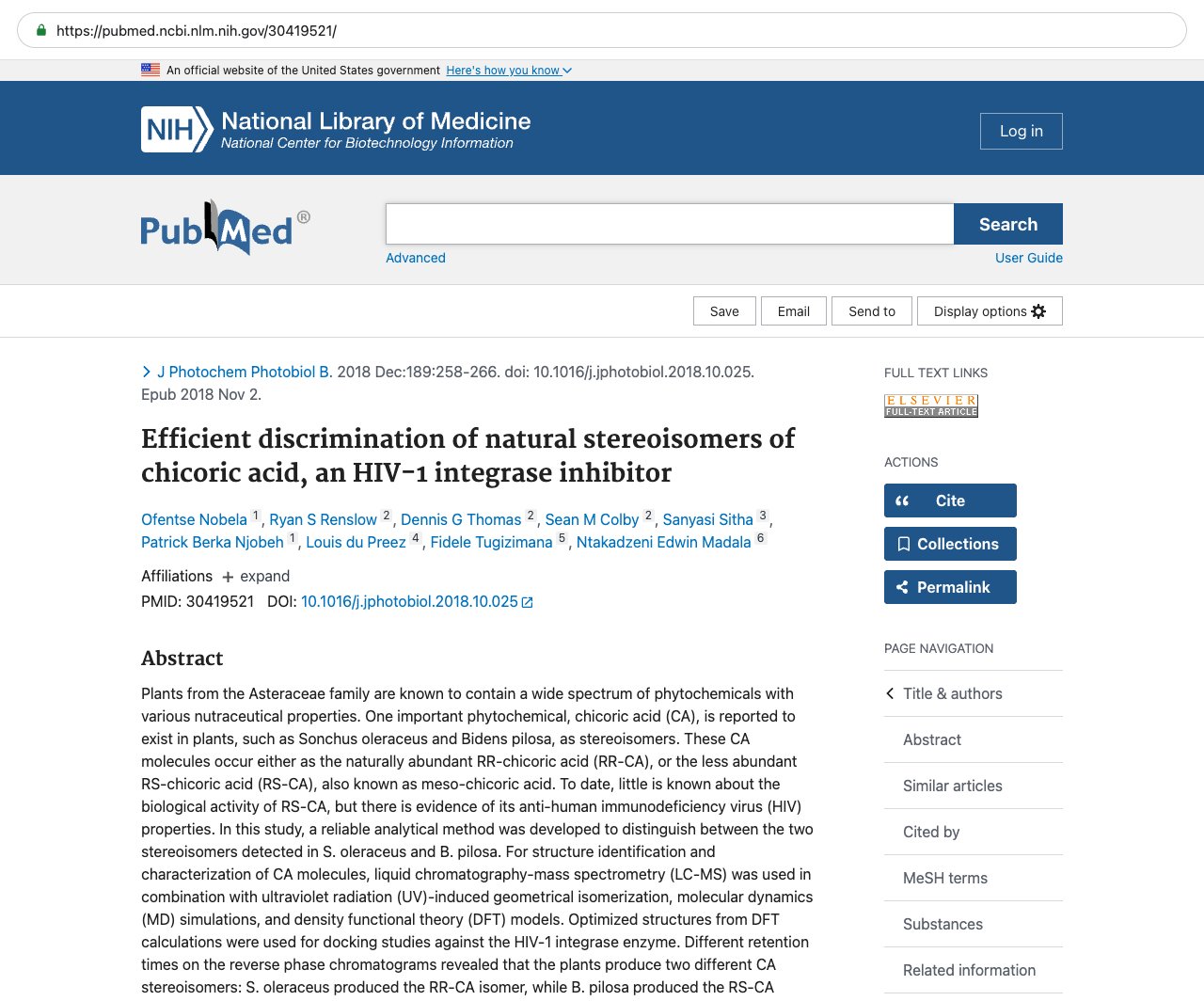
This page mirrors the published abstract (© the authors / publisher) for reference and citation. The canonical source is the PubMed record linked above. This is not medical advice.