2021 · Nogueira et al. — Recent Advances in Molecular Hydrogen Research Reducing Exercise-Induced Oxidative Stress and Inflammation.
Super-Abstract
Exercise-induced oxidative stress and inflammation — harmful when exercise is exhaustive — may be mitigated by molecular hydrogen (H₂), which has shown antioxidant and anti-inflammatory properties in both animal and human studies. This review summarises the current knowledge base and highlights the still-incomplete picture under physiological conditions like physical exercise. (Current Pharmaceutical Design, 2021.)
Commentary
Nogueira and colleagues survey how H₂ interacts with the oxidative and inflammatory responses provoked by physical exercise. The framing is nuanced: regular moderate exercise-induced oxidative stress is acknowledged as beneficial (hormesis), while exhaustive exercise in unaccustomed individuals is harmful. H₂ is positioned as a targeted intervention for the latter. The review covers both animal and human data, which is helpful for gauging translation. However, the human data are described as still limited in scope and number, meaning definitive conclusions about optimal dosing, timing, or delivery method cannot yet be drawn. The review is appropriately cautious in tone.
Key quotes
- „Molecular hydrogen (H2) has recently appeared as a potent antioxidant and anti-inflammatory molecule in numerous pathological conditions.“ — the authors' positioning of H₂ based on the broader research literature
- „Its role is relatively unknown under physiological conditions such as physical exercise.“ — the honest acknowledgement of the specific evidence gap this review addresses
- „This review summarizes the current knowledge of the H2, reducing oxidative stress and inflammation in physical exercise, reporting data from both animal and human studies.“ — scope: both preclinical and human data are included, though human evidence is still limited
Our assessment
This is a review covering both animal and human studies, which is more informative than purely preclinical reviews. However, the human evidence base in 2021 for H₂ in exercise physiology was modest in volume and heterogeneous in design. The review does not perform a meta-analysis or systematic quality assessment of included studies. Honest note: the field is genuinely interesting and the biological rationale is sound, but practical recommendations on H₂ supplementation for athletes or exercisers cannot yet be firmly derived from this literature alone.
Study design
- Type: narrative review · n: n/a (literature synthesis; both animal and human studies included) · H₂ delivery: unspecified (various methods across cited studies)
- Result: narrative synthesis suggests H₂ attenuates exercise-induced oxidative stress and inflammation; human evidence exists but is limited in volume and consistency; no meta-analytic pooling
Abstract
Physical exercise-induced oxidative stress and inflammation may be beneficial when exercise is a regular activity, but it is rather harmful when exercise is exhaustive and performed by unaccustomed organisms. Molecular hydrogen (H2) has recently appeared as a potent antioxidant and anti-inflammatory molecule in numerous pathological conditions. However, its role is relatively unknown under physiological conditions such as physical exercise. Therefore, this review summarizes the current knowledge of the H2, reducing oxidative stress and inflammation in physical exercise, reporting data from both animal and human studies.
Source & links
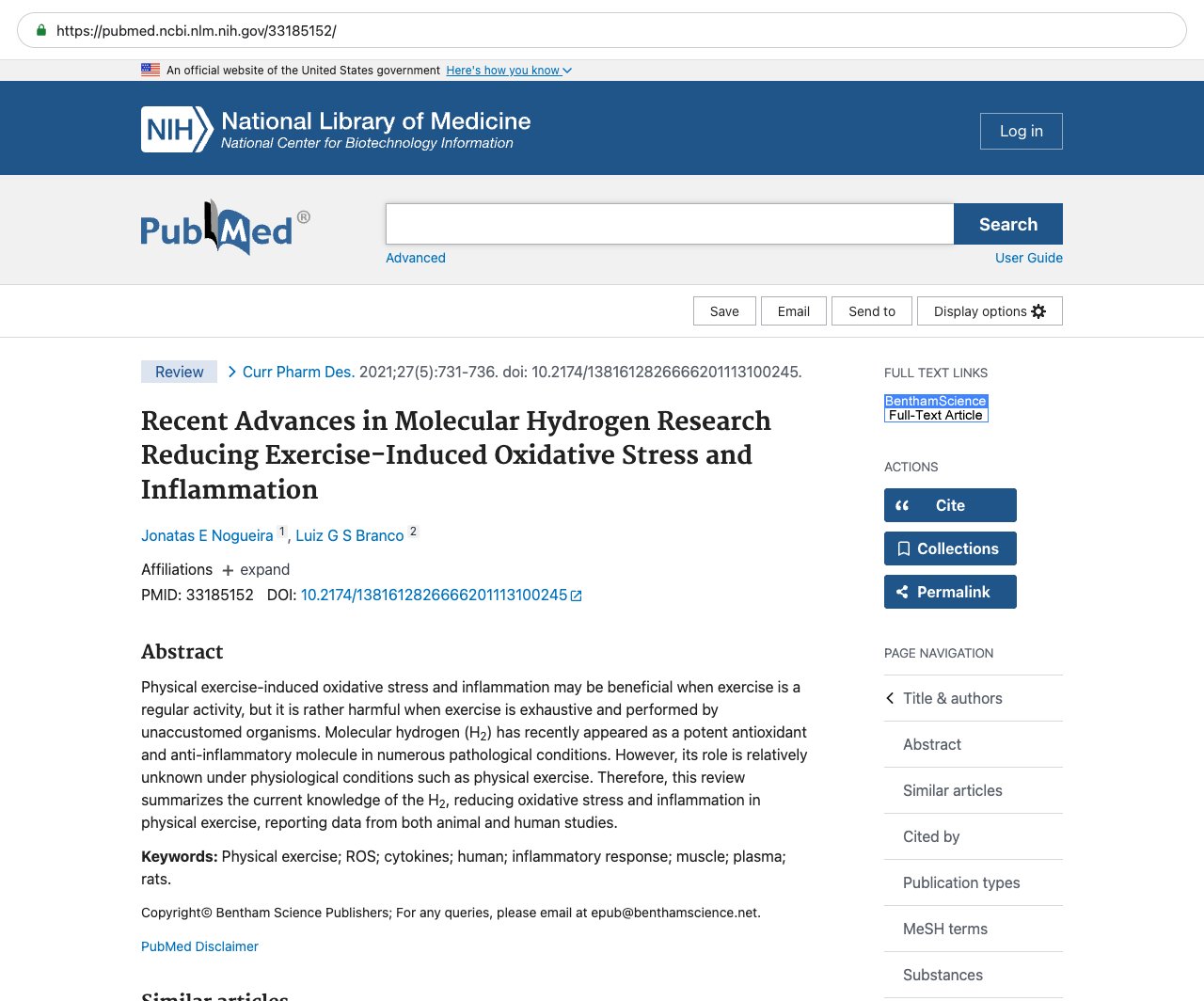
Screenshot of the PubMed page
This page mirrors the published abstract (© the authors / publisher) for reference and citation. The canonical source is the PubMed record linked above. This is not medical advice.