2022 · Okada et al. — A Double-Blinded, Randomized Controlled Clinical Trial of Hydrogen Inhalation Therapy for Idiopathic Sudden Sensorineural Hearing Loss
Super-Abstract
In 65 patients with sudden sensorineural hearing loss also given glucocorticoids and prostaglandin E1, hydrogen inhalation gave no significant difference in 3-month hearing threshold compared with air (39.0 compared with 49.5 dB), but a larger improvement (32.7 compared with 24.2 dB, P = 0.048). Both measures formed the primary outcome, and the second result lies close to the usual significance threshold. The abstract gives no result for the secondary outcome, the share of patients with complete recovery or marked improvement, and does not state the hydrogen concentration or schedule. No adverse effects of hydrogen inhalation were reported. (Frontiers in Neuroscience, 2022.)
Commentary
Hydrogen reduced hearing loss in animal studies, but the authors state that no study had tested it in humans. This double-blind randomised controlled trial ran at six hospitals between June 2019 and March 2022 and was registered in the Japan Registry of Clinical Trials (jRCTs06119004). Patients with idiopathic sudden sensorineural hearing loss (ISSNHL) inhaled either hydrogen (H₂ group) or air as a placebo (control group), in both cases combined with systemic glucocorticoids and prostaglandin E1. Of the 65 patients included, 31 were in the H₂ group and 34 in the control group. The primary outcome was the hearing threshold and its change 3 months after therapy. The secondary outcomes included the proportion of patients with a good prognosis, defined as complete recovery or marked improvement. The abstract does not state the hydrogen concentration, the daily inhalation time or the number of treatment days.
Key quotes
- „The hearing threshold 3 months after treatment was not significantly different between the groups; 39.0 decibels (dB) (95% confidence interval [CI]: 28.7-49.3) and 49.5 dB (95% CI: 40.3-58.7) in the H2 and control groups, respectively.“ — first part of the primary outcome: no significant difference in hearing threshold
- „In contrast, the changes in hearing threshold 3 months after treatment was 32.7 dB (95% CI: 24.2-41.3) and 24.2 dB (95% CI: 18.1-30.3) in the H2 and control groups, respectively. Consequently, the changes in hearing threshold were significantly better in the H2 group than in the control group (P = 0.048).“ — second part of the primary outcome: a larger gain, with a p-value close to the threshold
- „This is the first study to investigate the efficacy of H2 for the treatment of ISSNHL in humans. The results suggest that H2 therapy may be effective for ISSNHL treatment.“ — the authors' conclusion, worded as a suggestion
Our assessment
This is a double-blind, placebo-controlled trial at six hospitals. The primary outcome gave a mixed result: the hearing threshold at 3 months did not differ significantly, while the improvement in threshold was larger with hydrogen (P = 0.048). In this sample, that suggests a possible added benefit but does not establish one. Limitations: 65 patients is a small sample. The primary outcome combined two measures, and only one reached significance, with a p-value close to the threshold. The abstract does not report baseline hearing thresholds, so it is unclear how far differences at the start contribute to the larger change. The result for the secondary outcome, good prognosis, is not given. The hydrogen dose and schedule are not described. All patients also received glucocorticoids and prostaglandin E1, so the trial tests hydrogen only as an add-on.
Study design
- Type: double-blind, randomised, placebo-controlled trial at six hospitals (June 2019 to March 2022) · n: 65 (31 H₂, 34 control) · H₂ delivery: inhaled H₂ (concentration and schedule not stated), combined with systemic glucocorticoids and prostaglandin E1
- Comparator: inhaled air as placebo, with the same drug treatment
- Result: primary outcome: hearing threshold at 3 months 39.0 dB (95% CI 28.7–49.3) vs. 49.5 dB (95% CI 40.3–58.7), not significant. Change in hearing threshold 32.7 dB (95% CI 24.2–41.3) vs. 24.2 dB (95% CI 18.1–30.3), P = 0.048. Secondary outcome (good prognosis) not reported in the abstract. No adverse effects of H₂ inhalation reported
Abstract
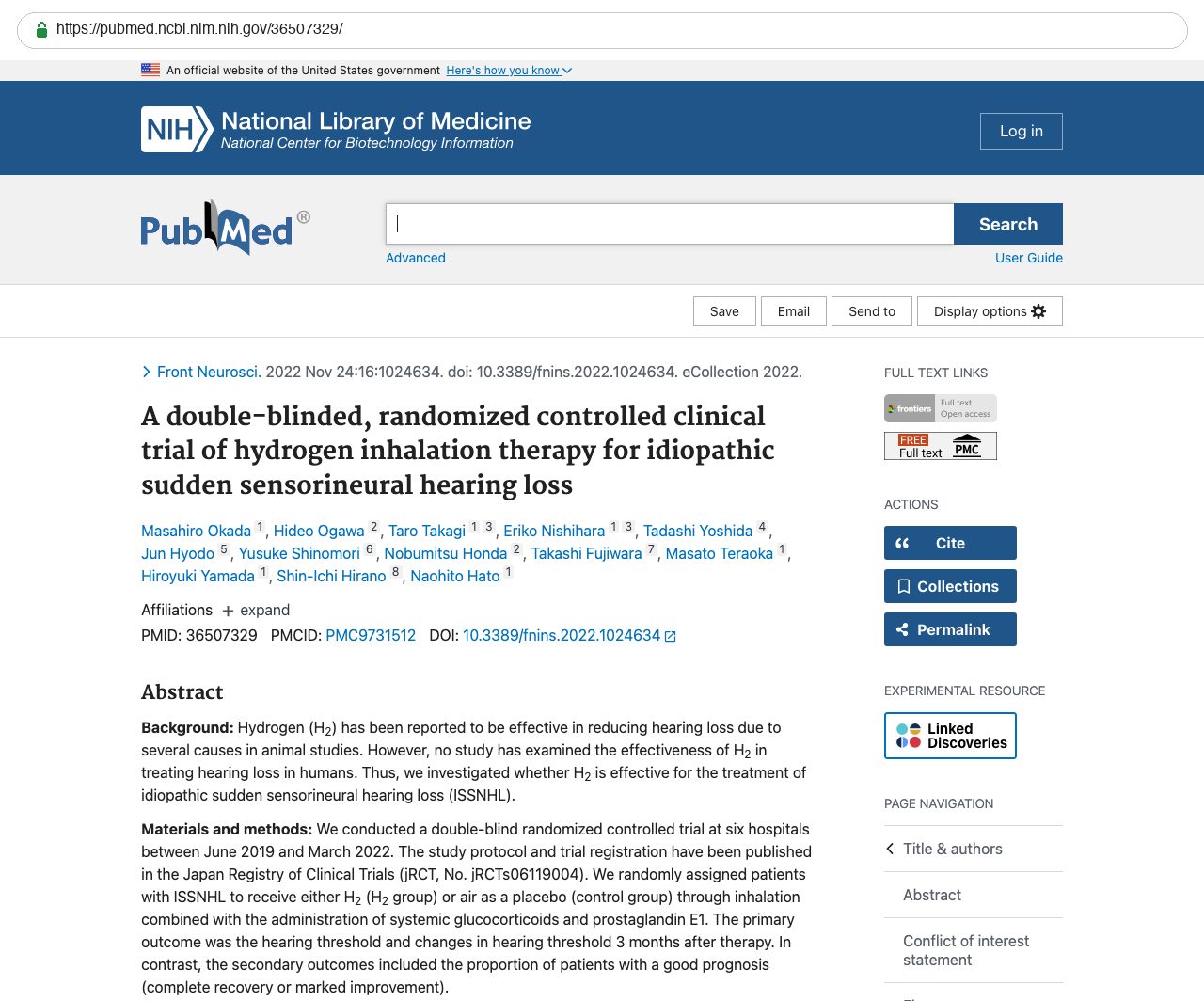
BACKGROUND: Hydrogen (H2) has been reported to be effective in reducing hearing loss due to several causes in animal studies. However, no study has examined the effectiveness of H2 in treating hearing loss in humans. Thus, we investigated whether H2 is effective for the treatment of idiopathic sudden sensorineural hearing loss (ISSNHL). MATERIALS AND METHODS: We conducted a double-blind randomized controlled trial at six hospitals between June 2019 and March 2022. The study protocol and trial registration have been published in the Japan Registry of Clinical Trials (jRCT, No. jRCTs06119004). We randomly assigned patients with ISSNHL to receive either H2 (H2 group) or air as a placebo (control group) through inhalation combined with the administration of systemic glucocorticoids and prostaglandin E1. The primary outcome was the hearing threshold and changes in hearing threshold 3 months after therapy. In contrast, the secondary outcomes included the proportion of patients with a good prognosis (complete recovery or marked improvement). RESULTS: Sixty-five patients with ISSNHL (31 and 34 in the H2 and control groups, respectively) were included in this study. The hearing threshold 3 months after treatment was not significantly different between the groups; 39.0 decibels (dB) (95% confidence interval [CI]: 28.7-49.3) and 49.5 dB (95% CI: 40.3-58.7) in the H2 and control groups, respectively. In contrast, the changes in hearing threshold 3 months after treatment was 32.7 dB (95% CI: 24.2-41.3) and 24.2 dB (95% CI: 18.1-30.3) in the H2 and control groups, respectively. Consequently, the changes in hearing threshold were significantly better in the H2 group than in the control group (P = 0.048). However, no adverse effects due to the inhalation of H2 gas have been reported. CONCLUSION: This is the first study to investigate the efficacy of H2 for the treatment of ISSNHL in humans. The results suggest that H2 therapy may be effective for ISSNHL treatment. CLINICAL TRIAL REGISTRATION: [https://jrct.niph.go.jp/re/reports/detail/10442], identifier [jRCTs06119004].
Source & links
Screenshot of the PubMed page
This page mirrors the published abstract (© the authors / publisher) for reference and citation. The canonical source is the PubMed record linked above. This is not medical advice.