2022 Frontiers in medicine Pilot / Observational Human H₂ therapy Inhalation HearingCancer (adjunct)
2022 · Kong et al. — Effect of Hydrogen Inhalation Therapy on Hearing Loss of Patients With Nasopharyngeal Carcinoma After Radiotherapy
Super-Abstract
In 17 long-term survivors of nasopharyngeal cancer with hearing loss after radiotherapy, 4 weeks of hydrogen inhalation were followed by lower air and bone conduction hearing thresholds and a lower eustachian tube dysfunction score than before treatment (P = 0.0027, 0.0404 and 0.0293). The study had no control group. The air-bone gap, otoscopy and tympanogram scores did not change significantly, and in the 8 patients who inhaled for 12 weeks (per full text), the hearing thresholds showed no statistically significant difference across the measurements before, at 4 and at 12 weeks (P = 0.6755 and P = 0.7712). No adverse reactions were observed. (Frontiers in Medicine, 2022.)
Commentary
The study asked whether hydrogen inhalation improves hearing loss in long-term survivors of nasopharyngeal carcinoma treated with radiotherapy alone or combined with chemotherapy. Hydrogen was tested for hearing rehabilitation, not as a cancer treatment. It was a prospective before-and-after study without a control group. Per full text, 34 patients were enrolled from May 2019 to October 2020 and 17 (34 ears) completed the study. The others were excluded because they did not inhale daily or missed examinations. The median time since radiotherapy was 228 months. Per full text, participants inhaled a hydrogen-oxygen mixture with 2.0 L/min hydrogen and 1.0 L/min oxygen through nasal tubes for 3 to 6 hours a day over 4 to 12 weeks, and 8 of them inhaled for 12 weeks. Outcomes were the eustachian tube dysfunction score, pure tone air and bone conduction thresholds, air-bone gap, otoscope and tympanogram scores and adverse reactions, assessed before treatment and after 4 and 12 weeks. The abstract does not name a primary endpoint.
Key quotes
- „After 4 weeks of hydrogen inhalation, the score of eustachian tube dysfunction, air conduction and bone conduction hearing thresholds were significantly reduced, P values were 0.0293, 0.0027, 0.0404, respectively.“ — the main result after four weeks, compared with values before treatment
- „At the 12th week, the mean values of air and bone hearing thresholds were the lowest, which were 66.88 ± 20.88 dB and 40.94 ± 18.93 dB, respectively, but there was no significant difference in air and bone hearing thresholds among all groups (P = 0.6755, P = 0.7712).“ — in the eight patients treated for twelve weeks (per full text), not significant
- „This is the first prospective study on the effect of hydrogen inhalation on hearing improvement in patients with deafness after radiotherapy/chemotherapy for nasopharyngeal carcinoma, suggesting that continuous hydrogen inhalation may be an alternative rehabilitation therapy for these patients.“ — the authors' conclusion, drawn from a study without a control group
Our assessment
The study shows how hearing values changed in 17 patients while they inhaled hydrogen. Without a control group it cannot separate an effect of hydrogen from chance variation or other influences over time. Limitations: no control group, no randomisation, blinding not reported and a small sample. Per full text, only 17 of 34 enrolled patients were analysed, and only 8 inhaled for the full 12 weeks. The abstract does not name a primary endpoint, and several outcomes were tested. Three of six measures changed significantly after 4 weeks in all 17 patients, but in the 8-patient subgroup followed to 12 weeks (per full text) the hearing thresholds showed no statistically significant difference across the three time points. The absence of adverse reactions in 17 patients says little about rare side effects. In this small, uncontrolled sample the results suggest a short-term change in hearing thresholds that a controlled trial would need to confirm.
Study design
- Type: prospective single-arm before-and-after study, not randomised, no control group · n: 17 analysed (34 ears), per full text 34 enrolled · H₂ delivery: inhaled hydrogen-oxygen mixture, per full text 2.0 L/min hydrogen and 1.0 L/min oxygen by nasal tubes, 3 to 6 hours a day for 4 to 12 weeks
- Comparator: none; each patient's values before inhalation served as baseline
- Result: after 4 weeks, eustachian tube dysfunction score (P = 0.0293), air conduction threshold (P = 0.0027) and bone conduction threshold (P = 0.0404) lower than before. Air-bone gap (P = 0.2079), otoscopy score (P = 0.0536) and tympanogram score (P = 0.1056) not significant. In the 8 patients who inhaled for 12 weeks (per full text): air conduction 74.69 ± 27.03 dB before and 66.88 ± 20.88 dB at week 12, bone conduction 45.70 ± 21.58 dB and 40.94 ± 18.93 dB, no significant difference across the three time points (P = 0.6755, P = 0.7712). No adverse reactions observed
Abstract
OBJECTIVE: To evaluate the clinical efficacy and safety of hydrogen inhalation in improving hearing loss in patients with long-term survival of nasopharyngeal carcinoma after radiotherapy. METHODS: The eustachian tube dysfunction score, pure tone air conduction threshold, bone conduction threshold, the score of tympanogram and otoscope were prospectively observed in patients with deafness after radiotherapy only or combined radiotherapy and chemotherapy for nasopharyngeal carcinoma. Paired t test and one-way analysis of variance were used to analyze the data before and after treatment. RESULTS: A total of 17 patients were observed. The median time from radiotherapy to now was 228 months, and the median time from the diagnose of deafness to now was 92 months. After 4 weeks of hydrogen inhalation, the score of eustachian tube dysfunction, air conduction and bone conduction hearing thresholds were significantly reduced, P values were 0.0293, 0.0027, 0.0404, respectively. The mean air-bone gap, the score of otoendoscopy and tympanogram were also decreased, but the differences were not significant (P = 0.2079, P = 0.0536, P = 0.1056). Patients with radiotherapy alone and concurrent chemo-radiotherapy had significantly lower air conduction hearing threshold after hydrogen absorption (P = 0.0142, P = 0.0495). The results of air and bone hearing thresholds before, 4 and 12 weeks after hydrogen inhalation showed a descending trend. The air and bone hearing thresholds before hydrogen inhalation were 74.69 ± 27.03 dB and 45.70 ± 21.58 dB, respectively. At the 12th week, the mean values of air and bone hearing thresholds were the lowest, which were 66.88 ± 20.88 dB and 40.94 ± 18.93 dB, respectively, but there was no significant difference in air and bone hearing thresholds among all groups (P = 0.6755, P = 0.7712). After hydrogen inhalation treatment, no adverse reactions such as nosebleed, chest pain, dyspnea, nausea, vomiting, dizziness, earache and allergic reaction were observed. CONCLUSION: This is the first prospective study on the effect of hydrogen inhalation on hearing improvement in patients with deafness after radiotherapy/chemotherapy for nasopharyngeal carcinoma, suggesting that continuous hydrogen inhalation may be an alternative rehabilitation therapy for these patients.
Source & links
Screenshot of the PubMed page
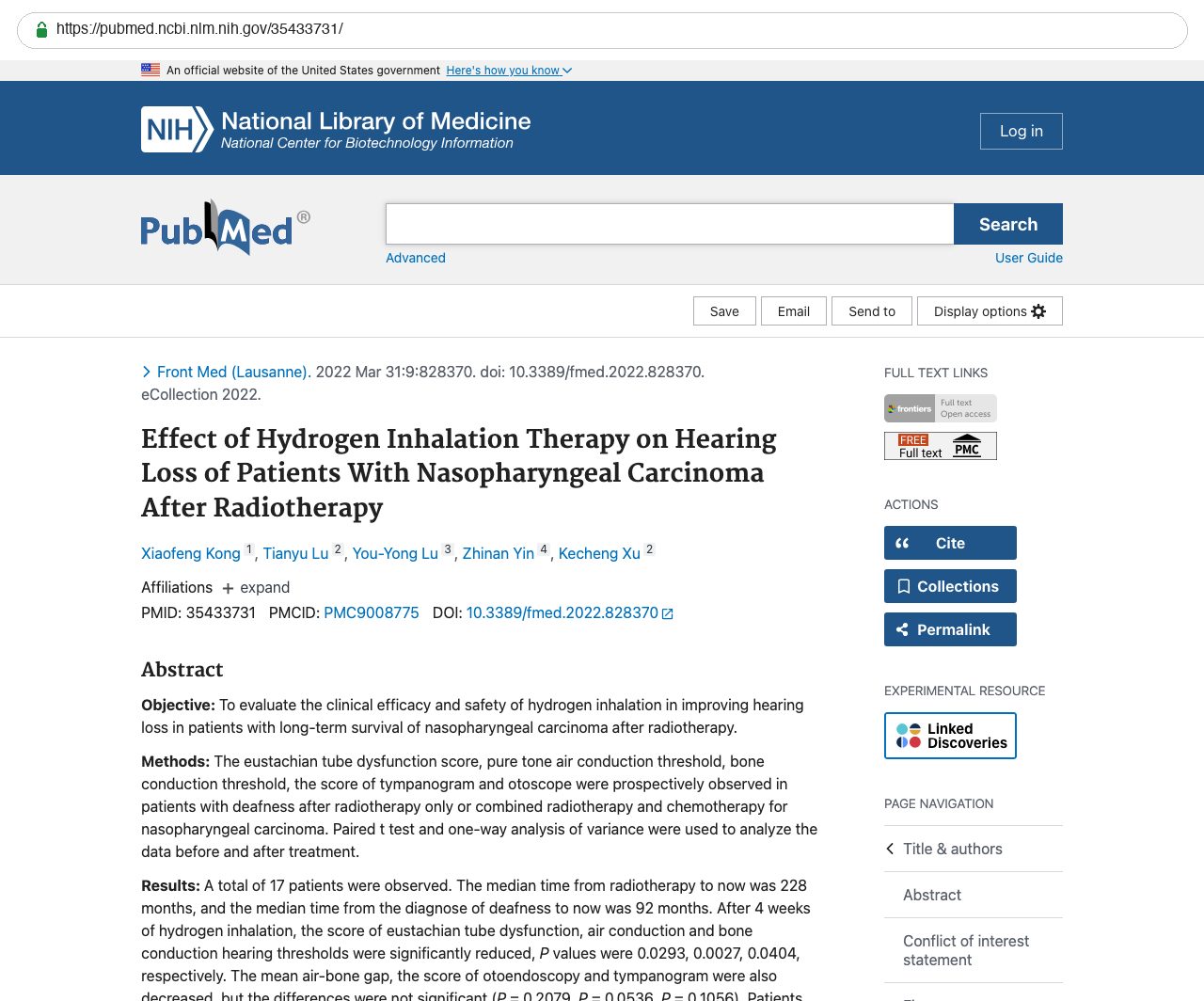
This page mirrors the published abstract (© the authors / publisher) for reference and citation. The canonical source is the PubMed record linked above. This is not medical advice.