2026 · Gao et al. — Effect of Hydrogen-Oxygen Inhalation on Sleep Disorders and Abnormal Mood: A Single-Blind, Randomized Controlled Trial
Super-Abstract
In 66 people with sleep disorders, seven days of nasal hydrogen-oxygen inhalation was followed by longer total sleep time and shorter wake time than in the control group, and by lower scores on a sleep-quality index and a depression scale after 7 days. Anxiety scores did not differ significantly, and the control group showed no significant change in sleep parameters. The trial was single-blind, and the abstract reports no effect sizes, p-values, hydrogen concentration, daily inhalation time or the gas given to the control group. (Medical Gas Research, 2026.)
Commentary
Sleep disorders are associated with various chronic diseases, and the authors state that the effect of hydrogen on them is unclear. This single-blind, randomised controlled trial ran from September 2022 to July 2023 at the Second Medical Center of the PLA General Hospital and the Affiliated Hospital of Chengde Medical College. Sixty-six participants with sleep disorders were randomly divided into a control group and a hydrogen-oxygen group, and both groups received nasal gas inhalation for seven days. The abstract does not state the hydrogen concentration, the daily duration of inhalation, the gas given to the control group or the number of participants per group. Sleep quality and mood were assessed with the Pittsburgh Sleep Quality Index (PSQI), the Self-Rating Depression Scale (SDS) and the Self-Rating Anxiety Scale (SAS). An activity-monitoring device recorded total sleep time, sleep efficiency and wake time. No primary endpoint is named.
Key quotes
- „Compared with those in the control group, the total sleep time was greater and the wake time was lower in the hydrogen-oxygen group.“ — the between-group result for the device-measured sleep data, given without numbers
- „After 7 days, the scores of the Pittsburgh Sleep Quality Index and Self-Rating Depression Scale in the hydrogen-oxygen group were lower than those in the control group, whereas the Self-Rating Anxiety Scale scores did not differ significantly.“ — questionnaire results: sleep quality and depression differed, anxiety did not
- „Hydrogen-oxygen therapy effectively improved sleep disorders by reducing wake time, relieving psychological stress, and enhancing sleep quality.“ — the authors' conclusion, stated without effect sizes in the abstract
Our assessment
This is a randomised trial at two hospitals with a short treatment period. Hydrogen-oxygen inhalation was followed by better device-measured sleep and lower sleep-quality and depression scores than control, while anxiety scores did not differ. The abstract gives these findings only in words, so their size cannot be judged. Limitations: 66 participants and seven days of treatment, with no follow-up after the end of inhalation reported. The trial was single-blind, and the abstract does not say who was blinded. Questionnaires on sleep and mood can respond to expectations. The hydrogen concentration, daily inhalation time and control gas are not described. Several results compare days 3, 5 and 7 with baseline within the hydrogen group, which is weaker evidence than a comparison between groups. No primary endpoint, no p-values and no adverse events are reported. The authors' statement that the therapy effectively improved sleep disorders rests on one week of treatment.
Study design
- Type: single-blind randomised controlled trial at two hospitals (September 2022 to July 2023) · n: 66 participants with sleep disorders (split per group not stated) · H₂ delivery: nasal inhalation of hydrogen-oxygen gas for seven days (concentration and daily duration not stated)
- Comparator: control group with nasal gas inhalation (gas not specified in the abstract)
- Result: no primary endpoint named. Device-measured sleep: total sleep time greater and wake time lower than control. Within the hydrogen-oxygen group, total sleep time and sleep efficiency improved on days 3, 5 and 7, and wake time fell on days 3 and 7. Control group: no significant change. After 7 days, PSQI and SDS scores lower than control, SAS not significantly different. No numbers or p-values in the abstract
Abstract
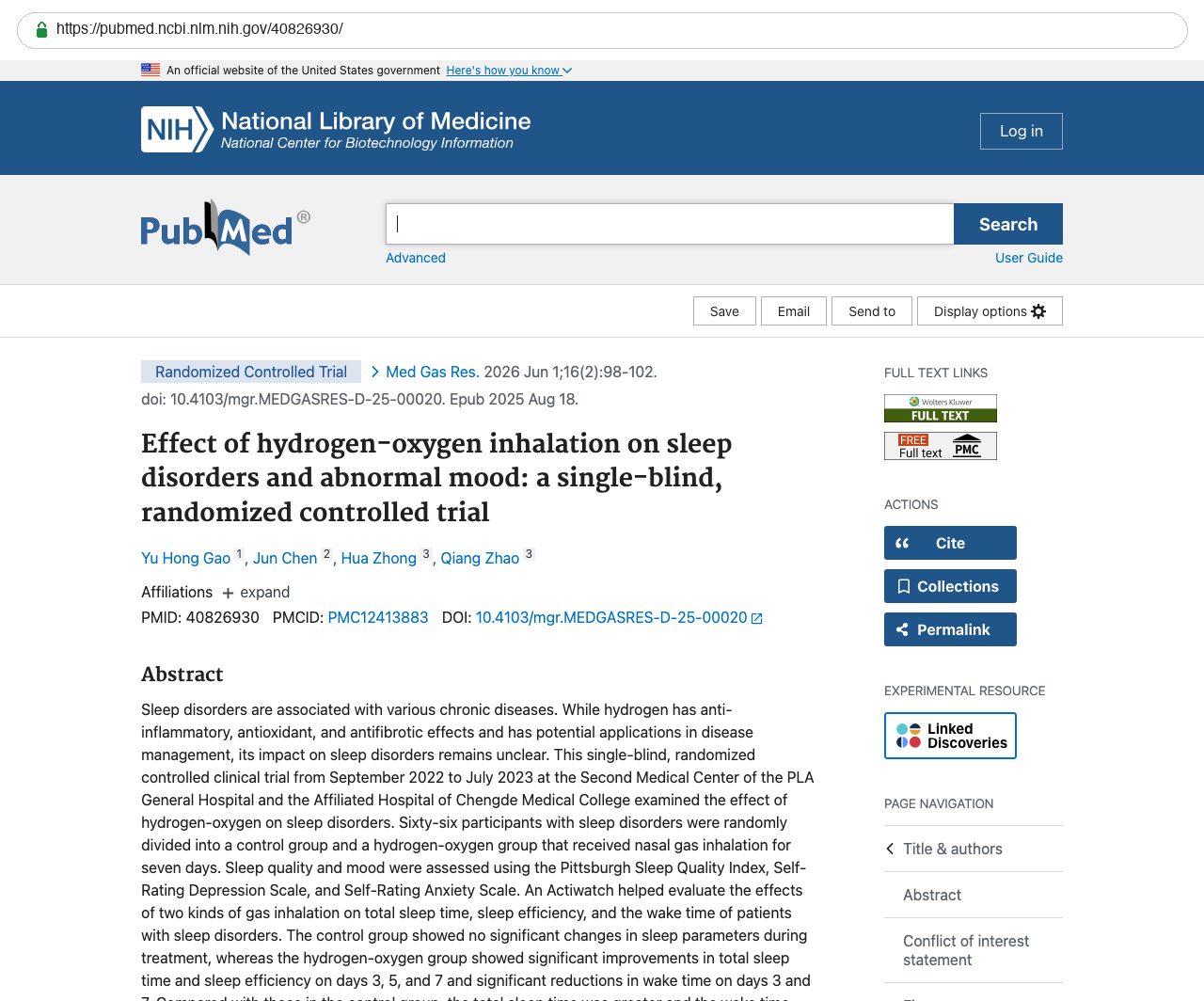
Sleep disorders are associated with various chronic diseases. While hydrogen has anti-inflammatory, antioxidant, and antifibrotic effects and has potential applications in disease management, its impact on sleep disorders remains unclear. This single-blind, randomized controlled clinical trial from September 2022 to July 2023 at the Second Medical Center of the PLA General Hospital and the Affiliated Hospital of Chengde Medical College examined the effect of hydrogen-oxygen on sleep disorders. Sixty-six participants with sleep disorders were randomly divided into a control group and a hydrogen-oxygen group that received nasal gas inhalation for seven days. Sleep quality and mood were assessed using the Pittsburgh Sleep Quality Index, Self-Rating Depression Scale, and Self-Rating Anxiety Scale. An Actiwatch helped evaluate the effects of two kinds of gas inhalation on total sleep time, sleep efficiency, and the wake time of patients with sleep disorders. The control group showed no significant changes in sleep parameters during treatment, whereas the hydrogen-oxygen group showed significant improvements in total sleep time and sleep efficiency on days 3, 5, and 7 and significant reductions in wake time on days 3 and 7. Compared with those in the control group, the total sleep time was greater and the wake time was lower in the hydrogen-oxygen group. After 7 days, the scores of the Pittsburgh Sleep Quality Index and Self-Rating Depression Scale in the hydrogen-oxygen group were lower than those in the control group, whereas the Self-Rating Anxiety Scale scores did not differ significantly. Hydrogen-oxygen therapy effectively improved sleep disorders by reducing wake time, relieving psychological stress, and enhancing sleep quality. The study was registered in the Chinese Clinical Trial Registry (registration No. ChiCTR2400084103).
Source & links
Screenshot of the PubMed page
This page mirrors the published abstract (© the authors / publisher) for reference and citation. The canonical source is the PubMed record linked above. This is not medical advice.