2012 Medical gas research Pilot / Observational Human H₂ therapy Inhalation NeurologyFundamentals / Safety
2012 · Ono et al. — A Basic Study on Molecular Hydrogen (H2) Inhalation in Acute Cerebral Ischemia Patients for Safety Check With Physiological Parameters and Measurement of Blood H2 Level
Super-Abstract
In patients with acute cerebral ischaemia, inhaling 3% or 4% hydrogen gas raised blood hydrogen to a plateau within about 20 minutes without changing physiological parameters, but blood levels after 30-minute inhalation varied widely between patients. Detailed measurements were made in 3 patients and a consistency check in 10. After inhalation stopped, hydrogen fell to 10% of the plateau in about 6 minutes in arterial and 18 minutes in venous blood. The study was not designed to test any clinical benefit. (Medical Gas Research, 2012.)
Commentary
Hydrogen has looked safe and effective in many animal experiments, but patients with cerebral ischaemia are mostly elderly, so the authors checked safety and the consistency of delivery by inhalation. Per full text, 13 patients with acute ischaemic cerebral disease took part. In 3 patients, the hydrogen concentration in arterial and venous blood was measured by gas chromatography before, during and after inhalation of 4% hydrogen (case 1, per full text via the ventilator) or 3% hydrogen (cases 2 and 3, per full text through a facial mask). Physiological parameters were monitored at the same time. For a consistency study, venous blood hydrogen was measured in 10 patients on multiple occasions at the end of 30-minute inhalation treatments. There was no control group, and no clinical outcomes were measured. The abstract does not report adverse events beyond the physiological parameters.
Key quotes
- „The HC gradually reached a plateau level in 20 min after H2 inhalation in the blood, which was equivalent to the level reported by animal experiments.“ — the main finding on how fast blood hydrogen rises during inhalation
- „The consistency study of 10 patients showed the HC at the end of 30-min inhalation treatment was quite variable but the inconsistency improved with more attention and encouragement.“ — a practical problem: mask inhalation delivered very different amounts
- „H2 inhalation of at least 3% concentration for 30 min delivered enough HC, equivalent to the animal experiment levels, in the blood without compromising the safety. However, the consistency of H2 delivery by inhalation needs to be improved.“ — the authors' conclusion, which names the delivery problem openly
Our assessment
This is an early measurement study, not a treatment trial. It shows that inhaled hydrogen reaches the blood of elderly patients with acute cerebral ischaemia within about 20 minutes and falls back quickly after inhalation stops. Physiological parameters in the 3 monitored patients were essentially unchanged. Limitations: the safety data come from only 3 patients during short inhalations, so they cannot show long-term or rare effects. There was no control group and no randomisation, and clinical outcomes were not measured. The abstract gives no blood concentrations in numbers and no statistics for the consistency study. The comparison with animal levels is the authors' own benchmark, not a proven therapeutic level. The wide variation in blood levels after mask inhalation means that delivery has to be checked before any effect of hydrogen in stroke can be judged.
Study design
- Type: uncontrolled safety and blood-level study, not randomised · n: 3 patients for blood kinetics and physiology, 10 for the consistency study (13 in total per full text) · H₂ delivery: inhaled hydrogen gas, 4% in 1 patient (per full text via ventilator) or 3% (per full text by facial mask), 30-minute treatments in the consistency study
- Comparator: none. Measurements before inhalation served as baseline
- Result: blood hydrogen reached a plateau about 20 minutes after the start of inhalation. After stopping, it fell to 10% of the plateau in about 6 minutes (arterial) and 18 minutes (venous). Physiological parameters essentially unchanged. Venous levels after 30-minute inhalation quite variable, improved with more attention and encouragement
Abstract
BACKGROUND: In animal experiments, use of molecular hydrogen ( H2) has been regarded as quite safe and effective, showing benefits in multiple pathological conditions such as ischemia-reperfusion injury of the brain, heart, kidney and transplanted tissues, traumatic and surgical injury of the brain and spinal cord, inflammation of intestine and lung , degenerative striatonigral tissue and also in many other situations. However, since cerebral ischemia patients are in old age group, the safety information needs to be confirmed. For the feasibility of H2 treatment in these patients, delivery of H2 by inhalation method needs to be checked for consistency. METHODS: Hydrogen concentration (HC) in the arterial and venous blood was measured by gas chromatography on 3 patients, before, during and after 4% (case 1) and 3% (case2,3) H2 gas inhalation with simultaneous monitoring of physiological parameters. For a consistency study, HC in the venous blood of 10 patients were obtained on multiple occasions at the end of 30-min H2 inhalation treatment. RESULTS: The HC gradually reached a plateau level in 20 min after H2 inhalation in the blood, which was equivalent to the level reported by animal experiments. The HC rapidly decreased to 10% of the plateau level in about 6 min and 18 min in arterial and venous blood, respectively after H2 inhalation was discontinued. Physiological parameters on these 3 patients were essentially unchanged by use of hydrogen. The consistency study of 10 patients showed the HC at the end of 30-min inhalation treatment was quite variable but the inconsistency improved with more attention and encouragement. CONCLUSION: H2 inhalation of at least 3% concentration for 30 min delivered enough HC, equivalent to the animal experiment levels, in the blood without compromising the safety. However, the consistency of H2 delivery by inhalation needs to be improved.
Source & links
Screenshot of the PubMed page
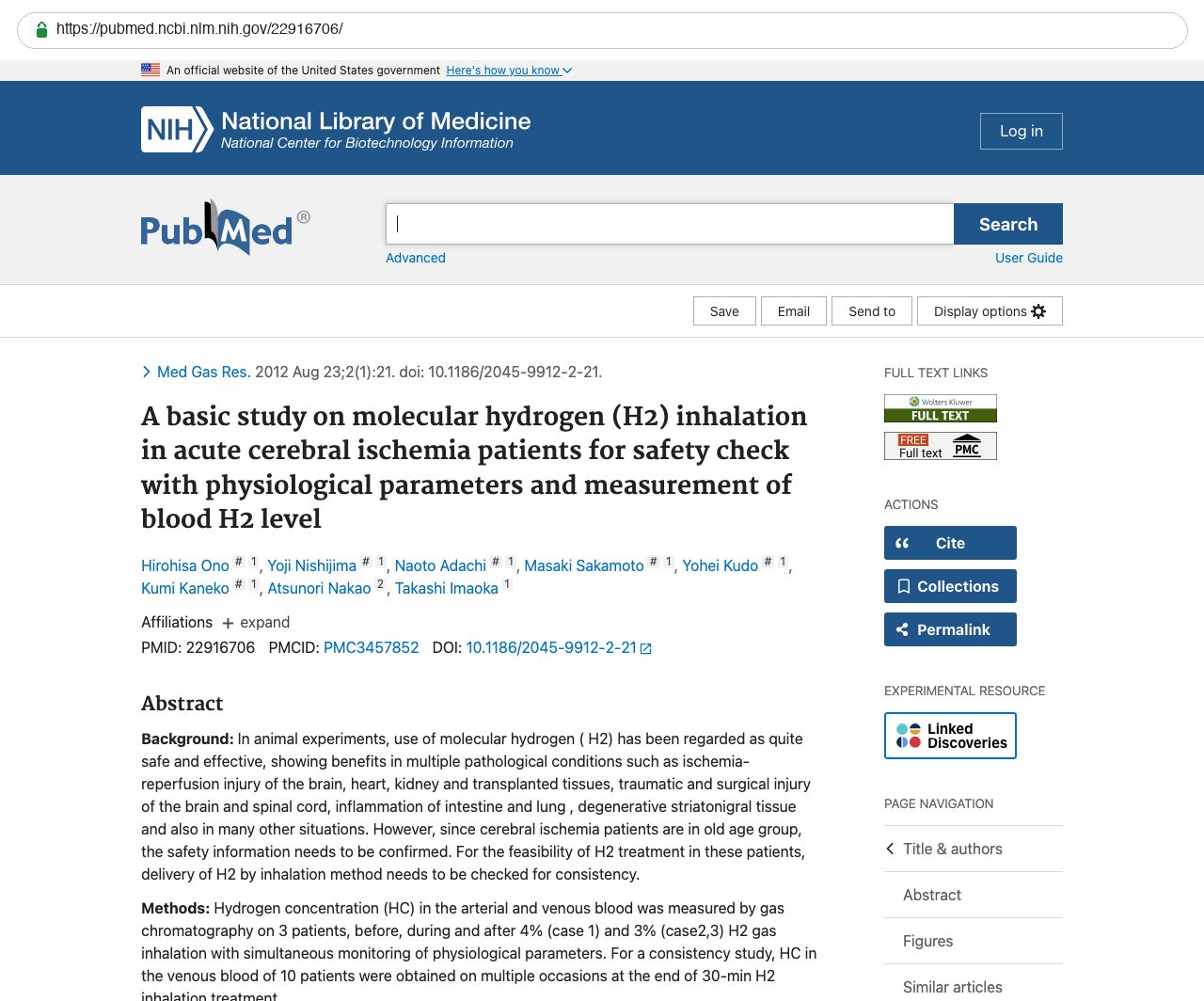
This page mirrors the published abstract (© the authors / publisher) for reference and citation. The canonical source is the PubMed record linked above. This is not medical advice.