2020 · Ooi — Acute ingestion of hydrogen-rich water does not improve incremental treadmill running performance in endurance-trained athletes
Super-Abstract
A single serving of hydrogen water shortly before the run brought no performance gain. In 14 endurance-trained runners, time to exhaustion, maximal oxygen uptake and perceived exertion did not differ from placebo. An honest null finding. (Appl Physiol Nutr Metab, 2020.)
Commentary
This study is important because with H₂ we also show the honest null results — otherwise we would lack credibility. 14 endurance-trained male runners were tested in a double-blind crossover design: once with H₂ water, once with placebo. The dose, however, was small — twice 290 ml: one serving before six submaximal running bouts, another before the maximal incremental treadmill test. Breathing gases, heart rate, perceived exertion and blood values were measured. The result is clearly negative: no difference in time to exhaustion (618 vs. 619 seconds), none in maximal oxygen uptake, maximal heart rate or perceived exertion. The authors conclude that this small, acutely ingested dose was not ergogenic in trained athletes and did not alter buffering capacity during intense exercise. Important for context: this fits the picture that with H₂ water in sports, dose and duration appear to be decisive — other studies found effects only with continuous intake over two weeks, not with a single serving.
Key quotes
- „No statistical difference was observed in running time to exhaustion (618 ± 126 vs. 619 ± 113 s), maximal oxygen uptake (56.9 ± 4.4 vs. 57.1 ± 4.7 mL·kg-1·min-1), maximal HR (184 ± 7 vs. 184 ± 7 beat·min-1), and RPE (19 ± 1 vs. 19 ± 1) in the runners between the trials.“ — the clear null finding with all metrics
- „The results suggest that the ingestion of 290 mL of H2-water before submaximal treadmill running and an additional dose before the subsequent incremental running to exhaustion were not sufficiently ergogenic in endurance-trained athletes.“ — the sober conclusion of the authors
- „A small dose of H2-water does not modulate buffering capacity during intense endurance exercise in athletes.“ — the likely reason: too small a dose
Our assessment
Deliberately included as an honest null finding — this strengthens the credibility of the whole database. The study is methodologically sound: a double-blind, placebo-controlled crossover design, each participant is their own control. The central lesson for us: a single small dose (2 × 290 ml) shortly before exercise is not enough for an ergogenic effect in already well-trained athletes. This is not an argument against H₂ in sport generally, but for realistic expectations and suitable protocols — other works (Mikami 2019, Botek 2019) found positive effects with different doses/designs, as did the two-week continuous use in Hori et al. Limitations, stated honestly: small sample (n = 14), only male, already fully trained runners (low room for improvement), and a low single dose.
Study design
- Type: RCT (randomized, double-blind, crossover, placebo-controlled) · n: 14 endurance-trained male runners · Duration: acute (single doses on the test day) · H₂ delivery: 2 × 290 ml H₂ water (before submaximal runs + before maximal test) vs. placebo
- Result: time to exhaustion 618 ± 126 vs. 619 ± 113 s (n.s.); VO₂max 56.9 ± 4.4 vs. 57.1 ± 4.7 mL·kg⁻¹·min⁻¹ (n.s.); max HR 184 vs. 184 (n.s.); RPE 19 vs. 19 (n.s.)
Abstract
There is emerging evidence that hydrogen-rich water (H2-water) has beneficial effects on the physiological responses to exercise. However, few studies investigate its ergogenic potential. This randomized controlled trial examined the effects of H2-water ingestion on physiological responses and exercise performance during incremental treadmill running. In a double-blind crossover design, 14 endurance-trained male runners (age, 34 ± 4 years; body mass, 63.1 ± 7.2 kg; height, 1.72 ± 0.05 m) were randomly assigned to ingest 2 doses of 290-mL H2-water or placebo on each occasion. The first bolus was given before six 4-min submaximal running bouts, and the second bolus was consumed before the maximal incremental running test. Expired gas, heart rate (HR), and ratings of perceived exertion (RPE) were recorded; blood samples were collected at the end of each submaximal stage and post maximal running test. Cardiorespiratory responses, RPE, and blood gas indices were not significantly different at each submaximal running intensity (range: 34%-91% maximal oxygen uptake) between H2-water and placebo trials. No statistical difference was observed in running time to exhaustion (618 ± 126 vs. 619 ± 113 s), maximal oxygen uptake (56.9 ± 4.4 vs. 57.1 ± 4.7 mL·kg-1·min-1), maximal HR (184 ± 7 vs. 184 ± 7 beat·min-1), and RPE (19 ± 1 vs. 19 ± 1) in the runners between the trials. The results suggest that the ingestion of 290 mL of H2-water before submaximal treadmill running and an additional dose before the subsequent incremental running to exhaustion were not sufficiently ergogenic in endurance-trained athletes. Novelty Acute ingestion of H2-water does not seem to be ergogenic for endurance performance. A small dose of H2-water does not modulate buffering capacity during intense endurance exercise in athletes.
Source & links
Screenshot of the PubMed page
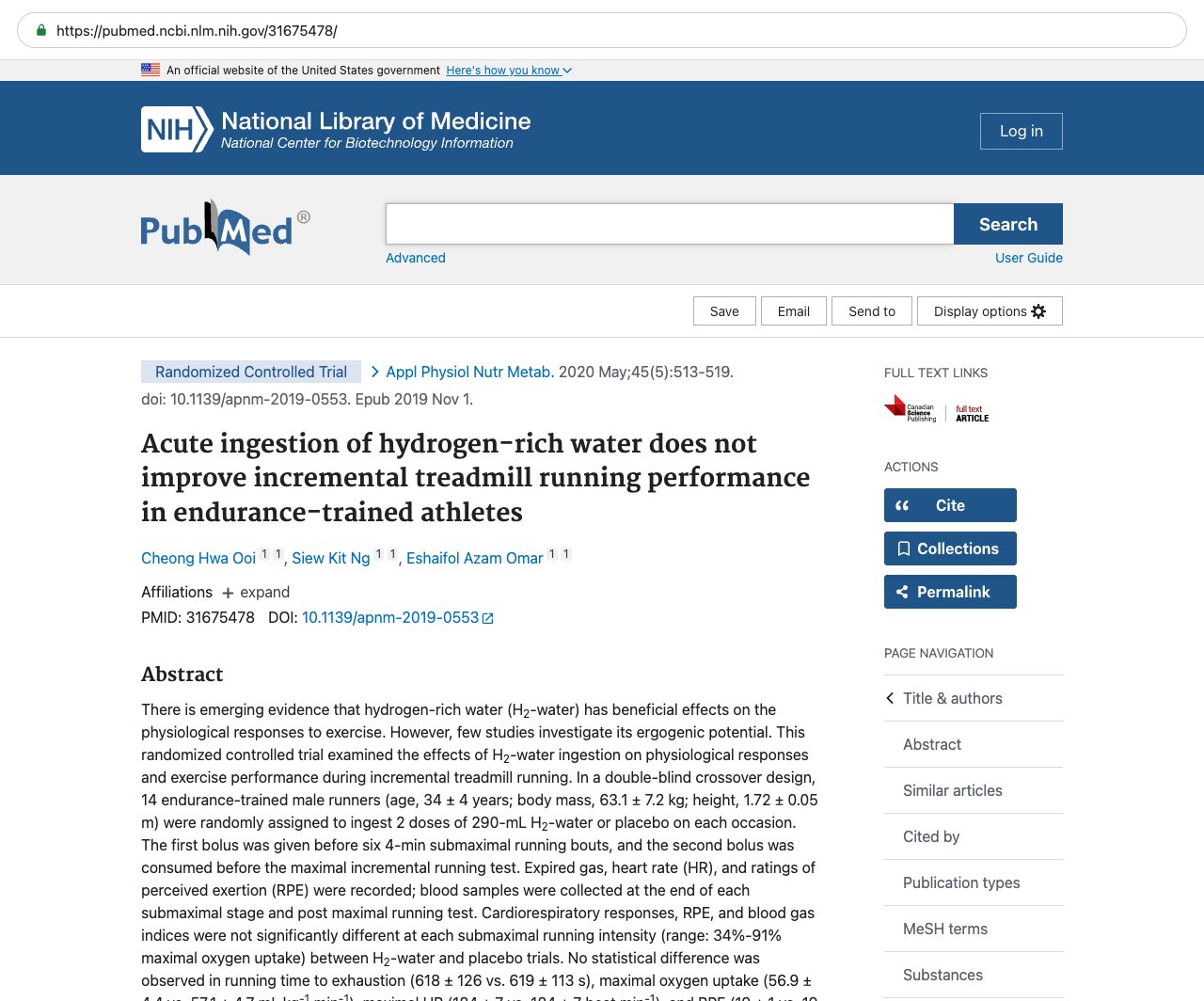
This page mirrors the published abstract (© the authors / publisher) for reference and citation. The canonical source is the PubMed record linked above. This is not medical advice.