2015 Nihon rinsho. Japanese journal of clinical medicine Review / Meta-analysis InhalationDrinking (HRW)
2015 · Osonoi — [Alpha-glucosidase inhibitor]. (Nihon Rinsho)
Super-Abstract
This Japanese-language clinical review discusses alpha-glucosidase inhibitors (α-GI) — a class of oral antidiabetic drugs — noting that their characteristic intestinal side effects (gas, bloating) arise from hydrogen gas produced by gut bacteria fermenting undigested carbohydrates. The review also covers synergies of α-GI with newer antidiabetic drug classes. It is a literature review, not an original study.
Commentary
Alpha-glucosidase inhibitors (acarbose, miglitol, voglibose) slow carbohydrate digestion in the small intestine; unabsorbed sugars pass to the colon where anaerobic bacteria ferment them, generating hydrogen gas (H₂) and other gases. This is the source of the well-known flatulence side effect of α-GIs. Osonoi's review notes the potentially interesting twist that this intestinal H₂ is absorbed systemically and may exert antioxidant effects — potentially contributing to the documented cardiovascular benefits of α-GI therapy (reduction of postprandial oxidative stress). The review also covers the pharmacological synergy of α-GI with DPP-4 inhibitors (enhanced GLP-1 secretion) and SGLT-2 inhibitors. This is a narrative review in a Japanese clinical journal; no original data are presented, no pooled effect sizes, and no systematic search methodology is reported. The H₂ component is discussed as a hypothesis within the broader clinical review, not as a standalone investigated endpoint.
Key quotes
- „The abdominal signs are caused by generation of intestinal gas which contains hydrogen gas.“ — the mechanism of α-GI side effects: gut bacteria produce H₂ from undigested carbohydrates
- „The hydrogen gas absorbed in the body eliminates oxidant stress and consequently the abdominal signs may have beneficial effects preventing onset and progression of arteriosclerosis.“ — the speculative beneficial angle: absorbed intestinal H₂ as an incidental antioxidant therapy
- „α-GI is not only a matured and reliable oral anti-diabtic agent (OAD) but also a promising OAD which collaborates effectively with DPP-4 inhibitors or sodium-glucose cotransporter-2 inhibitors.“ — the primary clinical point: α-GI as a versatile combination partner in modern diabetes management
Our assessment
This is a narrative review article in a Japanese clinical journal — it synthesises existing knowledge rather than generating new data. The H₂-related claim (intestinal H₂ from α-GI fermentation may protect against arteriosclerosis) is plausible and aligns with the broader H₂ biology literature, but it is a hypothesis within the review, not a tested endpoint. Limitations: no systematic literature search, no pooled effect sizes, no risk-of-bias assessment. The primary value is as a clinically oriented overview of α-GI pharmacology and combination therapy options — not as evidence for H₂ supplementation.
Study design
- Type: narrative review (Japanese clinical journal) · Topic: alpha-glucosidase inhibitors in type 2 diabetes management · H₂ relevance: peripheral — intestinal H₂ gas as a by-product of α-GI mechanism discussed as potential antioxidant benefit
- No original data: no experimental design, no patient cohort, no systematic search · Key points: α-GI side effects via gut H₂ production; α-GI + DPP-4i synergy (GLP-1); α-GI + SGLT-2i combination potential
Abstract
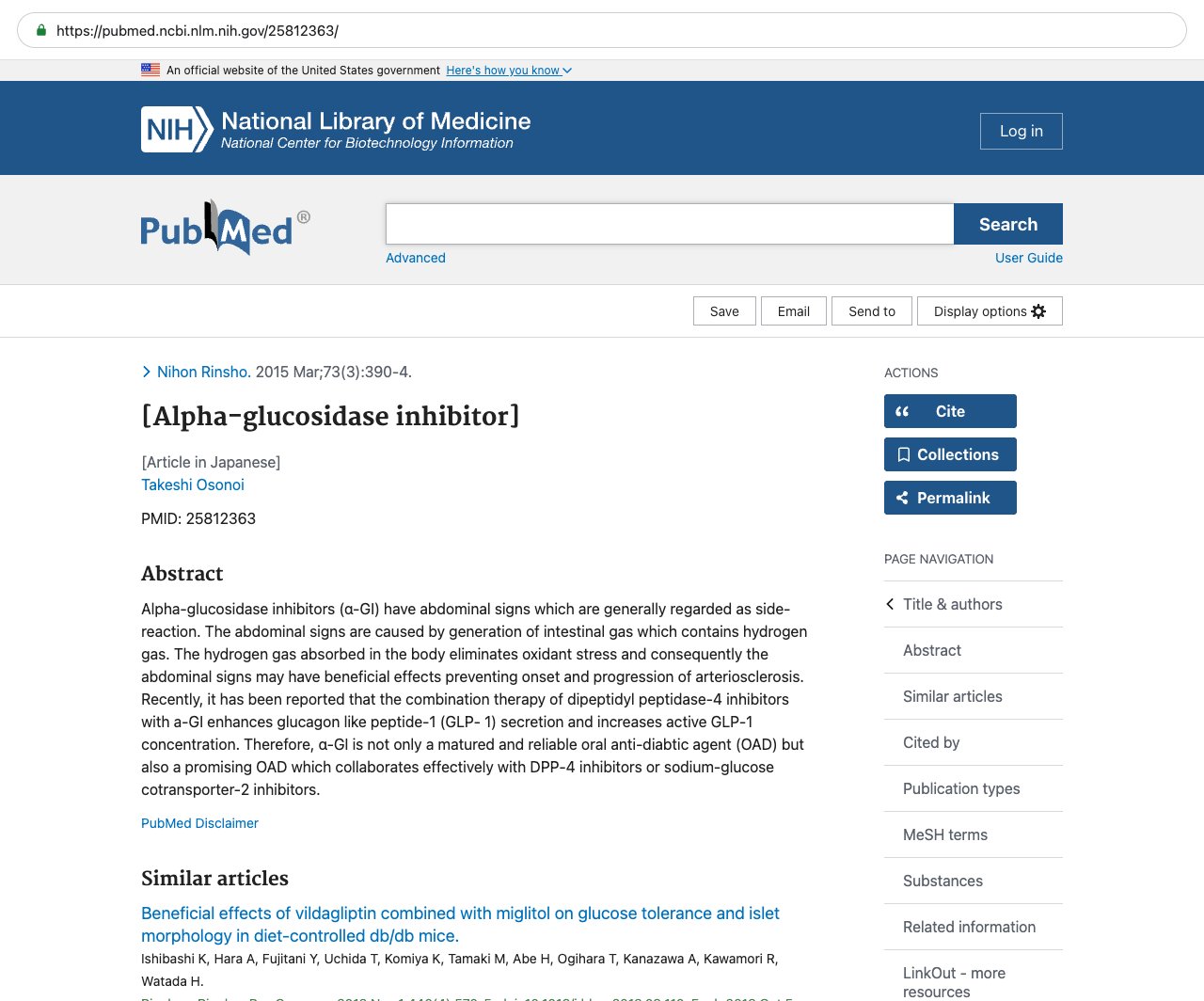
Alpha-glucosidase inhibitors (α-GI) have abdominal signs which are generally regarded as side-reaction. The abdominal signs are caused by generation of intestinal gas which contains hydrogen gas. The hydrogen gas absorbed in the body eliminates oxidant stress and consequently the abdominal signs may have beneficial effects preventing onset and progression of arteriosclerosis. Recently, it has been reported that the combination therapy of dipeptidyl peptidase-4 inhibitors with a-GI enhances glucagon like peptide-1 (GLP- 1) secretion and increases active GLP-1 concentration. Therefore, α-GI is not only a matured and reliable oral anti-diabtic agent (OAD) but also a promising OAD which collaborates effectively with DPP-4 inhibitors or sodium-glucose cotransporter-2 inhibitors.
Source & links
Screenshot of the PubMed page
This page mirrors the published abstract (© the authors / publisher) for reference and citation. The canonical source is the PubMed record linked above. This is not medical advice.