2021 · Bragina — Intestinal microbiota of athletes.
Super-Abstract
This systematic review of 14 studies finds that athletes harbour a more diverse gut microbiome than sedentary individuals, with higher proportions of bacteria that ferment complex carbohydrates into short-chain fatty acids — including species that use hydrogen gas (H₂) and formate to drive fermentation. H₂ appears here as a natural metabolic product of gut fermentation, not as an administered therapeutic. (Voprosy Pitaniya, 2021.)
Commentary
The gut microbiome has emerged as a major regulator of metabolism, immunity, and physical performance. Bragina et al. conducted a systematic search across EMBASE, MEDLINE, Web of Science, Google Scholar, and eLIBRARY, ultimately analyzing 14 studies meeting their inclusion criteria. The pattern that emerges is consistent: athletes show higher α-diversity, reduced Bacteroidetes at the phylum level, and elevated levels of fermentation-associated taxa such as Faecalibacterium prausnitzii, Eubacterium rectale, and Methanobrevibacter smithii. Notably, some of these bacteria — particularly methanogens like Methanobrevibacter smithii — use H₂ and formate produced by fermenting bacteria to reduce CO₂ to methane, thereby maintaining a low H₂ partial pressure that drives fermentation efficiency for the broader microbial community. The H₂ connection here is microbiological and ecological, not therapeutic: H₂ is a waste product of fermentation, not something being administered externally. The review quality is limited by the heterogeneity of included studies and the relatively small number that fully met criteria.
Key quotes
- „athletes had a greater α-diversity of the microbiota, while the level of microorganisms of the phylum Bacteroidetes was reduced“ — key microbiome pattern distinguishing athletes from sedentary individuals
- „increases the fermentation efficiency of many bacterial taxa in the gut by using hydrogen gas (H2) and formate to reduce carbon dioxide (CO2) to methane“ — how H₂ functions in this context: as a microbial energy substrate in gut fermentation, not a therapeutic agent
- „There is a need to study other members of the microecological community, leading to a better understanding of the adaptation of the gut microbiota to levels of physical activity“ — authors' call for more research — the field is still developing
Our assessment
This is a systematic review of observational cross-sectional studies, not an intervention trial. It describes associations between physical activity level and gut microbiome composition; causality cannot be established. The role of H₂ discussed here is endogenous gut H₂ from bacterial fermentation — a normal physiological process — not administered molecular hydrogen therapy. The evidence base is limited (14 studies, heterogeneous populations), and the review excludes dietary confounders imperfectly. Interesting as microbiome background, but not a study of H₂ supplementation.
Study design
- Type: systematic review of cross-sectional observational studies · n: 14 studies fully meeting criteria (from 743 articles screened) · H₂ relevance: endogenous gut fermentation H₂, not administered therapy
- Outcome: higher microbiota α-diversity in athletes; elevated fermentation-associated bacteria; Methanobrevibacter smithii (a hydrogenotrophic methanogen) enriched in some athlete groups
Abstract
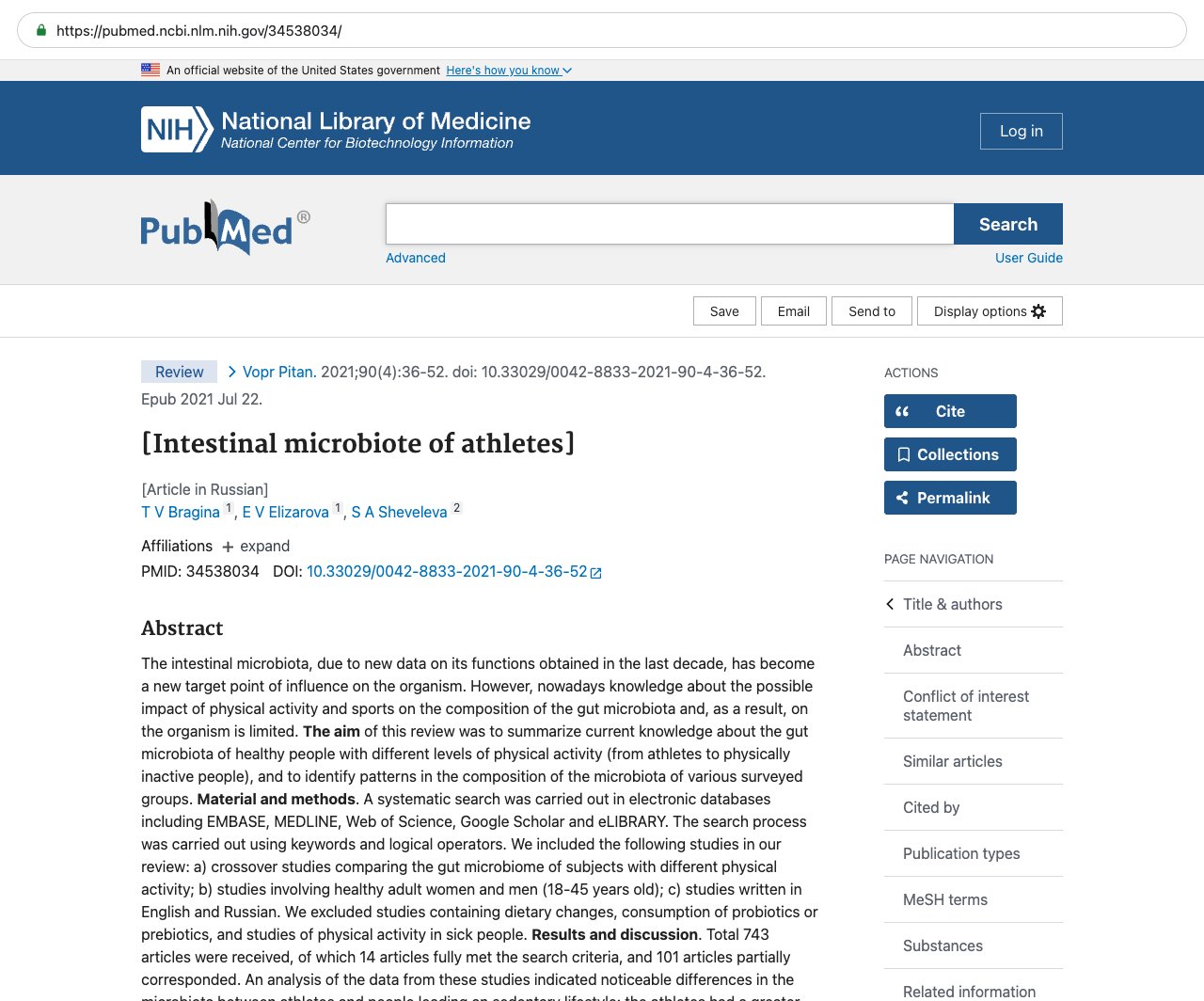
The intestinal microbiota, due to new data on its functions obtained in the last decade, has become a new target point of influence on the organism. However, nowadays knowledge about the possible impact of physical activity and sports on the composition of the gut microbiota and, as a result, on the organism is limited. The aim of this review was to summarize current knowledge about the gut microbiota of healthy people with different levels of physical activity (from athletes to physically inactive people), and to identify patterns in the composition of the microbiota of various surveyed groups. Material and methods. A systematic search was carried out in electronic databases including EMBASE, MEDLINE, Web of Science, Google Scholar and eLIBRARY. The search process was carried out using keywords and logical operators. We included the following studies in our review: a) crossover studies comparing the gut microbiome of subjects with different physical activity; b) studies involving healthy adult women and men (18-45 years old); c) studies written in English and Russian. We excluded studies containing dietary changes, consumption of probiotics or prebiotics, and studies of physical activity in sick people. Results and discussion. Total 743 articles were received, of which 14 articles fully met the search criteria, and 101 articles partially corresponded. An analysis of the data from these studies indicated noticeable differences in the microbiota between athletes and people leading an sedentary lifestyle: the athletes had a greater α-diversity of the microbiota, while the level of microorganisms of the phylum Bacteroidetes was reduced; Akkermansiaceae and Faecalibacterium bacteria are elevated in athletes and people with active lifestyles. Different levels of physical activity in physically active people according to the levels of cardiorespiratory endurance did not affect the level of α- and β-diversity. When analyzing the effect of loads on the microbiota in various sports disciplines and skill levels, a connection was found with an increase in α-diversity in professionals and highly qualified athletes, with the relative content of series of bacteria (Methanobrevibacter smithii in professional cyclists; Parabacteroides, Phascolarctobacterium, Oscillibacter, Bilophila, Megasphaera in athletes of high martial arts qualifications of wushu; Eubacterium rectale, Polynucleobacter needarius, Faecalibacterium prausnitzii, Bacteroides vulgatus, Gordonibacter massiliensis in athletes of international level of various sports), and certain genera of bacteria have been identified (Parabacteroides, Phascolarctobacterium, Besilibacterium). Conclusion. The data obtained indicate a higher relative proportion of microbiota effective members, which are involved in the fermentation of complex polysaccharides and the production of short-chain fatty acids such as Faecalibacterium prausnitzii, Eubacterium hallii, Phascolarctobacterium, Eubacterium rectale, and Methanobrevibacter smithii, which increases the fermentation efficiency of many bacterial taxa in the gut by using hydrogen gas (H2) and formate to reduce carbon dioxide (CO2) to methane. There is a need to study other members of the microecological community, leading to a better understanding of the adaptation of the gut microbiota to levels of physical activity and its potentially positive effects on metabolism and endurance.
Source & links
Screenshot of the PubMed page
This page mirrors the published abstract (© the authors / publisher) for reference and citation. The canonical source is the PubMed record linked above. This is not medical advice.