2025 · Ogannisyan — Hydrogen-Rich Water Decreases Muscle Damage and Improves Power Endurance in Elite Athletes: A Randomized, Double-Blinded, Placebo-Controlled Trial
Super-Abstract
Hydrogen-rich water reduces muscle damage and boosts power performance in competitive female athletes. In a randomized double-blind placebo design (22 elite female athletes), total creatine kinase fell significantly, torque after intensive exertion rose, and body fat percentage went down (all p < 0.05). (Journal of Lifestyle Medicine, 2025 — one of the few H₂ studies in real elite athletes.)
Commentary
Here hydrogen is tested exactly where antioxidants matter: in high-performance sport, where intense exertion massively generates reactive oxygen species (ROS). The design is clean — <strong>randomized, double-blind, placebo-controlled</strong> — with 22 female elite athletes from handball and skeleton. One group used H₂ water tablets, the other a visually and taste-identical placebo. The results are concrete: muscle mass rose, fat percentage fell (p < 0.05), maximal torque increased especially after an intensive exercise test (p < 0.05), and the muscle damage marker creatine kinase went down. The antioxidant shift pattern is also interesting: vitamin C and beta-carotene fell, while vitamin E and the anti-inflammatory interleukin-10 rose — a hint that H₂ modulates the exercise-induced inflammatory and antioxidant response. Honestly: the sample is very small (n = 22) and all-female, recovery and stress values did not improve significantly, and the exact mechanism of action remains unclear.
Key quotes
- „HRW consumption resulted in an increase in muscle mass and a reduction in fat mass (p < 0.05).“ — body composition improves measurably
- „the HRW group exhibited a significant increase in torque, particularly after an intensive exercise test (p < 0.05).“ — power performance rises especially after hard exertion
- „HRW intake led to a reduction in total creatine kinase ... whereas the vitamin E and interleukin-10 levels increased compared with baseline levels (p < 0.05).“ — less muscle damage, modulated inflammatory response
Our assessment
Directly relevant to H₂ supplementation in competitive sport, because the study design (double-blind, placebo-controlled) largely excludes placebo and expectation effects — precisely in sport, where motivation plays a big role. The finding fits mechanistically with the antioxidant profile of H₂: less oxidative stress after exertion, less muscle damage. Limitation, stated honestly: very small sample (n = 22), only women, only two sports — transferability is limited. Stress and recovery values (RESTQ-Sport) showed no effect, and the mechanism of action remains unexplained according to the authors.
Study design
- Type: RCT, randomized/double-blind/placebo-controlled · n: 22 (female elite athletes, handball + skeleton) · Duration: not specified in the abstract · H₂ delivery: H₂-water-generating tablets (HRW)
- Result figures: muscle mass ↑, fat mass ↓ (p < 0.05); maximal torque ↑ after exercise test (p < 0.05); creatine kinase, vitamin C, beta-carotene ↓ (p < 0.05); vitamin E, IL-10 ↑ (p < 0.05); stress/recovery (RESTQ-Sport) without significant change
Abstract
Physical activity significantly increases the production of reactive oxygen species in the body. Molecular hydrogen has been shown to have safe and effective antioxidant properties on athletes. However, research on elite athletes is scarce. A randomized, double-blinded, placebo-controlled trial was conducted with 22 female elite athletes participating in handball and skeleton sports. The first group received hydrogen-rich water (HRW)-generating tablets, whereas the second group consumed a visually and organoleptically similar placebo. Various assessments were performed during HRW intake, such as anthropometric and biochemical measurements, stress, and recovery parameters, as well as biomechanical testing. HRW consumption resulted inan increase in muscle mass and a reduction in fat mass (p < 0.05). However, HRW did not significantly affect stress or recovery rates, as determined by the Recovery-Stress Questionnaire-Sport questionnaire. However, the HRW group exhibited a significant increase in torque, particularly after an intensive exercise test (p < 0.05). Moreover, HRW intake led to a reduction in total creatine kinase, vitamin C, and beta-carotene contents (p < 0.05), whereas the vitamin E and interleukin-10 levels increased compared with baseline levels (p < 0.05). The HRW-generating tablets were found to be safe and well-tolerated by the participants. These tablets also exerted ergogenic effects by reducing body fat percentage, increasing muscle mass percentage, improving maximal torque, decreasing muscle damage, and positively modulating the exercise-induced inflammatory and antioxidant responses to exercise. Although the mechanism of action of HRW remains unclear, these effects observed indicate its potential for diverse applications in high-performance sports.
Source & links
Screenshot of the PubMed page
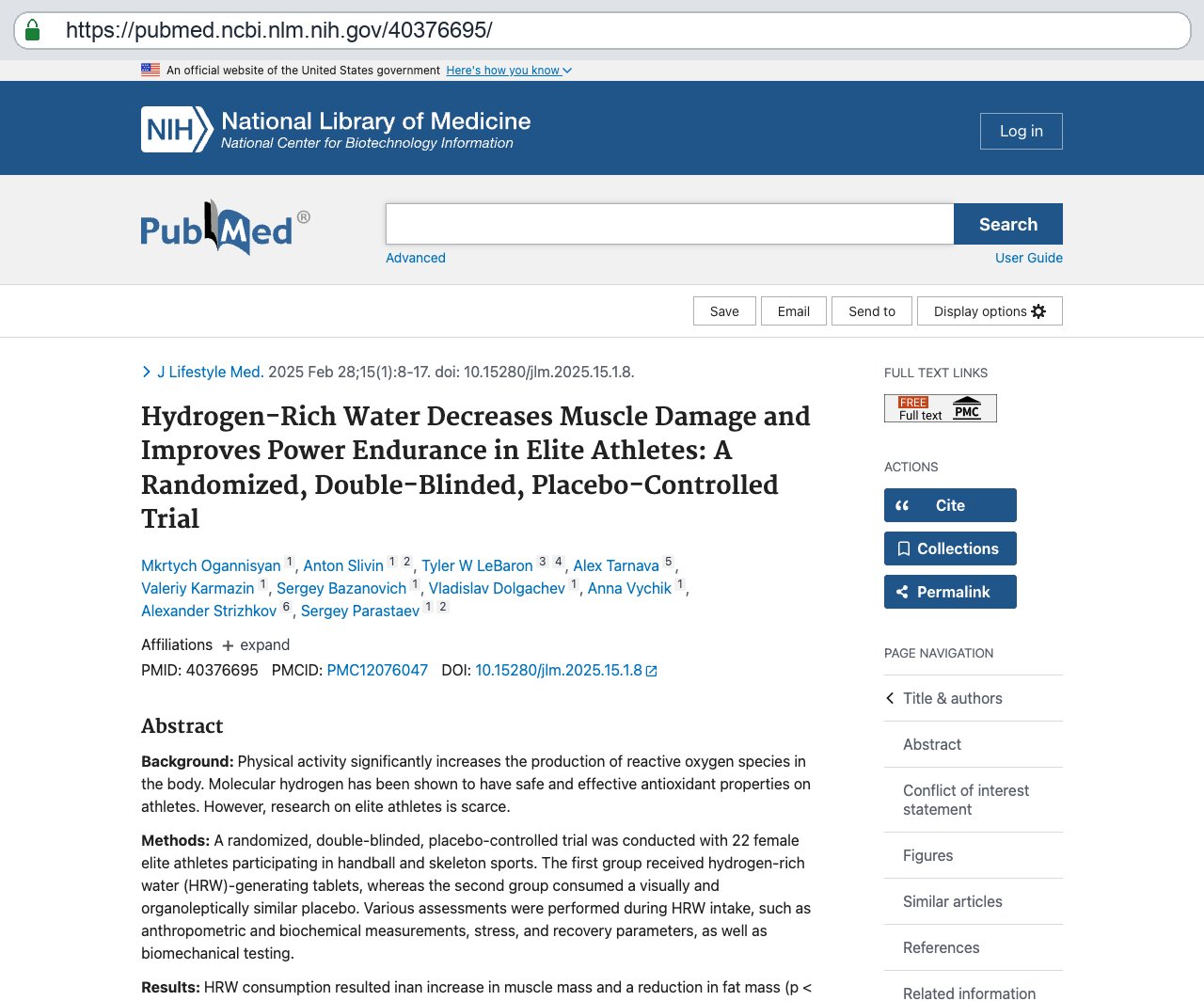
This page mirrors the published abstract (© the authors / publisher) for reference and citation. The canonical source is the PubMed record linked above. This is not medical advice.