2015 · Ostojic — Eumelanin-driven production of molecular hydrogen: A novel element of skin defense?
Super-Abstract
This theoretical hypothesis paper proposes that eumelanin — the dark pigment in skin and hair — may produce endogenous molecular hydrogen (H₂) and that this capacity could represent a previously overlooked mechanism of skin protection against oxidative stress. No experiments were conducted; this is a speculative hypothesis based on existing knowledge of melanin chemistry and H₂ biology, published in a hypotheses journal.
Commentary
Ostojic builds on two established observations: (1) molecular H₂ selectively scavenges the most cytotoxic reactive oxygen species (ROS), particularly the hydroxyl radical; and (2) eumelanin is known to undergo redox reactions and has antioxidant properties. The hypothesis connects these: if eumelanin can generate H₂ through its redox chemistry, then skin's own pigment system might provide an intrinsic, dose-adjustable source of the antioxidant gas right where UV-driven oxidative stress occurs. The paper cites no direct experimental evidence for eumelanin-to-H₂ conversion in vivo; it is a conceptual bridge between melanin photochemistry and H₂ biology. The hypothesis is plausible but entirely unproven — it was submitted to Medical Hypotheses, which publishes speculative ideas without requiring experimental validation. This needs laboratory confirmation before any conclusions can be drawn.
Key quotes
- „It seems that melanin, natural pigment of skin and hair, might produce endogenous hydrogen.“ — the core speculative claim: melanin as an endogenous H₂ source
- „The protective role of skin melanin (eumelanin) could be due to its capacity for molecular hydrogen production.“ — proposed mechanism: H₂ production as part of melanin's antioxidant role
- „An effective pooling of dihydrogen by eumelanin should be considered as a novel element of skin defense system against oxidative stress-related disorders.“ — the hypothesis conclusion: H₂ pooling by melanin as a skin-defense element
Our assessment
This is a theoretical hypothesis paper — no experiments, no animal models, no human subjects. The idea that eumelanin generates biologically relevant quantities of H₂ in skin is novel and intellectually interesting, but it has not been experimentally tested. Until direct measurement of eumelanin-generated H₂ under physiological conditions is demonstrated, this remains speculation. The Medical Hypotheses journal specifically exists for unvalidated ideas, which means the paper has not passed standard peer-review experimental scrutiny. It should be read as a hypothesis-generating paper, not as evidence.
Study design
- Type: theoretical hypothesis paper · Experimental basis: none (literature reasoning only) · H₂ relevance: central — proposes eumelanin as an endogenous H₂ source in skin
- Proposed mechanism: eumelanin undergoes redox reactions → generates molecular H₂ → H₂ scavenges ROS locally in skin · Status: unvalidated hypothesis; no in-vitro, animal, or human data presented
Abstract
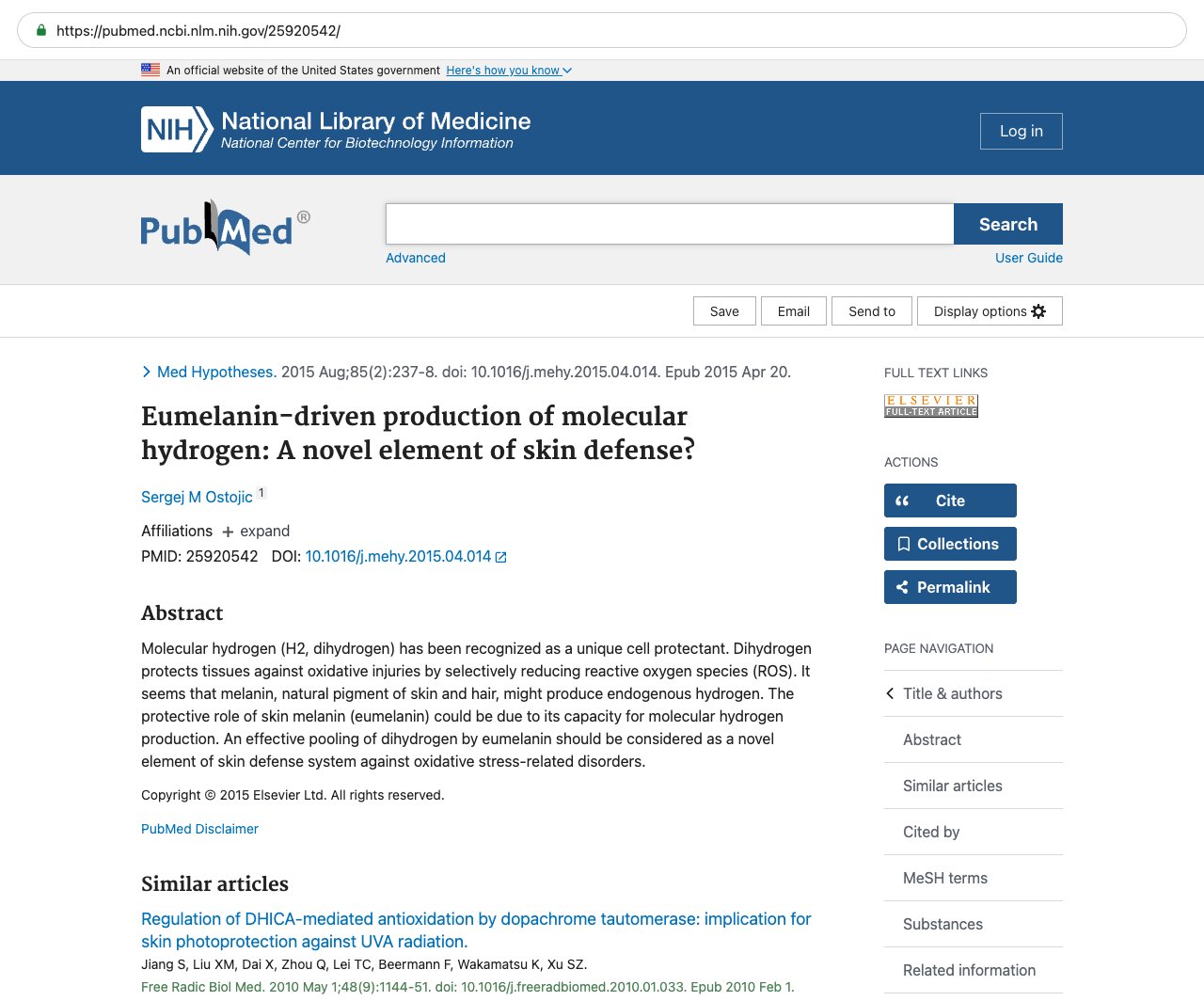
Molecular hydrogen (H2, dihydrogen) has been recognized as a unique cell protectant. Dihydrogen protects tissues against oxidative injuries by selectively reducing reactive oxygen species (ROS). It seems that melanin, natural pigment of skin and hair, might produce endogenous hydrogen. The protective role of skin melanin (eumelanin) could be due to its capacity for molecular hydrogen production. An effective pooling of dihydrogen by eumelanin should be considered as a novel element of skin defense system against oxidative stress-related disorders.
Source & links
Screenshot of the PubMed page
This page mirrors the published abstract (© the authors / publisher) for reference and citation. The canonical source is the PubMed record linked above. This is not medical advice.