2022 · Ostojic — Hydrogen-Rich Water as a Dietary Activator of Brown Adipose Tissue and UCP1?
Super-Abstract
This short theoretical communication poses the question of whether hydrogen-rich water (HRW) could activate brown adipose tissue (BAT) and the thermogenic protein UCP1 — and thereby contribute to fat metabolism and energy expenditure. The author proposes a mechanistic hypothesis based on existing H₂ biology and BAT physiology, but presents no new experimental data. The abstract is empty; this is a hypothesis/commentary piece. (Annals of Nutrition and Metabolism, 2022.)
Commentary
Brown adipose tissue (BAT) is a metabolically active fat tissue that generates heat through the uncoupling protein UCP1 — dissipating energy rather than storing it. BAT activation is of considerable interest as a potential strategy against obesity and metabolic disease. Ostojic raises the question of whether H₂ might influence BAT activity, given what is known about H₂'s role in mitochondrial biology and oxidative phosphorylation. However, this paper contains no experimental data — the abstract is blank, and the full text of this brief communication presents a theoretical hypothesis only. Without data, this cannot be evaluated as evidence for or against H₂'s effect on BAT.
Key quotes
- „Hydrogen-Rich Water as a Dietary Activator of Brown Adipose Tissue and UCP1?“ — the paper's title is itself the hypothesis — phrased as a question, not a claim
Our assessment
This is a theoretical hypothesis/commentary with no experimental data available (the abstract is empty). The hypothesis — that HRW might activate BAT and UCP1 — is mechanistically plausible and scientifically interesting, but remains entirely speculative without supporting data. Honest limitation: This contribution cannot be assessed for scientific weight beyond the plausibility of its proposed mechanism. Readers should consult the full text (DOI: 10.1159/000525175) for any reasoning presented. No conclusions about efficacy can be drawn.
Study design
- Type: theoretical hypothesis/short communication · n: n/a (no experiment reported) · H₂ delivery: hydrogen-rich water (HRW), as discussed hypothetically
- Result: no experimental results; paper proposes a mechanistic hypothesis linking HRW to brown adipose tissue activation via UCP1; full text required for complete assessment
Source & links
Screenshot of the PubMed page
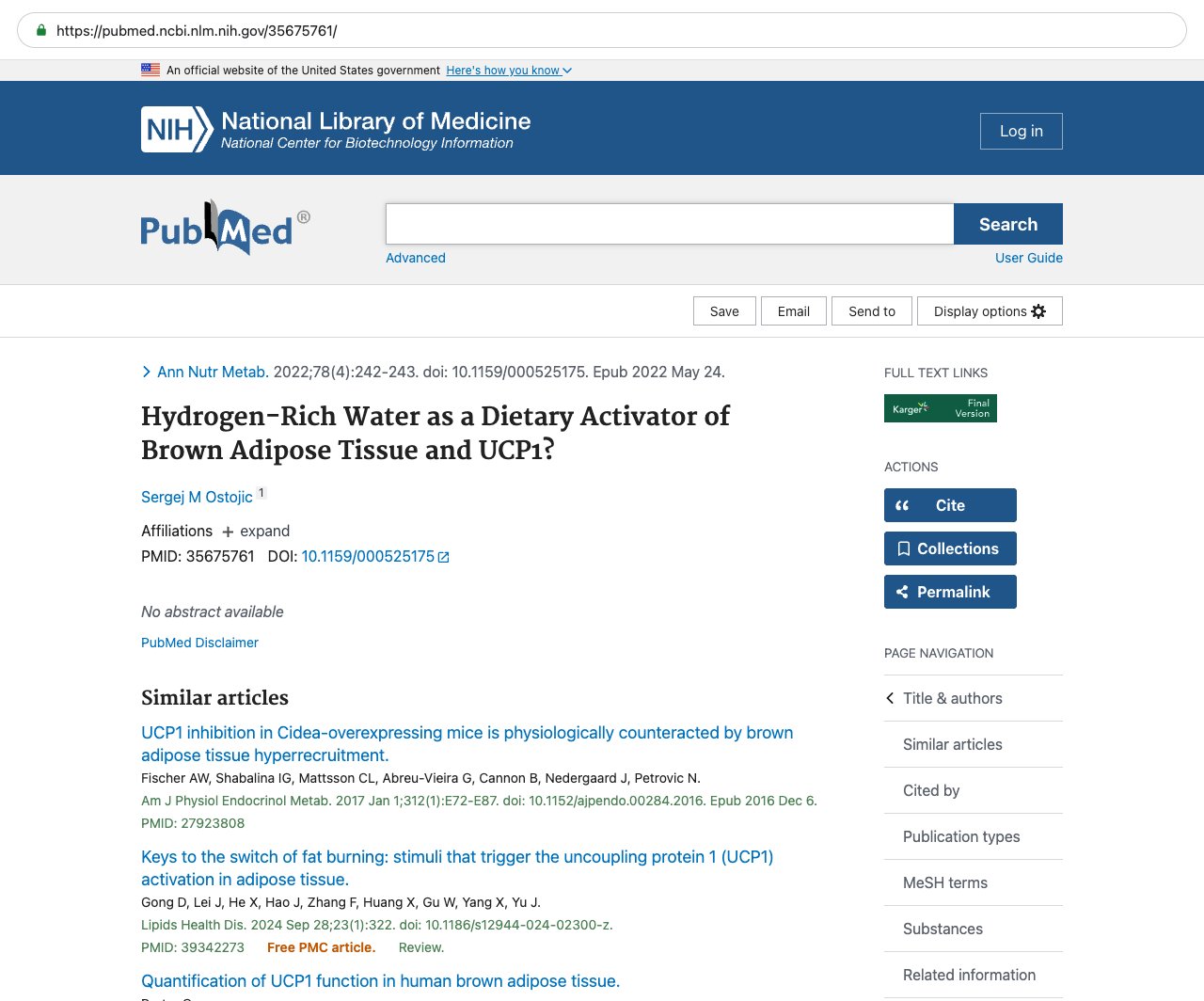
This page mirrors the published abstract (© the authors / publisher) for reference and citation. The canonical source is the PubMed record linked above. This is not medical advice.