2018 · Jackson — Effects of alkaline-electrolyzed and hydrogen-rich water, in a high-fat-diet nonalcoholic fatty liver disease mouse model
Super-Abstract
In mice fed a high-fat diet, only high-concentration hydrogen-rich water (0.8 mg H₂/L) — not electrolyzed-alkaline water with low H₂ (0.2 mg/L) — significantly reduced fat mass gain and liver lipid accumulation. The study concludes that H₂ is the therapeutic agent in electrolyzed water, and that dose matters: low H₂ concentrations were ineffective. This is a mouse study; results cannot be directly extrapolated to humans. (World Journal of Gastroenterology, 2018.)
Commentary
This well-designed rodent experiment makes two important mechanistic points. First, it confirms that alkaline pH alone (pH 11 electrolyzed water with low H₂) provides no measurable benefit over regular water in a high-fat diet model — neatly separating the H₂ effect from the alkalinity effect. Second, it demonstrates a dose-response: low-concentration HRW (0.3 mg/L) was not significantly different from controls, while high-concentration HRW (0.8 mg/L) produced meaningful improvements in body composition and liver histology. The ex-vivo hepatocyte palmitate-overload experiment adds mechanistic plausibility. Limitations are the typical ones for preclinical animal work: mouse metabolism differs substantially from human metabolism, the diet model is artificial, and no biomarkers of human liver disease progression (AST/ALT, fibrosis staging) were the primary readouts.
Key quotes
- „H2 is the therapeutic agent in electrolyzed-alkaline water and attenuates HFD-induced nonalcoholic fatty liver disease in mice.“ — main conclusion: H₂ — not alkalinity — is the active principle
- „Compared to RW and L-HRW, H-HRW resulted in a lower increase in fat mass (46% vs 61%), an increase in lean body mass (42% vs 28%), and a decrease in hepatic lipid accumulation (P < 0.01).“ — quantified dose-response effect — high H₂ vs low H₂ vs regular water
- „We hypothesized that the null result was due to low H2 concentrations.“ — honest explanation for why electrolyzed water at pH 11 / 0.2 mg H₂ did not work
Our assessment
A carefully controlled animal study with an honest null result for low-H₂ alkaline water — which adds credibility. The dose-response finding (0.3 mg/L ineffective, 0.8 mg/L effective) is practically relevant for product evaluation. Critical limitations: this is a mouse model; the high-fat-diet NAFLD mouse does not perfectly replicate human NAFLD progression. No human data exist from this group. Results should be interpreted as hypothesis-generating for dose thresholds, not as proof of human efficacy. Translation to humans requires controlled clinical trials.
Study design
- Type: controlled animal experiment · Model: C57BL/6 mice on high-fat diet · H₂ delivery: drinking water (low-HRW 0.3 mg/L vs high-HRW 0.8 mg/L vs electrolyzed-alkaline water 0.2 mg/L vs regular water)
- Duration: 12 weeks · n: multiple groups (exact n per group not specified in abstract)
- Result: high-HRW reduced fat-mass gain (46% vs 61%), increased lean mass (42% vs 28%), decreased hepatic lipid accumulation (P < 0.01); electrolyzed-alkaline water and low-HRW: no significant difference from controls
Abstract
AIM: To identify the effect of hydrogen-rich water (HRW) and electrolyzed-alkaline water (EAW) on high-fat-induced non-alcoholic fatty acid disease in mice. METHODS: Mice were divided into four groups: (1) Regular diet (RD)/regular water (RW); (2) high-fat diet (HFD)/RW; (3) RD/EAW; and (4) HFD/EAW. Weight and body composition were measured. After twelve weeks, animals were sacrificed, and livers were processed for histology and reverse-transcriptase polymerase chain reaction. A similar experiment was performed using HRW to determine the influence and importance of molecular hydrogen (H2) in EAW. Finally, we compared the response of hepatocytes isolated from mice drinking HRW or RW to palmitate overload. RESULTS: EAW had several properties important to the study: (1) pH = 11; (2) oxidation-reduction potential of -495 mV; and (3) H2 = 0.2 mg/L. However, in contrast to other studies, there were no differences between the groups drinking EAW or RW in either the RD or HFD groups. We hypothesized that the null result was due to low H2 concentrations. Therefore, we evaluated the effects of RW and low and high HRW concentrations (L-HRW = 0.3 mg H2/L and H-HRW = 0.8 mg H2/L, respectively) in mice fed an HFD. Compared to RW and L-HRW, H-HRW resulted in a lower increase in fat mass (46% vs 61%), an increase in lean body mass (42% vs 28%), and a decrease in hepatic lipid accumulation (P < 0.01). Lastly, exposure of hepatocytes isolated from mice drinking H-HRW to palmitate overload demonstrated a protective effect from H2 by reducing hepatocyte lipid accumulation in comparison to mice drinking regular water. CONCLUSION: H2 is the therapeutic agent in electrolyzed-alkaline water and attenuates HFD-induced nonalcoholic fatty liver disease in mice.
Source & links
Screenshot of the PubMed page
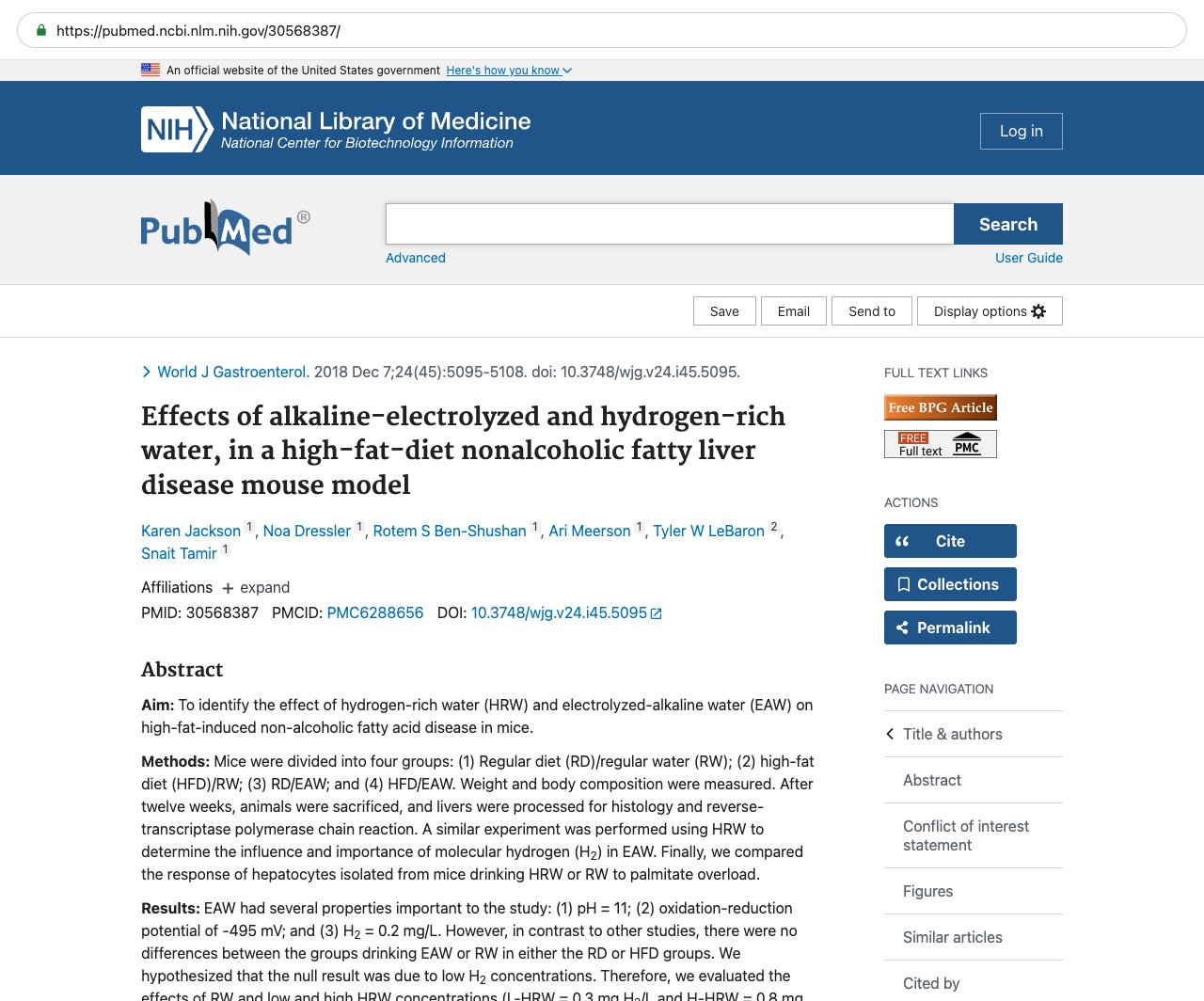
This page mirrors the published abstract (© the authors / publisher) for reference and citation. The canonical source is the PubMed record linked above. This is not medical advice.