1983 · Ostrander — Breath hydrogen analysis: a review of the methodologies and clinical applications.
Super-Abstract
Hydrogen gas exhaled in breath — produced when gut bacteria ferment unabsorbed carbohydrates — can serve as a non-invasive clinical tool to detect carbohydrate malabsorption in adults and older children. This review covers breath H₂ methodology, its clinical uses, and the special challenges in interpreting results in infants. (Journal of Pediatric Gastroenterology and Nutrition, 1983.)
Commentary
This is a methodological review of breath hydrogen testing as a clinical diagnostic tool. Hydrogen gas in this context is an endogenous bacterial metabolite — it is produced in the colon when carbohydrates escape absorption and are fermented, then diffuses into the bloodstream and is exhaled. The review covers test methodology, interpretation, and clinical applications such as lactose malabsorption and small intestinal bacterial overgrowth. Importantly, it highlights that breath H₂ analysis in neonates and young infants is unreliable due to confounding variables. This paper has no connection to therapeutic molecular hydrogen — H₂ here is a diagnostic marker, not a treatment.
Key quotes
- „H2 is actually an exogenously produced gas, which either is passed as flatus, or diffuses into the body and is exhaled.“ — mechanistic basis of the breath H₂ test
- „breath H2 analysis may provide the best available method for estimating semiquantitatively the degree of CHO malabsorption.“ — the clinical case for breath H₂ testing
- „The interpretation of the results of breath H2 analysis in neonates and young infants remains especially problematic because of confounding variables which are difficult to control.“ — honest limitation: the test is unreliable in the youngest patients
Our assessment
This is a clinical methodology review of breath hydrogen testing — H₂ is a diagnostic biomarker here, not a therapeutic molecule. The review provides a solid foundation for understanding how breath H₂ tests work and where they are clinically useful. Its honest acknowledgement of the test's limitations in infants is a valuable contribution. No connection to H₂ therapy; relevant as background context for understanding endogenous hydrogen metabolism.
Study design
- Type: narrative review · n: n/a (literature synthesis) · H₂ role: exhaled breath hydrogen as diagnostic marker for carbohydrate malabsorption (not therapeutic)
- Key findings: breath H₂ testing is non-invasive and well-suited for adults and older children; fractional excretion in breath is fairly constant in adults, providing reliable signal; results in neonates and young infants are unreliable due to uncontrolled confounders; discrepancies with other CHO absorption measures are expected and explainable
Abstract
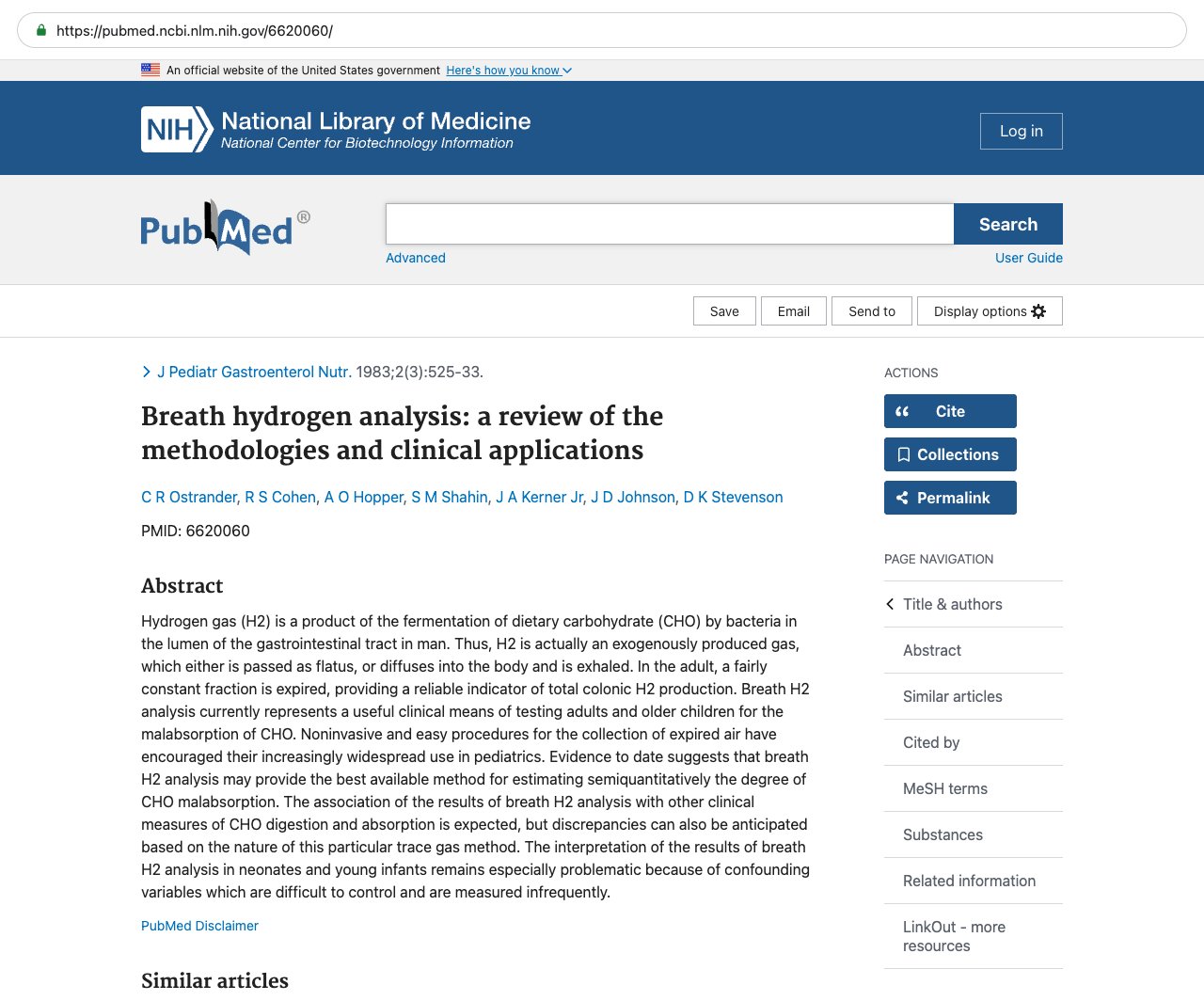
Hydrogen gas (H2) is a product of the fermentation of dietary carbohydrate (CHO) by bacteria in the lumen of the gastrointestinal tract in man. Thus, H2 is actually an exogenously produced gas, which either is passed as flatus, or diffuses into the body and is exhaled. In the adult, a fairly constant fraction is expired, providing a reliable indicator of total colonic H2 production. Breath H2 analysis currently represents a useful clinical means of testing adults and older children for the malabsorption of CHO. Noninvasive and easy procedures for the collection of expired air have encouraged their increasingly widespread use in pediatrics. Evidence to date suggests that breath H2 analysis may provide the best available method for estimating semiquantitatively the degree of CHO malabsorption. The association of the results of breath H2 analysis with other clinical measures of CHO digestion and absorption is expected, but discrepancies can also be anticipated based on the nature of this particular trace gas method. The interpretation of the results of breath H2 analysis in neonates and young infants remains especially problematic because of confounding variables which are difficult to control and are measured infrequently.
Source & links
Screenshot of the PubMed page
This page mirrors the published abstract (© the authors / publisher) for reference and citation. The canonical source is the PubMed record linked above. This is not medical advice.