2021 · Qi — Perspective of Molecular Hydrogen in the Treatment of Sepsis
Super-Abstract
In sepsis — the most common cause of death in intensive care units — molecular hydrogen (H₂) as a „medical gas“ shows a protective effect on several organs. The effect rests on anti-inflammatory, antioxidant and anti-apoptotic mechanisms. (Review, Current Pharmaceutical Design, 2021.)
Commentary
This paper is a review, not an experiment — it summarizes the state of research on why H₂ is investigated in sepsis. Sepsis is a life-threatening organ dysfunction resulting from a dysregulated immune response to an infection and remains the main cause of death in critically ill patients — to this day without any truly decisive therapy. The authors describe H₂ as a „novel medical gas“ that can, in animal models, mitigate the multiple organ injuries caused by sepsis. According to the authors, the underlying molecular pathways are not yet fully understood but are likely related to anti-inflammation, anti-oxidation, inhibition of programmed cell death (apoptosis), regulation of autophagy and several signaling pathways. Important for honesty: this is a theoretical, foundational overview that aims only to prepare a later clinical application — it provides no patient evidence of its own. It serves as evidence that H₂ is taken seriously as a research topic even in intensive care medicine.
Key quotes
- „As a novel medical gas, molecular hydrogen (H2) has a therapeutic effect on many diseases, such as sepsis.“ — classifying H₂ as a medical gas with a broad spectrum of action
- „H2 treatment exerts multiple biological effects, which can effectively improve multiple organ injuries caused by sepsis.“ — the central finding: protection of several organs in sepsis
- „the underlying molecular mechanisms of hydrogen involved in the treatment of sepsis remain elusive, which are likely related to anti-inflammation, anti-oxidation, anti-apoptosis, regulation of autophagy and multiple signaling pathways.“ — honest statement: mechanism not yet finally clarified
Our assessment
The paper shows that, beyond the known fields of application (sport, metabolism, neuro), H₂ is also discussed in highly acute intensive care medicine — evidence of the breadth of the mechanism „selective antioxidant + anti-inflammatory“. For us it is only marginally relevant: sepsis is a clinical emergency scenario (inhalation of high H₂ concentrations), not the field of everyday H₂ water — transferring it to consumer products is not permissible. Limitation, stated honestly: a pure review (evidence level 4), no study of its own, no patient data, and the authors themselves stress that the mechanism remains „elusive“ — still unresolved.
Study design
- Type: review · n: — (no cohort of its own) · Duration: — · H₂ delivery: predominantly inhalation / H₂-enriched solutions (summarized from primary studies)
- Result: qualitative — H₂ improves multiple organ injuries in animal models; mechanisms: anti-inflammatory, antioxidant, anti-apoptotic, autophagy regulation
Abstract
Sepsis is the main cause of death in critically ill patients with no effective treatment. Sepsis is lifethreatening organ dysfunction due to a dysregulated host response to infection. As a novel medical gas, molecular hydrogen (H2) has a therapeutic effect on many diseases, such as sepsis. H2 treatment exerts multiple biological effects, which can effectively improve multiple organ injuries caused by sepsis. However, the underlying molecular mechanisms of hydrogen involved in the treatment of sepsis remain elusive, which are likely related to anti-inflammation, anti-oxidation, anti-apoptosis, regulation of autophagy and multiple signaling pathways. This review can help better understand the progress of hydrogen in the treatment of sepsis, and provide a theoretical basis for the clinical application of hydrogen therapy in sepsis in the future.
Source & links
Screenshot of the PubMed page
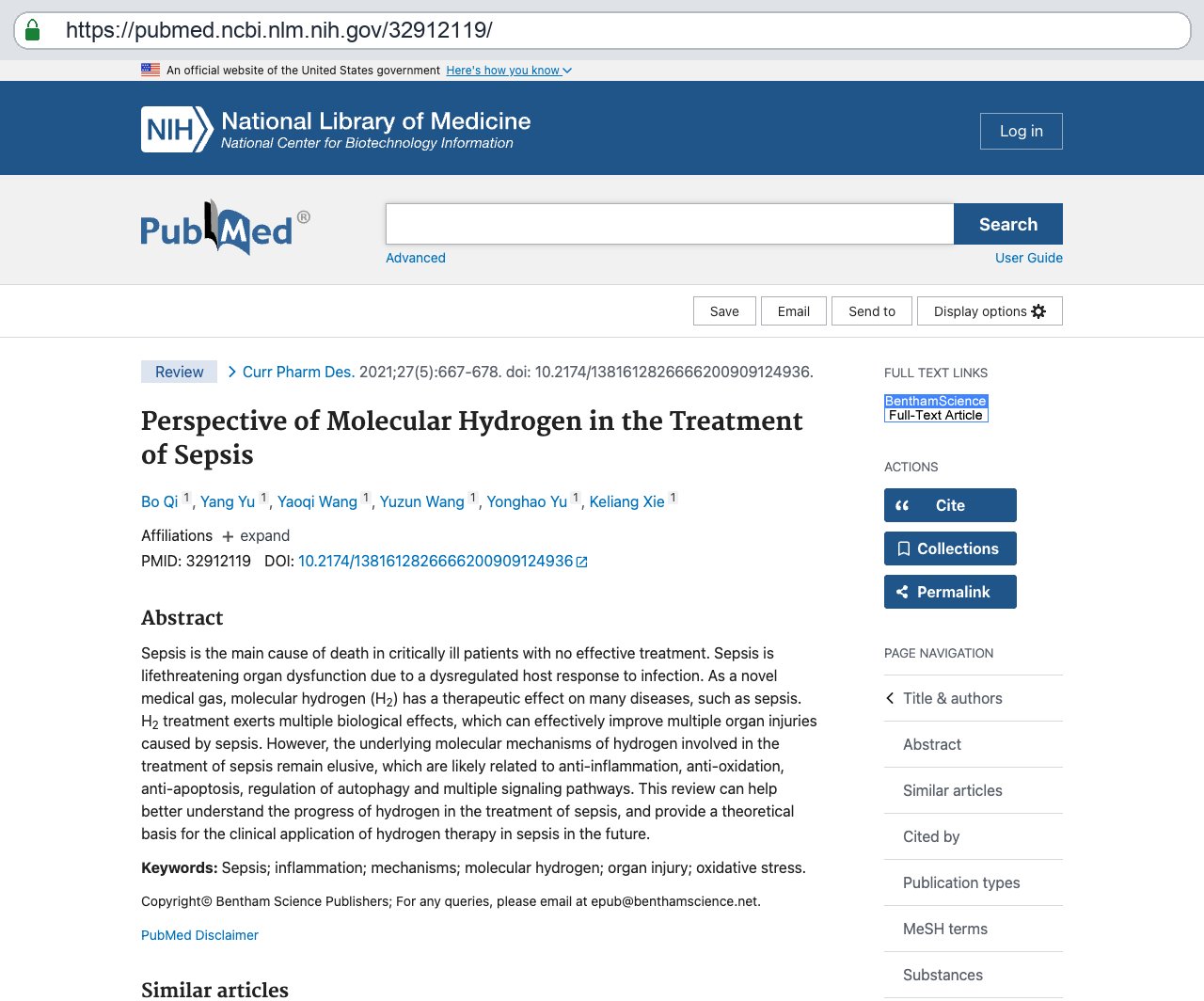
This page mirrors the published abstract (© the authors / publisher) for reference and citation. The canonical source is the PubMed record linked above. This is not medical advice.