2021 · Ostojic — Hydrogen Gas as an Exotic Performance-Enhancing Agent: Challenges and Opportunities
Super-Abstract
This review maps approximately two dozen studies on hydrogen (H₂) and exercise performance, finding promising ergogenic signals — but also highlighting the absence of a gold-standard protocol. H₂ — whether inhaled, drunk as hydrogen-rich water, or given intravenously — appears to benefit several exercise biomarkers, yet effect sizes are inconsistent and methodology varies widely. (Current Pharmaceutical Design, 2021.)
Commentary
Ostojic surveys the literature from PubMed, Web of Science, SCOPUS and JSTOR on H₂ and exercise. Around two dozen trials are identified, most published in the previous five years, with hydrogen-rich water as the most studied delivery route. The review covers outcomes including exercise-induced fatigue, oxidative stress markers, inflammatory cytokines and performance metrics. A recurring problem: studies differ markedly in H₂ dose, duration, and source — making direct comparison difficult. No single „gold-standard protocol” has emerged. The author notes that H₂ appears to favorably affect several exercise outcomes but is cautious: effect sizes need replication in larger, well-controlled trials. A regulatory aside is also raised — H₂ is not yet classified or regulated in sport, which could become relevant if ergogenic use scales up. As a narrative review without meta-analysis, no pooled effect sizes are provided.
Key quotes
- „Either administered as an inhalational gas, enteral hydrogen-rich water, or intravenous hydrogen-rich saline, H2 seems to favorably affect various exercise performance outcomes and biomarkers of exercise-associated fatigue, inflammation, and oxidative stress.“ — main finding: positive signals across all administration routes
- „It appears that the gold-standard protocol for applying H2 in the field of exercise science does not exist at the moment, with studies markedly differ in the dose of H2 administered, the duration of treatment, and the source of hydrogen.“ — key limitation of the field: no standardised protocol
- „H2 is a newfangled and rather effective performance-enhancing agent, yet its promising ergogenic potency has to be further validated and characterized in more well-controlled, appropriately sampled and longterm mechanistic trials.“ — cautious conclusion — promising but not proven
Our assessment
A useful overview of an emerging research niche, but several caveats apply. This is a narrative review — no meta-analysis, no pooled effect sizes. The author himself is a prominent H₂ researcher, which should be considered when reading the conclusions. The field is genuinely nascent: ~24 trials with heterogeneous designs are insufficient for definitive claims. The regulatory observation about H₂ in sport is interesting but speculative. Overall this review is informative for understanding the state of the field in 2020–2021, not for making strong efficacy claims.
Study design
- Type: narrative review · n: ~24 trials identified (literature analysis) · H₂ delivery: inhalation, hydrogen-rich water (oral), hydrogen-rich saline (IV) — all routes reviewed
- Result: narrative synthesis only; favorable signals for exercise performance, fatigue, oxidative stress and inflammation biomarkers across routes; no pooled effect sizes; no gold-standard protocol identified
Abstract
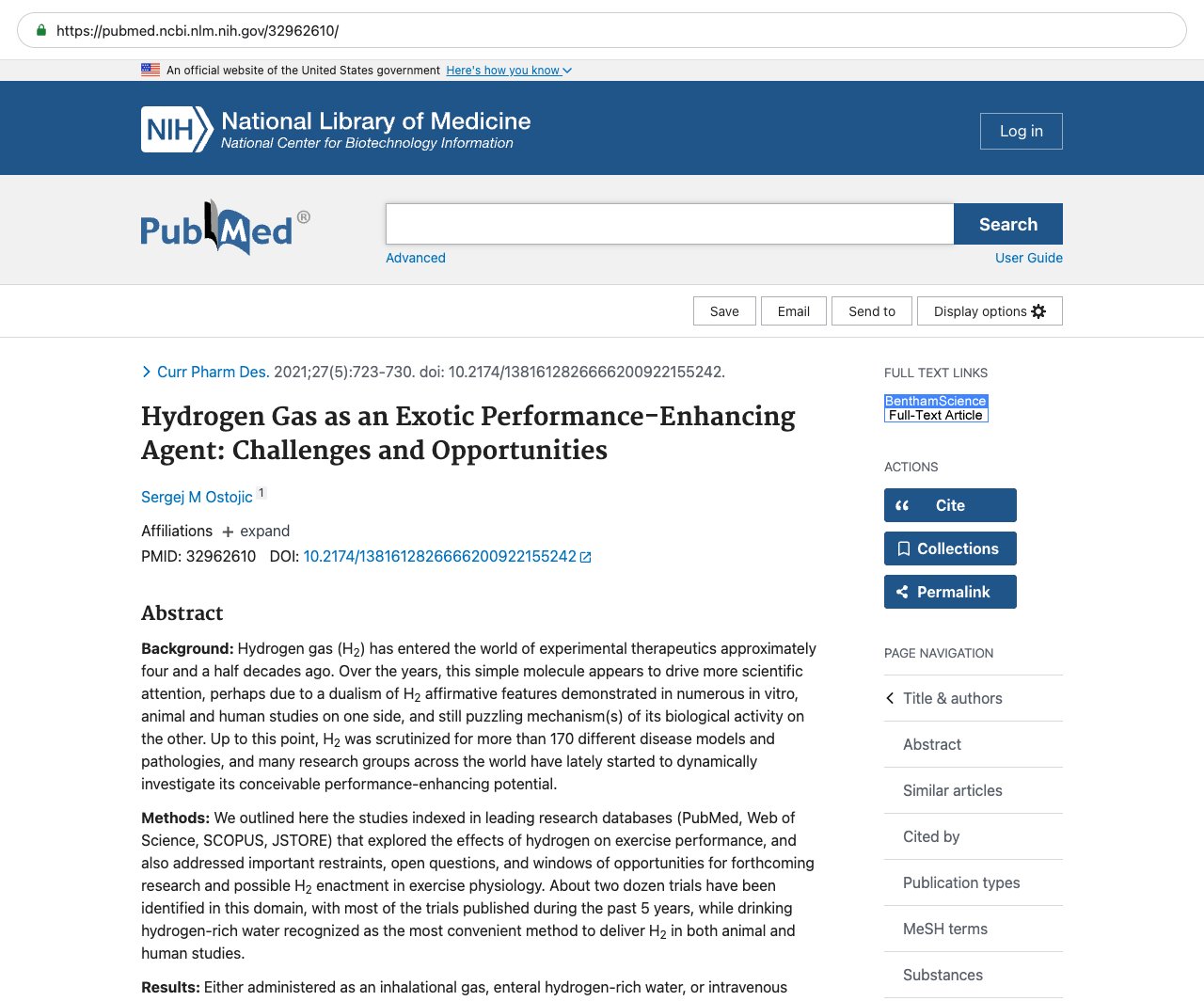
BACKGROUND: Hydrogen gas (H2) has entered the world of experimental therapeutics approximately four and a half decades ago. Over the years, this simple molecule appears to drive more scientific attention, perhaps due to a dualism of H2 affirmative features demonstrated in numerous in vitro, animal and human studies on one side, and still puzzling mechanism(s) of its biological activity on the other. Up to this point, H2 was scrutinized for more than 170 different disease models and pathologies, and many research groups across the world have lately started to dynamically investigate its conceivable performance-enhancing potential. METHODS: We outlined here the studies indexed in leading research databases (PubMed, Web of Science, SCOPUS, JSTORE) that explored the effects of hydrogen on exercise performance, and also addressed important restraints, open questions, and windows of opportunities for forthcoming research and possible H2 enactment in exercise physiology. About two dozen trials have been identified in this domain, with most of the trials published during the past 5 years, while drinking hydrogen-rich water recognized as the most convenient method to deliver H2 in both animal and human studies. RESULTS: Either administered as an inhalational gas, enteral hydrogen-rich water, or intravenous hydrogen-rich saline, H2 seems to favorably affect various exercise performance outcomes and biomarkers of exercise-associated fatigue, inflammation, and oxidative stress. Not all studies have shown corroborative effects, and it appears that the gold-standard protocol for applying H2 in the field of exercise science does not exist at the moment, with studies markedly differ in the dose of H2 administered, the duration of treatment, and the source of hydrogen. CONCLUSION: H2 is a newfangled and rather effective performance-enhancing agent, yet its promising ergogenic potency has to be further validated and characterized in more well-controlled, appropriately sampled and longterm mechanistic trials. Also, appropriate regulation of hydrogen utilization in sport as an exotic medical gas may require distinctive legislative actions of relevant regulatory agencies in the future.
Source & links
Screenshot of the PubMed page
This page mirrors the published abstract (© the authors / publisher) for reference and citation. The canonical source is the PubMed record linked above. This is not medical advice.