2013 · Ramachandran — An in silico analysis of troponin I mutations in hypertrophic cardiomyopathy of Indian origin
Super-Abstract
Four mutations in the Troponin I gene (including one novel mutation) were identified in Indian patients with hypertrophic cardiomyopathy (HCM), and in-silico structural modeling showed these mutations disrupt intermolecular hydrogen bonds within the troponin complex, reducing protein stability and subunit interactions. This is a computational genetics study; the hydrogen bonds mentioned are molecular structural chemistry, not therapeutic H₂. (PLoS ONE, 2013.)
Commentary
This is an in-silico (computational) study of genetic mutations causing hypertrophic cardiomyopathy (HCM), an autosomal dominant heart muscle disease. The study identified four Troponin I mutations in Indian HCM patients, modeled their effects on the troponin complex structure using X-ray crystallography data, and found that arginine-to-glutamine substitutions disrupt hydrogen bonds between troponin subunits — weakening the complex. The „hydrogen bonds“ here are fundamental protein biochemistry (H-bond interactions between amino acid residues), completely unrelated to dissolved molecular hydrogen gas (H₂) or hydrogen medicine. This paper appears in the H₂ database due to keyword matching. It contributes to genetic cardiology, not to H₂ research.
Key quotes
- „These mutations, especially the arginine to glutamine substitutions were found to result in local perturbations within the troponin complex by creating/removing inter/intra molecular hydrogen bonds with troponin T and troponin C.“ — hydrogen bonds = protein biochemistry, not molecular H₂ therapy
- „This has led to a decrease in the protein stability and loss of important interactions between the three subunits.“ — functional consequence of the mutations on cardiac protein structure
- „It could have a significant impact on the disease progression when coupled with allelic heterogeneity which was observed in the cases carrying these mutations.“ — clinical relevance of the structural findings for HCM
Our assessment
This is a computational/in-silico genetics study on hypertrophic cardiomyopathy mutations with no relevance to therapeutic molecular hydrogen (H₂). The hydrogen bonds described are protein biochemistry. The paper contributes to understanding genetic HCM in South Asian populations, which is valuable for cardiology. No conclusions about H₂ therapy can be drawn. This entry is indexed in the H₂ database due to keyword overlap only.
Study design
- Type: in-silico structural modeling / computational genetics · Model: X-ray crystal structure (PDB ID: 1JIE) used for troponin complex modeling · H₂ relevance: none (hydrogen = H-bonds in protein structure)
- Mutations analyzed: Pro82Ser, Arg98Gln, Arg141Gln, Arg162Gln in Troponin I · Result: arginine-to-glutamine substitutions disrupt inter/intramolecular H-bonds, reduce troponin complex stability
Abstract
Hypertrophic Cardiomyopathy (HCM) is an autosomal dominant disorder of the myocardium which is hypertrophied resulting in arrhythmias and heart failure leading to sudden cardiac death (SCD). Several sarcomeric proteins and modifier genes have been implicated in this disease. Troponin I, being a part of the Troponin complex (troponin I, troponin C, troponin T), is an important gene for sarcomeric function. Four mutations (1 novel) were identified in Indian HCM cases, namely, Pro82Ser, Arg98Gln, Arg141Gln and Arg162Gln in Troponin I protein, which are in functionally significant domains. In order to analyse the effect of the mutations on protein stability and protein-protein interactions within the Troponin complex, an in silico study was carried out. The freely available X-ray crystal structure (PDB ID: 1JIE) was used as the template to model the protein followed by loop generation and development of troponin complex for both the troponin I wild type and four mutants (NCBI ID: PRJNA194382). The structural study was carried out to determine the effect of mutation on the structural stability and protein-protein interactions between three subunits in the complex. These mutations, especially the arginine to glutamine substitutions were found to result in local perturbations within the troponin complex by creating/removing inter/intra molecular hydrogen bonds with troponin T and troponin C. This has led to a decrease in the protein stability and loss of important interactions between the three subunits. It could have a significant impact on the disease progression when coupled with allelic heterogeneity which was observed in the cases carrying these mutations. However, this can be further confirmed by functional studies on protein levels in the identified cases.
Source & links
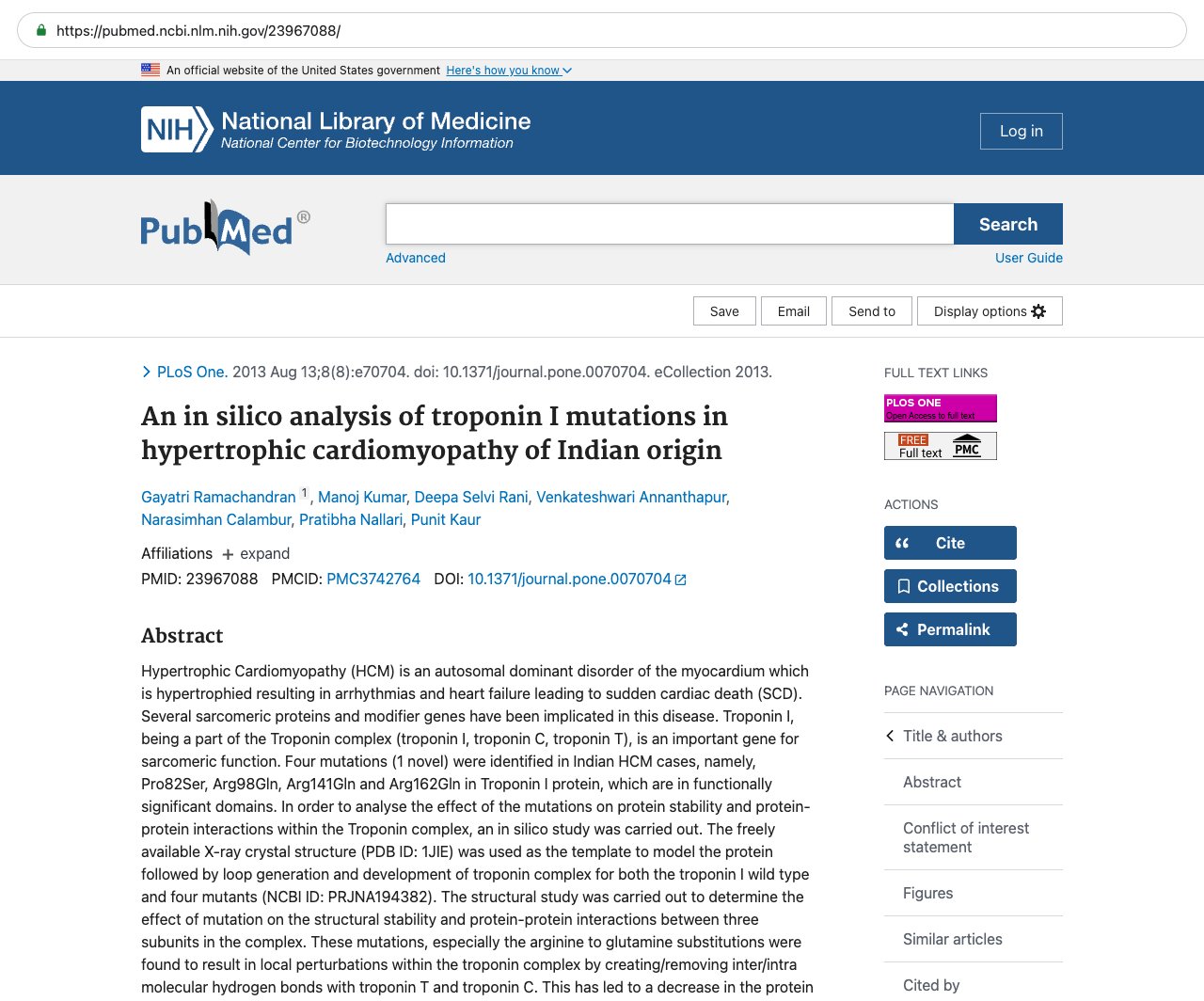
Screenshot of the PubMed page
This page mirrors the published abstract (© the authors / publisher) for reference and citation. The canonical source is the PubMed record linked above. This is not medical advice.