2021 · Shaik et al. — An Overview of Ovarian Cancer: Molecular Processes Involved and Development of Target-based Chemotherapeutics.
Super-Abstract
Ovarian cancer remains one of the deadliest gynaecological cancers, with most patients diagnosed at an advanced stage; this review surveys the molecular processes driving the disease and the development of targeted chemotherapeutics to address them. The role of H₂ in this context is indirect — it appears in the broader indication scope — but the review itself is largely a molecular oncology overview. (Current Topics in Medicinal Chemistry, 2021.)
Commentary
This review primarily concerns ovarian cancer biology and the landscape of targeted drug development — not H₂ therapy. It covers genomics, proteomics, and radiomics contributions, as well as the challenge of drug resistance and recurrence. The link to H₂ research in the study list is through the cancer and womens-health indications; however, the abstract does not explicitly discuss H₂. The review is a general oncology synthesis useful as background context for understanding cancer molecular pathways, but it should not be read as evidence for H₂ in ovarian cancer treatment. No H₂ intervention data appear in the abstract.
Key quotes
- „Most patients with it do not show any symptoms until the disease has moved to an advanced stage.“ — the central clinical challenge with ovarian cancer: late diagnosis
- „Drug-resistance and the recurrence of this disease are still a problem.“ — the persistent limitation of current targeted therapies
- „Some theoretical approaches have also been applied. A description of such methods and their success in this direction is also covered in this review.“ — the review also covers computational/theoretical drug discovery approaches
Our assessment
This is a molecular oncology review covering ovarian cancer biology and chemotherapeutic development. It does not present H₂-specific trial or mechanistic data for ovarian cancer. Its presence in an H₂ study collection reflects thematic overlap at the indication level (cancer, womens-health), but readers seeking evidence for H₂ in ovarian cancer will not find it in this paper. The review is valuable as background oncology literature but has limited direct relevance to H₂ therapy.
Study design
- Type: narrative review of ovarian cancer molecular biology and targeted drug development · n: n/a (literature synthesis) · H₂ delivery: not applicable (H₂ not a focus of this review)
- Result: comprehensive overview of ovarian cancer pathways and drug resistance; no H₂ intervention data reported; primarily relevant as oncology background context
Abstract
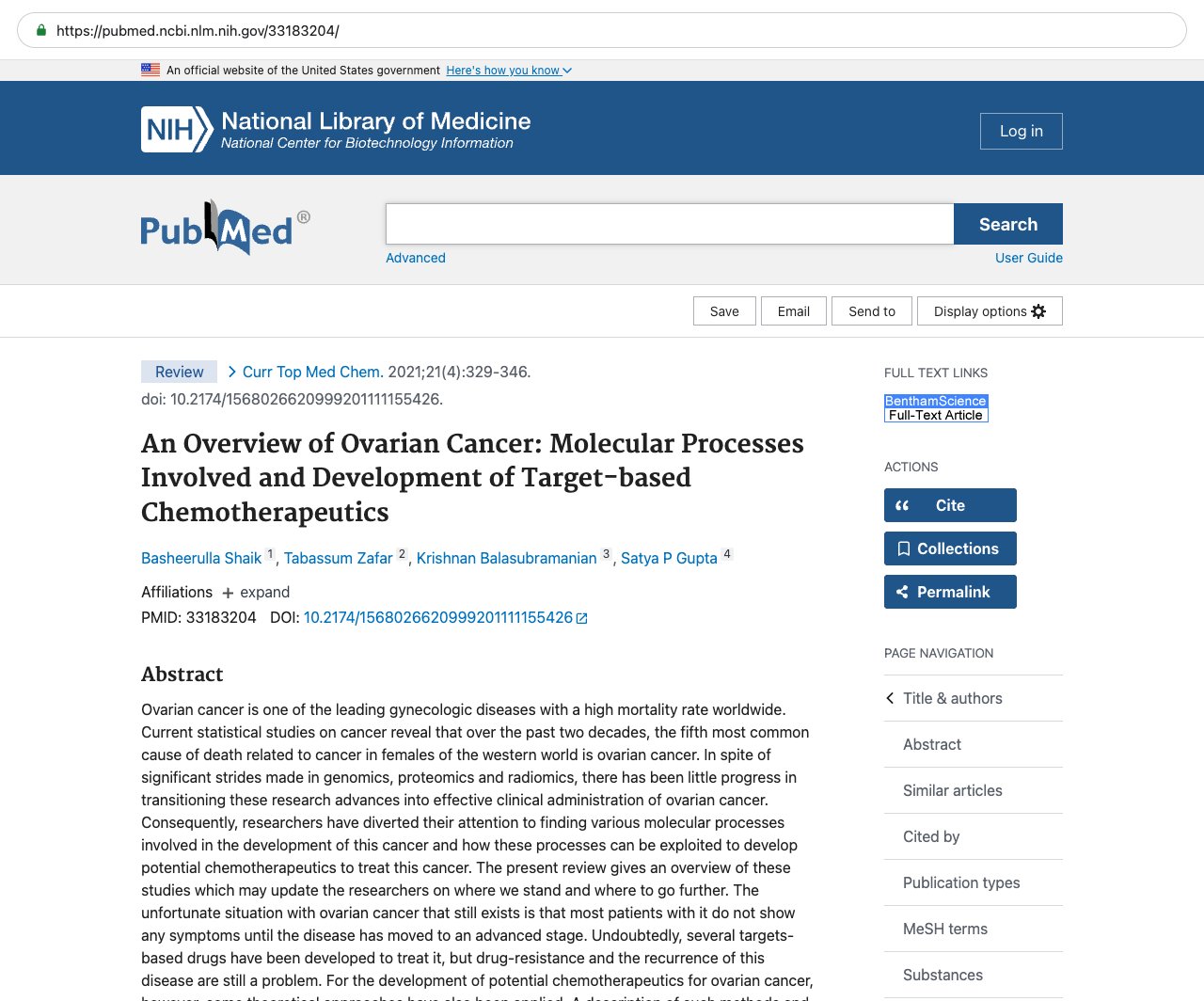
Ovarian cancer is one of the leading gynecologic diseases with a high mortality rate worldwide. Current statistical studies on cancer reveal that over the past two decades, the fifth most common cause of death related to cancer in females of the western world is ovarian cancer. In spite of significant strides made in genomics, proteomics and radiomics, there has been little progress in transitioning these research advances into effective clinical administration of ovarian cancer. Consequently, researchers have diverted their attention to finding various molecular processes involved in the development of this cancer and how these processes can be exploited to develop potential chemotherapeutics to treat this cancer. The present review gives an overview of these studies which may update the researchers on where we stand and where to go further. The unfortunate situation with ovarian cancer that still exists is that most patients with it do not show any symptoms until the disease has moved to an advanced stage. Undoubtedly, several targets-based drugs have been developed to treat it, but drug-resistance and the recurrence of this disease are still a problem. For the development of potential chemotherapeutics for ovarian cancer, however, some theoretical approaches have also been applied. A description of such methods and their success in this direction is also covered in this review.
Source & links
Screenshot of the PubMed page
This page mirrors the published abstract (© the authors / publisher) for reference and citation. The canonical source is the PubMed record linked above. This is not medical advice.