2010 · Shen — Hydrogen as a novel and effective treatment of acute carbon monoxide poisoning.
Super-Abstract
This hypothesis paper proposes that inhaled molecular hydrogen (H₂) could be an effective treatment for acute carbon monoxide (CO) poisoning. The authors reason that since CO poisoning triggers oxidative stress, free radical damage and neuroinflammation — and since H₂ has been shown to selectively neutralise the most damaging radicals (hydroxyl radical, peroxynitrite) — H₂ therapy may protect the brain from CO-induced injury. This is a theoretical proposal, not a clinical or animal study.
Commentary
This is a short hypothesis paper published in Medical Hypotheses — a journal that publishes reasoned theoretical propositions, not original experiments. The authors draw on early (2007–2009) preclinical H₂ research showing neuroprotective effects in ischaemia-reperfusion models and transpose this mechanistic logic onto CO poisoning, where oxidative damage follows a similar pathway. The reasoning is plausible and internally consistent, but no experimental data specific to H₂ and CO poisoning are presented. As of the paper's publication, the hypothesis had not been tested. It should be read as a call for further research, not as evidence of efficacy.
Key quotes
- „A recent study provided evidence that hydrogen inhalation exerted antioxidant and anti-apoptotic effects and protected the brain against ischemia-reperfusion injury by selectively reducing hydroxyl radical and peroxynitrite.“ — the mechanistic basis borrowed from ischaemia-reperfusion research
- „The mechanisms underlying the brain injury after acute carbon monoxide poisoning are interwoven with multiple factors including oxidative stress, free radicals, and neuronal nitric oxide synthase as well as abnormal inflammatory responses.“ — the pathophysiological rationale for applying H₂ to CO poisoning
- „We hypothesize that hydrogen therapy may be an effective, simple, economic and novel strategy in the treatment of acute carbon monoxide poisoning.“ — the central hypothesis — untested at time of publication
Our assessment
This is a theoretical hypothesis paper — not a clinical trial or animal experiment. It contains no original data on H₂ and CO poisoning. The mechanistic logic is reasonable: CO poisoning and ischaemia-reperfusion share oxidative pathways, and H₂ has shown antioxidant effects in the latter. However, this is not a human study, and the hypothesis had not been experimentally validated at the time of publication. It represents a starting point for investigation, not a demonstrated treatment.
Study design
- Type: hypothesis / theory paper · n: n/a (no experimental data) · H₂ delivery: inhalation (proposed)
- Result: theoretical proposal that H₂ inhalation may protect against CO-induced brain injury via selective hydroxyl radical and peroxynitrite scavenging; no empirical findings
Abstract
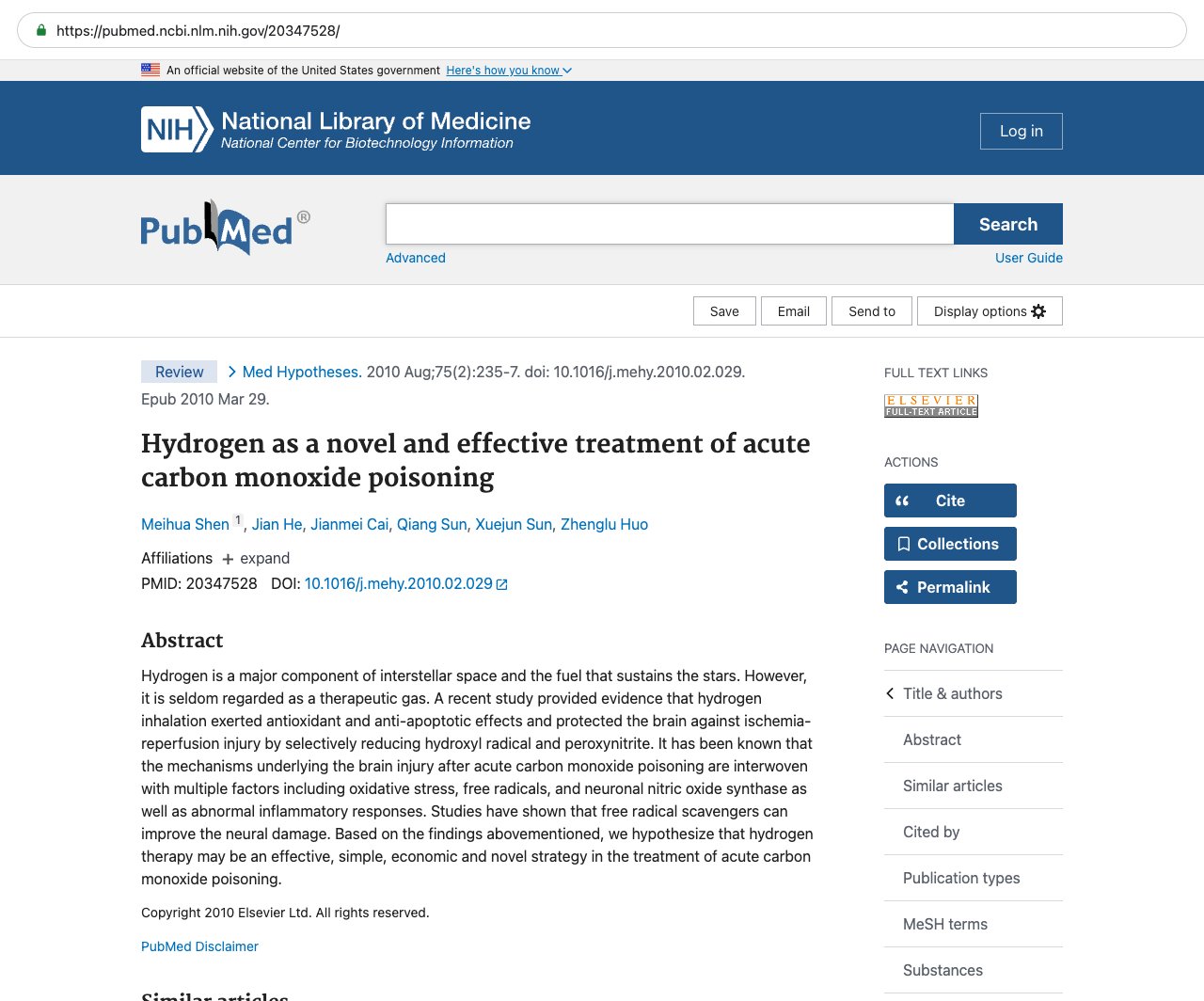
Hydrogen is a major component of interstellar space and the fuel that sustains the stars. However, it is seldom regarded as a therapeutic gas. A recent study provided evidence that hydrogen inhalation exerted antioxidant and anti-apoptotic effects and protected the brain against ischemia-reperfusion injury by selectively reducing hydroxyl radical and peroxynitrite. It has been known that the mechanisms underlying the brain injury after acute carbon monoxide poisoning are interwoven with multiple factors including oxidative stress, free radicals, and neuronal nitric oxide synthase as well as abnormal inflammatory responses. Studies have shown that free radical scavengers can improve the neural damage. Based on the findings abovementioned, we hypothesize that hydrogen therapy may be an effective, simple, economic and novel strategy in the treatment of acute carbon monoxide poisoning.
Source & links
Screenshot of the PubMed page
This page mirrors the published abstract (© the authors / publisher) for reference and citation. The canonical source is the PubMed record linked above. This is not medical advice.