2026 · Shi — New progress in hydrogen-synergistic diagnostic and therapeutic nanoplatforms for tumor treatment.
Super-Abstract
This review maps the emerging field of hydrogen-synergistic diagnostic and therapeutic nanoplatforms (HSDT-NPs): engineered nanomaterials that combine H₂ therapy with other cancer treatment strategies to increase specificity and effectiveness at the tumor site. The paper is a technical overview of nanoplatform design strategies — no human clinical data are presented; this is entirely a laboratory and animal research domain. (Biomaterials Science, 2026.)
Commentary
The core concept here is that H₂ alone, delivered conventionally, may not reach sufficient concentrations at tumor sites or may have limited selectivity. Nanoplatform engineering attempts to solve this: encapsulating H₂-generating materials alongside other therapeutic agents (phototherapy, chemotherapy, immunotherapy) to achieve synergistic killing of cancer cells while protecting normal tissue. This is a rapidly evolving area in materials science and oncology, but it is important to note that virtually all described systems are at the preclinical stage — animal models, in-vitro assays — and are far from clinical use. The review is useful for researchers but contains no information directly applicable to patients or clinicians today.
Key quotes
- „HSDT-NPs, a novel type of tool for tumor treatment, integrate hydrogen therapy with various tumor diagnostic and therapeutic strategies, significantly enhancing the efficiency and specificity of tumor treatment.“ — the paper's core claim: nanoplatforms amplify H₂'s selectivity and therapeutic reach in cancer
- „not only improving the efficacy of traditional therapies on tumors but also effectively protecting normal cells.“ — a key rationale for H₂-combination approaches: reducing collateral damage to healthy tissue
- „Our work aims to offer new perspectives and innovative approaches for advancing cancer treatment based on hydrogen therapy research.“ — stated scope: future perspectives, not current clinical recommendations
Our assessment
Evidence level: narrative/technical review (EV 4). No original experimental data; no human trial data; summarizes laboratory and animal research on H₂ nanoplatforms in oncology. Limitations clearly stated: all described nanoplatform systems are preclinical; human translation faces major hurdles (nanoparticle safety, immune response, manufacturing, regulatory approval); H₂ production at tumor site via nanoplatforms is a promising concept but unproven in humans. Bottom line: an interesting forward-looking review for researchers working at the intersection of nanomedicine and H₂ biology — not actionable clinical evidence.
Study design
- Type: narrative/technical review · n: n/a (literature synthesis of nanoplatform studies) · H₂ delivery: nanoplatform-mediated in-situ H₂ generation at tumor site (review of various material types)
- Result: no pooled effect sizes; classification of HSDT-NP construction strategies by material type; overview of synergistic mechanisms (H₂ + phototherapy, chemotherapy, immunotherapy); all evidence from in-vitro/in-vivo preclinical models
Abstract
Hydrogen synergistic therapy, an emerging and promising strategy in tumor treatment, has been bolstered by nanotechnology to establish a stable and multifunctional foundation for its implementation. Hydrogen-synergistic diagnostic and therapeutic nanoplatforms (HSDT-NPs), a novel type of tool for tumor treatment, integrate hydrogen therapy with various tumor diagnostic and therapeutic strategies, significantly enhancing the efficiency and specificity of tumor treatment, which is crucial for achieving precision therapy at the tumor site. The construction of HSDT-NPs relies on the design of hydrogen nanomaterials and the selection and assembly of synergistic units. Through HSDT-NPs, the synergistic effects between hydrogen therapy and other strategies are markedly enhanced, not only improving the efficacy of traditional therapies on tumors but also effectively protecting normal cells. Based on different material types, this study explores the construction strategies of HSDT-NPs. Subsequently, focusing on the collaborative treatment modes, it delves into the synergistic mechanisms of HSDT-NPs. Our work aims to offer new perspectives and innovative approaches for advancing cancer treatment based on hydrogen therapy research.
Source & links
Screenshot of the PubMed page
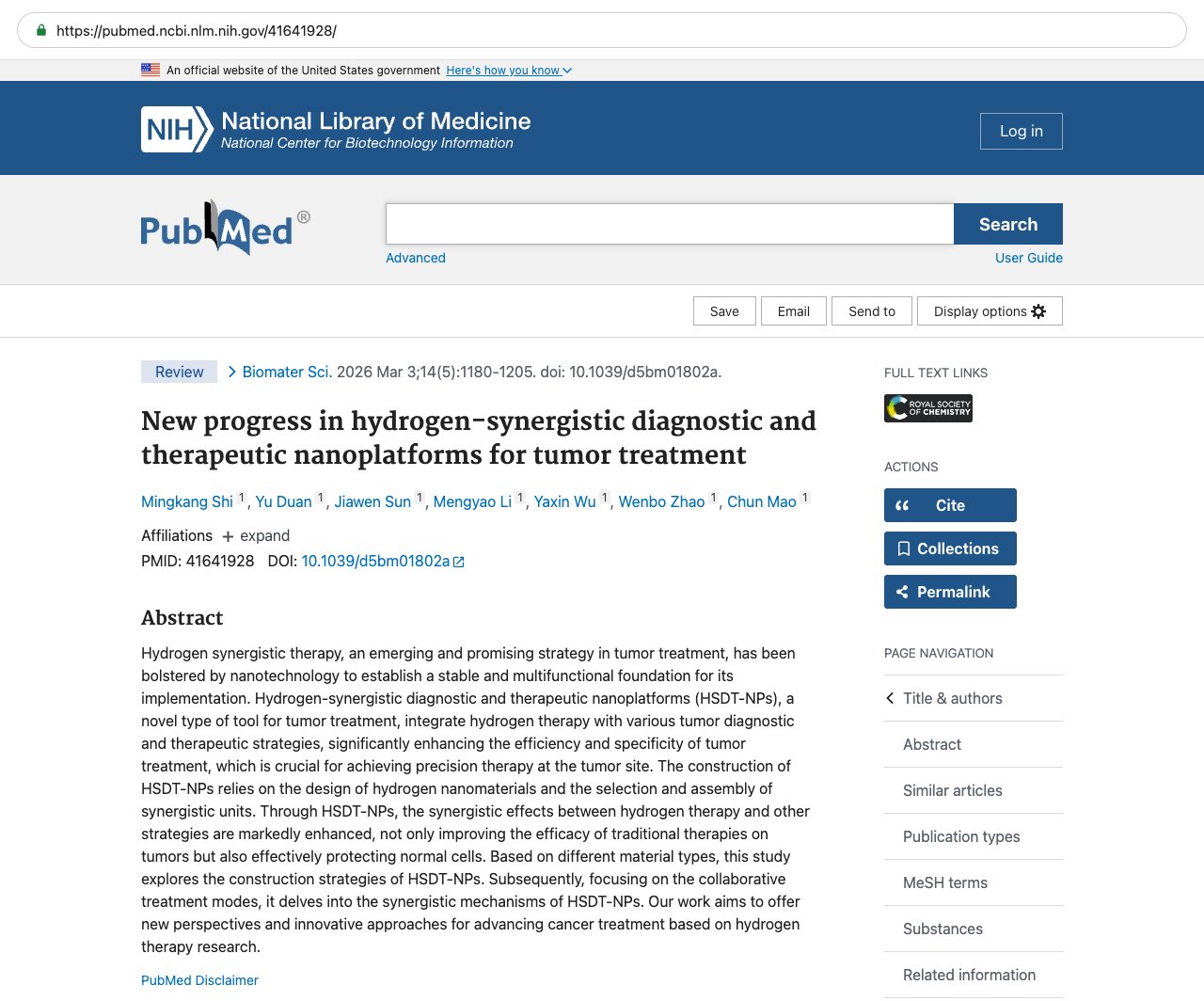
This page mirrors the published abstract (© the authors / publisher) for reference and citation. The canonical source is the PubMed record linked above. This is not medical advice.