2011 · Slaba — Variation in Lunar Neutron Dose Estimates
Super-Abstract
This theoretical physics study calculates how much albedo neutrons — reflected cosmic rays — contribute to radiation exposure on the lunar surface, and shows that hydrogen-rich shielding materials such as polyethylene can reduce that exposure. The study is pure radiation physics modelling; it has no connection to molecular hydrogen therapy in humans. (Physics in Medicine and Biology, 2011.)
Commentary
When primary cosmic rays hit the lunar surface, they produce secondary albedo neutrons that contribute to the total radiation dose received by astronauts or future lunar inhabitants. This study uses the Monte Carlo-compatible transport code HZETRN2010 to model these contributions across a range of radiation environments, shielding materials, and regolith compositions. A key finding: hydrogen-rich materials such as polyethylene (C₂H₄) or liquid hydrogen are effective neutron shields because hydrogen nuclei efficiently slow down fast neutrons through elastic collisions. The connection to „hydrogen“ here is entirely physical — it refers to hydrogen atoms in shielding material, not molecular hydrogen (H₂) gas or water used therapeutically. This paper is not related to H₂ medicine.
Key quotes
- „It is also shown that polyethylene or other hydrogen-rich materials may be used to mitigate the albedo neutron exposure.“ — hydrogen's role as a neutron shield in space — a physical, not therapeutic, application
- „the albedo neutron contribution to effective dose is found to vary between 1-32%, with the environmental model, shielding material and shielding thickness being the driving factors that determine the exact contribution.“ — the main quantitative finding on neutron dose variability
- „a single percentage number for characterizing the albedo neutron contribution to effective dose can be misleading.“ — caution against oversimplification in radiation risk estimates
Our assessment
This is a theoretical/computational study in space radiation physics. It is not a study of molecular hydrogen therapy or of any biological effect of H₂. Its relevance to this database is marginal: the mention of „hydrogen“ refers exclusively to hydrogen atoms as a component of shielding materials. Honest note: this paper should not be cited in support of H₂ health claims. It belongs to aerospace medicine and radiation protection physics, not H₂ biomedicine.
Study design
- Type: computational/theoretical study · Model: HZETRN2010 Monte Carlo radiation transport code, lunar surface environments · H₂ relevance: hydrogen-rich materials as neutron shields — not H₂ therapy
- Result: albedo neutron contribution to effective dose varies 1–32% depending on environment, shielding, and thickness; polyethylene and liquid hydrogen are optimal shielding materials
Abstract
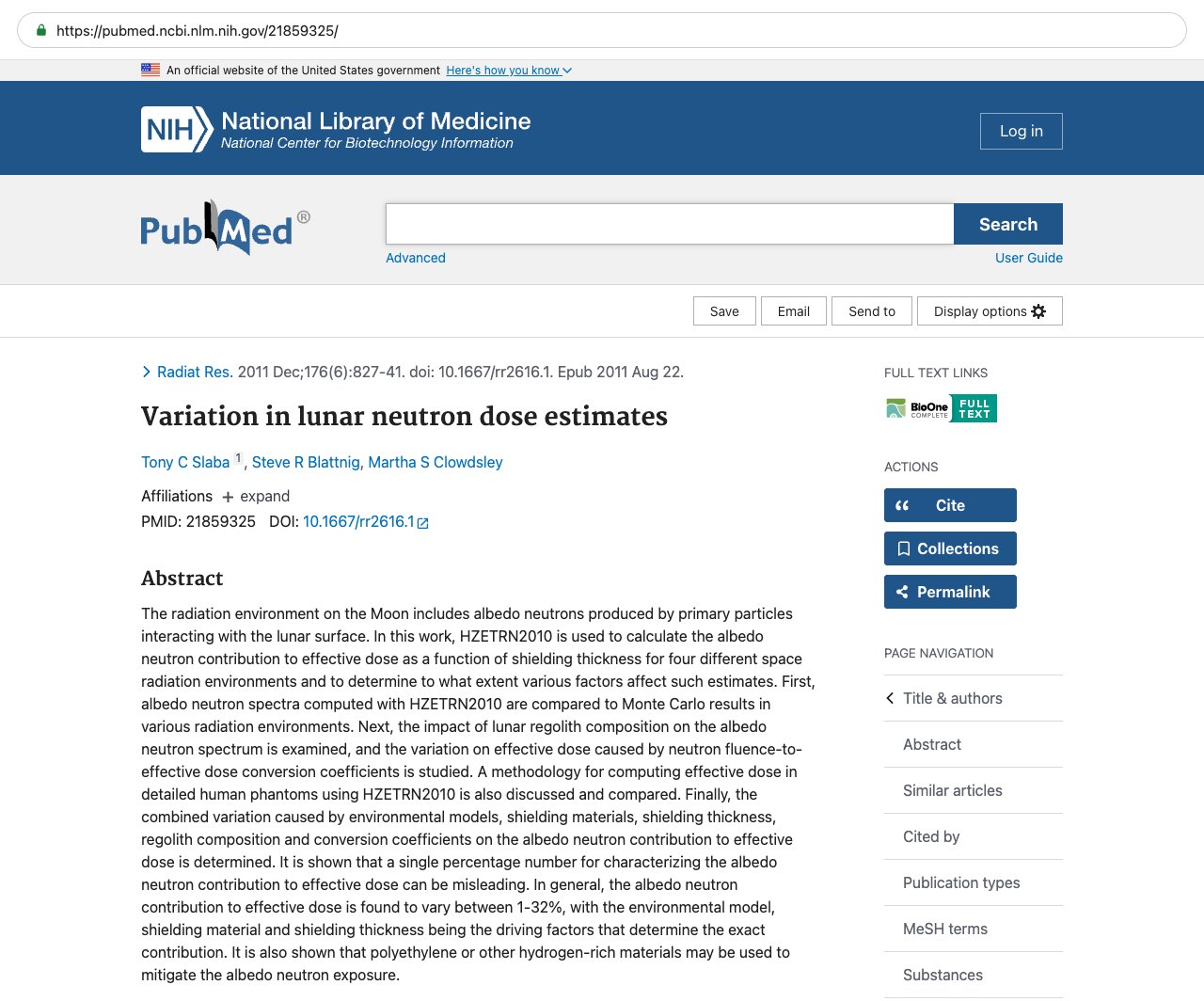
The radiation environment on the Moon includes albedo neutrons produced by primary particles interacting with the lunar surface. In this work, HZETRN2010 is used to calculate the albedo neutron contribution to effective dose as a function of shielding thickness for four different space radiation environments and to determine to what extent various factors affect such estimates. First, albedo neutron spectra computed with HZETRN2010 are compared to Monte Carlo results in various radiation environments. Next, the impact of lunar regolith composition on the albedo neutron spectrum is examined, and the variation on effective dose caused by neutron fluence-to-effective dose conversion coefficients is studied. A methodology for computing effective dose in detailed human phantoms using HZETRN2010 is also discussed and compared. Finally, the combined variation caused by environmental models, shielding materials, shielding thickness, regolith composition and conversion coefficients on the albedo neutron contribution to effective dose is determined. It is shown that a single percentage number for characterizing the albedo neutron contribution to effective dose can be misleading. In general, the albedo neutron contribution to effective dose is found to vary between 1-32%, with the environmental model, shielding material and shielding thickness being the driving factors that determine the exact contribution. It is also shown that polyethylene or other hydrogen-rich materials may be used to mitigate the albedo neutron exposure.
Source & links
Screenshot of the PubMed page
This page mirrors the published abstract (© the authors / publisher) for reference and citation. The canonical source is the PubMed record linked above. This is not medical advice.