2005 · Sobko et al. — Birth-Related Increase in Intracolonic Hydrogen Gas and Nitric Oxide as Indicator of Host-Microbial Interactions
Super-Abstract
This study measured endogenous hydrogen gas produced by gut bacteria in 32 newborns during the first 6 months of life to monitor intestinal colonization — it is not an H₂ therapy study. Intracolonic H₂ was used as a marker of bacterial fermentation activity to understand the development of the infant microbiome and its potential link to allergy development. (Allergy, 2005.)
Commentary
In the newborn gut, bacterial colonization begins at birth, and these bacteria produce hydrogen gas through fermentation. This study developed a minimally invasive technique to repeatedly sample colonic gas (H₂ and NO) in newborns to track the dynamics of microbiome establishment. The rise of intracolonic H₂ paralleled the rise of short-chain fatty acids (both byproducts of fermentation), while NO (a mucosal immune marker) rose later. The study contributes to understanding early host-microbiome interactions relevant to allergy, inflammatory bowel disease, and immune development. No therapeutic H₂ was administered; the H₂ was endogenously produced by gut bacteria.
Key quotes
- „Colonic H2, NO and faecal SCFAs were undetectable at birth. The H2 and SCFAs appeared within 24 h and continued to increase during the 6 months follow-up.“ — timeline of microbiome establishment: bacterial fermentation H₂ begins within 24 hours of birth
- „Intracolonic measurements of H2 and NO may be useful to monitor the developmental colonization process as well as mucosal responses.“ — conclusion: endogenous H₂ as a microbiome monitoring tool, not therapy
Our assessment
Off-topic for H₂ therapy. This study investigates endogenous, bacterially produced colonic H₂ as a biomarker of gut microbiome colonization in newborns. No H₂ was administered. The H₂ measured is entirely produced by intestinal bacteria. While this is interesting microbiome research published in a respected allergy journal, it has no connection to therapeutic molecular hydrogen medicine.
Study design
- Type: prospective observational study with novel minimally invasive gas sampling technique · n: 32 healthy newborns (vaginal and cesarean delivery) · H₂ delivery: none — endogenous colonic H₂ measured at 5 time points from birth to 6 months
- Result: H₂ and SCFAs undetectable at birth, appeared within 24 h; NO low until days 3–5, then sharply increased; colonization pattern differed by delivery mode (vaginal vs. cesarean)
Abstract
BACKGROUND: Bacterial colonization of the intestine early in life might have implications for allergy development. We studied early host-bacterial interactions in the gut by simultaneous measurements of hydrogen gas (H(2)) and faecal short chain fatty acid pattern (SCFAs), i.e. bacterial products, as well as of nitric oxide (NO), a marker of mucosal immune activation. METHODS: A novel minimally invasive technique was used for repeated measurements of luminal colonic H(2) and NO in 32 healthy newborn infants delivered vaginally or by Caesarean section. Luminal gas was sampled and analysed at five occasions: immediately after birth, day 1, days 3-5, 1 and 5-6 months after birth. RESULTS: Colonic H(2), NO and faecal SCFAs were undetectable at birth. The H(2) and SCFAs appeared within 24 h and continued to increase during the 6 months follow-up. Nitric oxide remained very low until 3-5 days after birth at which time it markedly increased. In some apparently healthy infants NO transiently reached levels similar to those seen in adults with inflammatory bowel disease. CONCLUSION: Intracolonic measurements of H(2) and NO may be useful to monitor the developmental colonization process as well as mucosal responses.
Source & links
Screenshot of the PubMed page
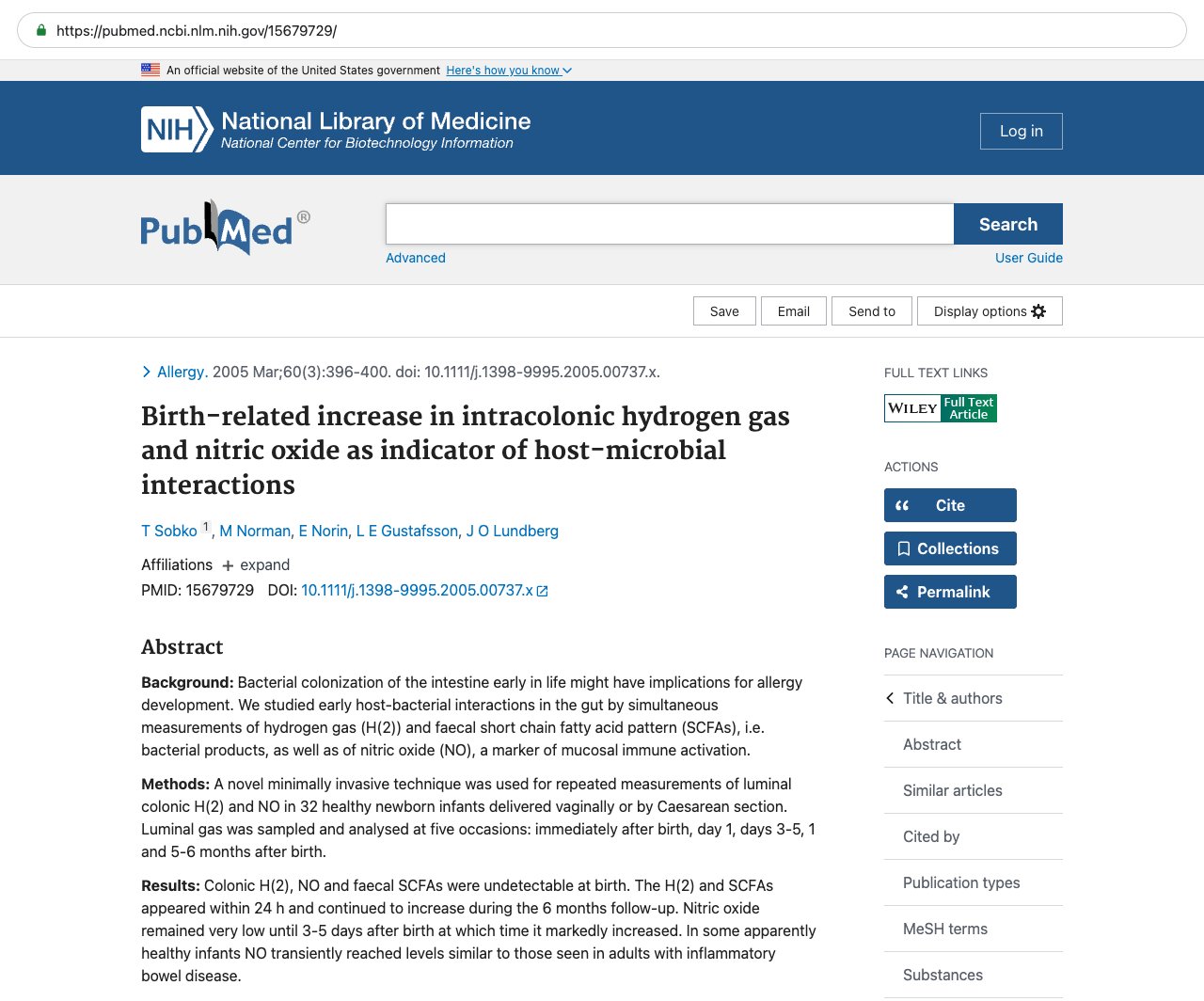
This page mirrors the published abstract (© the authors / publisher) for reference and citation. The canonical source is the PubMed record linked above. This is not medical advice.