2025 · Neykhonji — Exploring the Potential of H₂ Therapy in Reducing Surgical Complications: A Review on Anti-inflammatory, Antioxidant, and Anti-fibrotic Mechanisms
Super-Abstract
Molecular hydrogen shows anti-inflammatory, antioxidant, and anti-fibrotic properties that could make it a candidate for preventing post-surgical adhesions — one of the most common and debilitating complications after abdominal and pelvic surgery. This review, based on a systematic search of PubMed and Google Scholar, traces the molecular pathways by which H₂ may dampen the inflammatory cascade that drives adhesion formation. (Current Pharmaceutical Design, 2025.)
Commentary
Post-surgical adhesions are a major unresolved problem: fibrous tissue bands that form between organs and surfaces after an operation can cause chronic pain, bowel obstruction, and infertility — yet no pharmacological standard of care exists. Neykhonji et al. make the case that hydrogen's triple mechanism (free-radical scavenging, cytokine suppression, anti-fibrosis) maps neatly onto the three drivers of adhesion formation (oxidative stress, inflammation, fibrosis). The review is thoughtfully framed around the surgical wound response rather than simply listing H₂ studies. However, the proposed application — intraperitoneal or systemic H₂ administration around the time of surgery — remains entirely untested in humans; all mechanistic evidence comes from animal and cellular models of related conditions (pancreatitis, I/R injury, respiratory diseases). The authors themselves call for clinical trials to assess efficacy and safety, which underlines how early-stage this concept is.
Key quotes
- „Molecular hydrogen exhibits selective antioxidant, anti-inflammatory, and anti-fibrotic properties, holding potential for the treatment and prevention of various disorders, including acute pancreatitis, respiratory diseases, and ischemia-reperfusion damage conditions, among others.“ — summary of established preclinical evidence that motivates the surgical hypothesis
- „The surgical injury initiates an inflammatory response characterized by immune cell mobilization and an increase in pro-inflammatory cytokine levels, thereby promoting adhesion formation.“ — mechanistic link between surgery, inflammation, and adhesion
- „Hydrogen is demonstrated to attenuate the early inflammatory response by down-regulating proinflammatory cytokines alongside its anti-oxidative and anti-fibrotic effects.“ — core conclusion: H₂ addresses all three adhesion-forming drivers
Our assessment
This is a hypothesis-generating review, not a clinical proof of concept. The authors make a scientifically coherent argument, but post-surgical adhesion prevention by H₂ has not been tested in humans. All supporting evidence is indirect — drawn from animal and cell studies on inflammation and fibrosis in contexts other than adhesion. The review is useful as a map of mechanistic rationale and as a call to action for researchers, but it should not be read as evidence that H₂ prevents adhesions in patients. A conflict-of-interest or funding statement was not apparent from the available data.
Study design
- Type: narrative review · n: n/a (literature analysis) · H₂ delivery: various preclinical modes discussed (inhalation, drinking water, intraperitoneal — from cited studies)
- Result: no original data; synthesis of preclinical literature supporting anti-inflammatory, antioxidant, and anti-fibrotic mechanisms of H₂ relevant to post-surgical adhesion biology; the authors conclude that clinical trials are needed
Abstract
OBJECTIVE: This review demonstrates the potential role of hydrogen in post-surgical adhesion prevention and calls for further investigation of its molecular pathways, as well as clinical studies to assess its efficacy and safety in a therapeutic setting. METHODS: PubMed and Google Scholar were extensively queried to investigate the potential role of hydrogen in preventing post-surgical adhesions and its underlying mechanisms. RESULTS: Molecular hydrogen exhibits selective antioxidant, anti-inflammatory, and anti-fibrotic properties, holding potential for the treatment and prevention of various disorders, including acute pancreatitis, respiratory diseases, and ischemia-reperfusion damage conditions, among others. Postoperative adhesion is associated with chronic pain, organ dysfunction, and acute complications, fundamentally rooted in inflammation, oxidative stress, and fibrosis. The surgical injury initiates an inflammatory response characterized by immune cell mobilization and an increase in pro-inflammatory cytokine levels, thereby promoting adhesion formation. CONCLUSION: Hydrogen is demonstrated to attenuate the early inflammatory response by down-regulating proinflammatory cytokines alongside its anti-oxidative and anti-fibrotic effects. As a potential therapeutic agent for post-surgical adhesions, hydrogen warrants additional investigation to elucidate the exact molecular pathways responsible for its observed efficacy and safety.
Source & links
Screenshot of the PubMed page
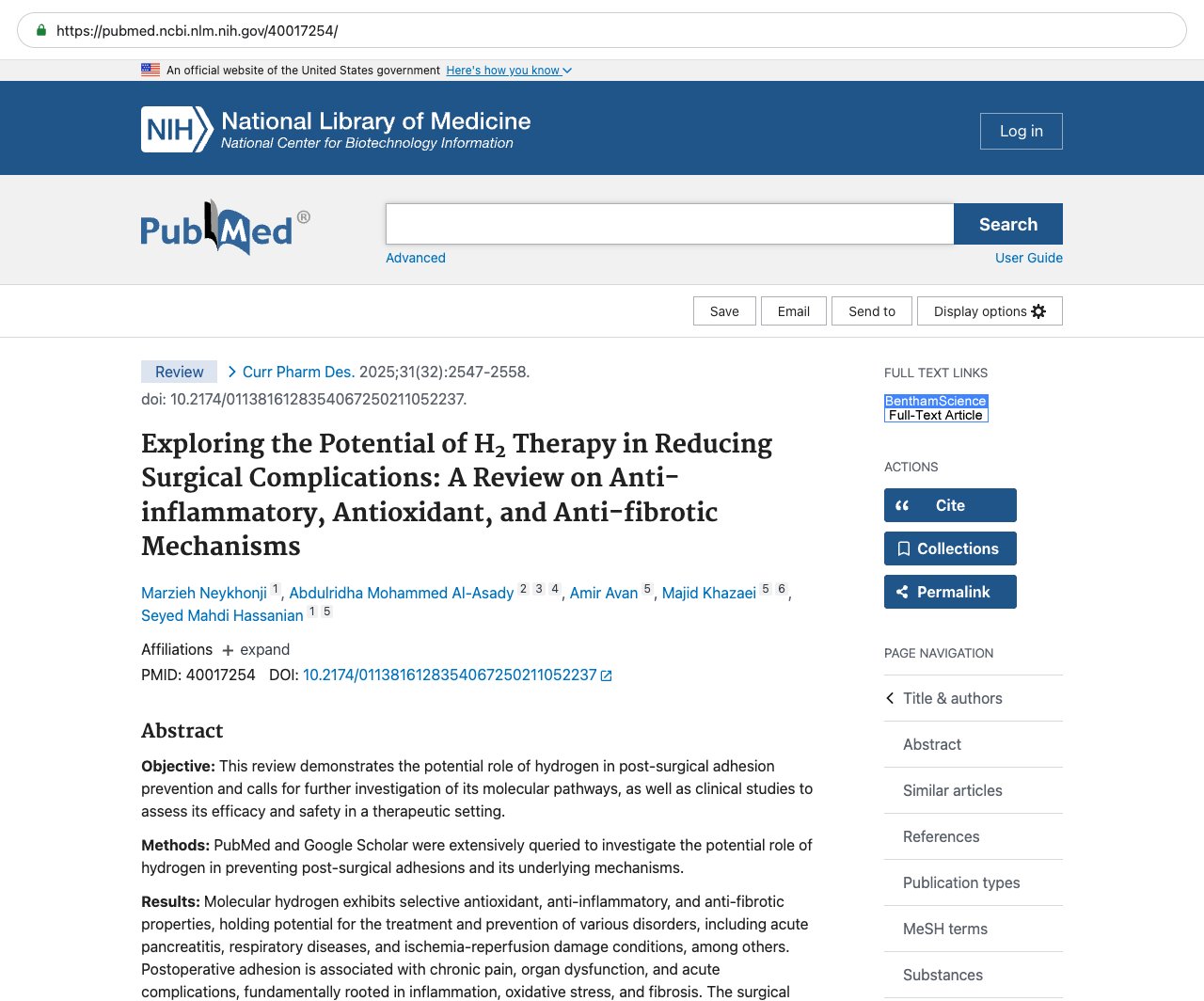
This page mirrors the published abstract (© the authors / publisher) for reference and citation. The canonical source is the PubMed record linked above. This is not medical advice.