2010 · Sugiyama — Use of laser speckle flowgraphy in ocular blood flow research.
Super-Abstract
This technical review describes laser speckle flowgraphy (LSFG), a non-contact imaging technique for measuring blood flow in the optic nerve head, choroid, retina and iris. The review explains the physics, calibration, and clinical protocols of LSFG — including a note that its blood flow index correlates with results from the „hydrogen gas clearance method”, an older calibration technique. Note: this paper has no connection to molecular hydrogen (H₂) therapy — the mention of hydrogen refers to a physiological measurement technique.
Commentary
This is a technical methods review of LSFG — an ophthalmology imaging tool that uses laser speckle patterns to estimate ocular blood flow velocity. The „hydrogen gas clearance method” mentioned as a validation reference is an old research technique in which inert H₂ gas is used as a tracer to measure blood flow by monitoring how quickly it clears from tissue — it has nothing to do with molecular hydrogen as an antioxidant therapy. The paper has no therapeutic H₂ content. Its presence in an H₂ database is an indexing artefact caused by the mention of hydrogen gas in a purely technical, non-therapeutic measurement context.
Key quotes
- „Normalized blur (NB) shows a good correlation with tissue blood flow rates determined with the microsphere method in the retina, choroid or iris, as well as blood flow rates determined with the hydrogen gas clearance method in the optic nerve head.“ — the only mention of hydrogen — as a calibration reference technique, not a therapeutic agent
- „The LSFG method is suitable for monitoring the time-course of change in the tissue circulation at the same site in the same eye at various intervals, ranging from seconds to months.“ — the primary clinical utility of LSFG for longitudinal ocular blood flow monitoring
- „Unresolved issues concern the effect of pupil size on measurement results, the effects of various stimulations, and how to measure choroidal and retinal blood flow velocity separately.“ — the authors' honest acknowledgement of current limitations of LSFG
Our assessment
This is a technical ophthalmology methods review — it has no relevance to molecular hydrogen (H₂) therapy. The mention of „hydrogen gas” refers to an inert tracer used in blood flow physiology research, not to any therapeutic application of H₂. Its presence in an H₂ database is an indexing artefact. No health claims regarding H₂ can be derived from this publication.
Study design
- Type: technical methods review · n: n/a (review of LSFG instrumentation and protocols) · H₂ relevance: none (hydrogen gas clearance method mentioned only as a historical calibration comparator)
- Result: description of LSFG physics, indices (NB, SBR), calibration procedures, clinical protocols, and limitations; no H₂ therapy data
Abstract
Laser speckle flowgraphy (LSFG) allows for the quantitative estimation of blood flow in the optic nerve head, choroid, retina and iris in vivo. It was developed to facilitate the non-contact analysis of ocular blood flow in living eyes, utilizing the laser speckle phenomenon. The technique uses a fundus camera, a diode laser, an image sensor, an infrared charge-coupled device (CCD) camera and a high-resolution digital CCD camera. Normalized blur (NB), an approximate reciprocal of speckle contrast, represents an index of blood velocity, and shows a good correlation with tissue blood flow rates determined with the microsphere method in the retina, choroid or iris, as well as blood flow rates determined with the hydrogen gas clearance method in the optic nerve head. The square blur ratio (SBR), another index for quantitative estimation of blood velocity, is proportional to the square of the NB. The SBR is theoretically a more exact measurement which is proportional to velocity, whereas the NB is an approximation. Normalized blur was calculated in earlier versions of LSFG because of technical limitations; the SBR is used in current versions of the LSFG instrument. As these values are in arbitrary units, they should not be used to make comparisons between different eyes or different sites in an eye. Clinical protocols, calibration, evaluation procedures and possible limitations of the LSFG technique are described and the results of ocular blood flow studies using LSFG are briefly summarized. The LSFG method is suitable for monitoring the time-course of change in the tissue circulation at the same site in the same eye at various intervals, ranging from seconds to months. Unresolved issues concern the effect of pupil size on measurement results, the effects of various stimulations, and how to measure choroidal and retinal blood flow velocity separately without using the blue-component of argon laser.
Source & links
Screenshot of the PubMed page
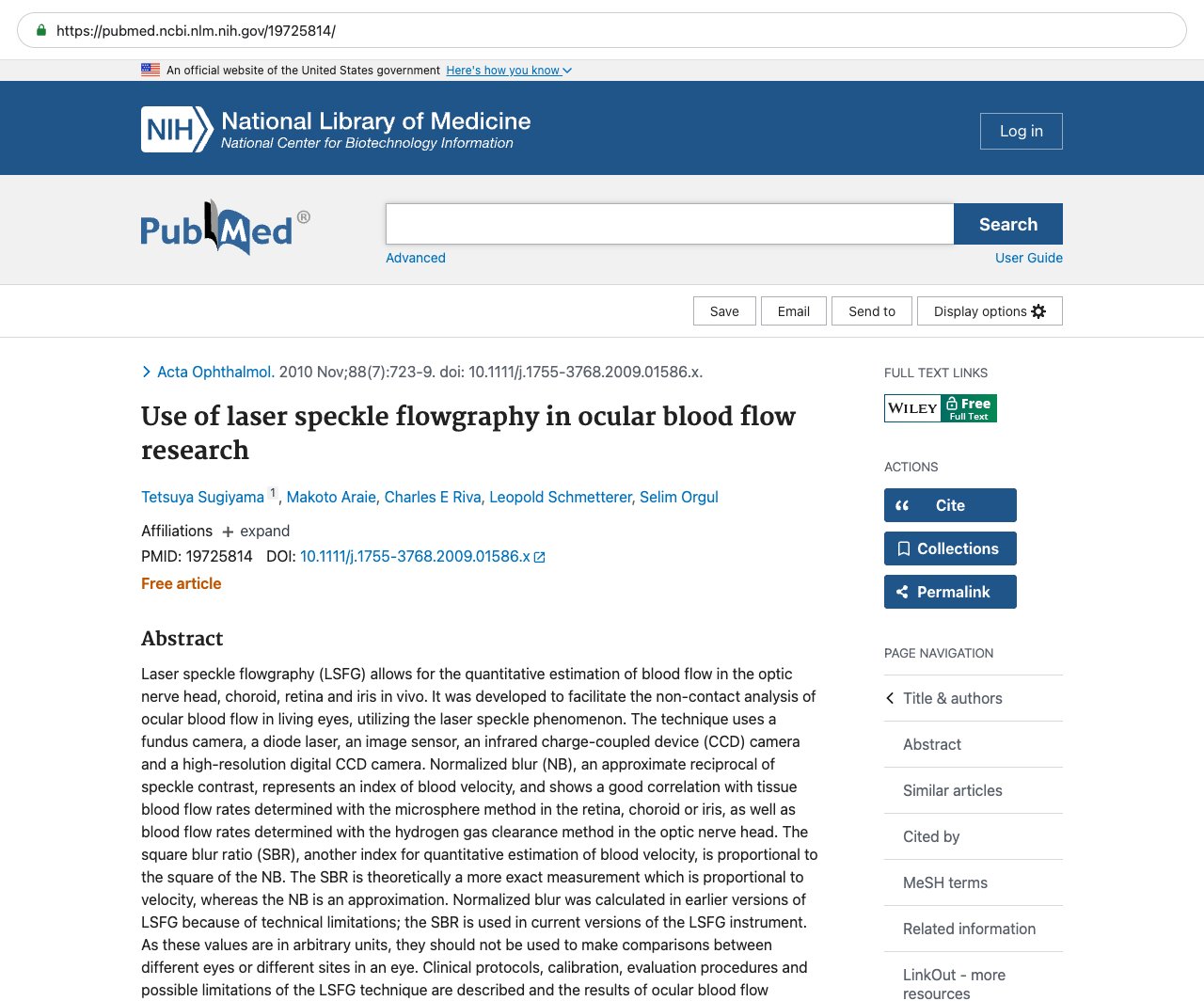
This page mirrors the published abstract (© the authors / publisher) for reference and citation. The canonical source is the PubMed record linked above. This is not medical advice.