2014 Pharmacology & therapeutics Review / Meta-analysis InhalationSaline / IVBath / TopicalDrinking (HRW)
2014 · Ohta — Molecular hydrogen as a preventive and therapeutic medical gas: initiation, development and potential of hydrogen medicine.
Super-Abstract
One of the founding papers of hydrogen medicine, authored by Shigeo Ohta, summarises how H₂ was discovered to react with harmful hydroxyl radicals in cells — and why this makes it a candidate for preventing and treating a wide range of diseases. The review covers multiple delivery routes, animal experiments, and early clinical examinations, while acknowledging that serious human evidence is still accumulating.
Commentary
Shigeo Ohta is one of the original authors who demonstrated in 2007 that molecular hydrogen can selectively neutralise hydroxyl radicals without disturbing normal cellular redox signalling. This 2014 review builds on that foundation, cataloguing in-vitro, animal, and emerging clinical data. It argues that H₂ is unique among antioxidants: small enough to penetrate any membrane, mild enough not to interfere with beneficial reactive oxygen species. Multiple delivery methods are discussed (inhalation, hydrogen-rich water, intravenous saline, baths, eye drops). The review also points to gene-expression regulation as a second — and arguably more important — mechanism beyond direct radical scavenging. As a review by a key proponent of hydrogen medicine, it should be read with awareness that it synthesises a field still maturing, and clinical trial evidence cited is largely from early-phase or observational studies.
Key quotes
- „H2 rapidly diffuses into tissues and cells, and it is mild enough neither to disturb metabolic redox reactions nor to affect signaling reactive oxygen species; therefore, there should be no or little adverse effects of H2.“ — core pharmacological argument for H₂'s safety profile
- „H2 reduces oxidative stress not only by direct reactions with strong oxidants, but also indirectly by regulating various gene expressions.“ — the dual mechanism: direct radical scavenging + gene regulation
- „Owing to its great efficacy and lack of adverse effects, H2 has promising potential for clinical use against many diseases.“ — the overall conclusion — promising but not yet proven at scale
Our assessment
This is an influential narrative review by a founder of the field, offering a broad synthesis of H₂ biology and early clinical data. Its strength is mechanistic depth and historical context. Limitations: it is not a systematic review or meta-analysis; the author is deeply invested in the field; clinical evidence cited ranges from strong to very preliminary. The paper correctly characterises H₂ research as promising but not yet conclusive for most human disease applications — a position that remains accurate today.
Study design
- Type: narrative review · Coverage: in-vitro, animal, and early clinical studies · H₂ delivery routes: inhalation, hydrogen-rich water (drinking), intravenous H₂ saline, bath, eye drops
- Result: narrative synthesis; mechanisms identified: selective hydroxyl radical scavenging + gene expression regulation (anti-inflammatory, anti-apoptotic, metabolic stimulation); multiple delivery methods shown effective in preclinical models; some early clinical data discussed
Abstract
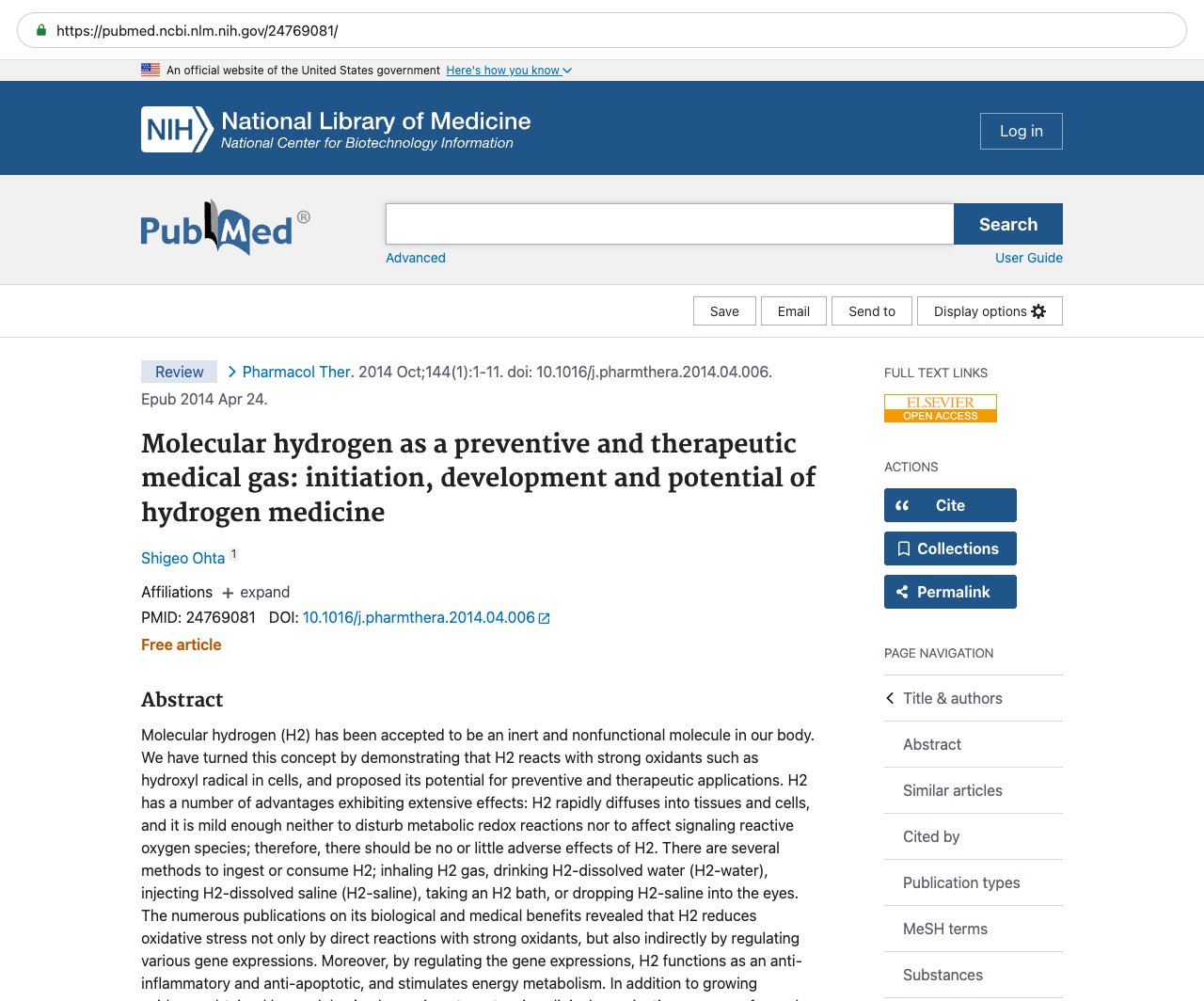
Molecular hydrogen (H2) has been accepted to be an inert and nonfunctional molecule in our body. We have turned this concept by demonstrating that H2 reacts with strong oxidants such as hydroxyl radical in cells, and proposed its potential for preventive and therapeutic applications. H2 has a number of advantages exhibiting extensive effects: H2 rapidly diffuses into tissues and cells, and it is mild enough neither to disturb metabolic redox reactions nor to affect signaling reactive oxygen species; therefore, there should be no or little adverse effects of H2. There are several methods to ingest or consume H2; inhaling H2 gas, drinking H2-dissolved water (H2-water), injecting H2-dissolved saline (H2-saline), taking an H2 bath, or dropping H2-saline into the eyes. The numerous publications on its biological and medical benefits revealed that H2 reduces oxidative stress not only by direct reactions with strong oxidants, but also indirectly by regulating various gene expressions. Moreover, by regulating the gene expressions, H2 functions as an anti-inflammatory and anti-apoptotic, and stimulates energy metabolism. In addition to growing evidence obtained by model animal experiments, extensive clinical examinations were performed or are under investigation. Since most drugs specifically act to their targets, H2 seems to differ from conventional pharmaceutical drugs. Owing to its great efficacy and lack of adverse effects, H2 has promising potential for clinical use against many diseases.
Source & links
Screenshot of the PubMed page
This page mirrors the published abstract (© the authors / publisher) for reference and citation. The canonical source is the PubMed record linked above. This is not medical advice.