2026 Medicina (Kaunas, Lithuania) Pilot / Observational Human H₂ therapy Inhalation Surgery & AnesthesiaNeurology
2026 · Sung et al. — Perioperative Hydrogen Inhalation and Postoperative Pain After Endoscopic Discectomy: A Pilot Non-Randomized Clinical Study with Exploratory Murine Data
Super-Abstract
In a small non-randomised pilot study of endoscopic disc surgery, patients who inhaled hydrogen during the operation had lower pain scores than controls at three of six postoperative time points: arrival in the recovery unit, 1 hour and 1 month. Intraoperative fentanyl and rescue analgesic use were also lower with hydrogen. The comparison is weak: groups were formed by enrolment period, the study was open-label, and original records for 12 of the 25 hydrogen-period patients could no longer be retrieved, so only 25 of 37 enrolled patients were analysed. (Medicina, 2026.)
Commentary
Pain after endoscopic discectomy may combine surgical pain with pre-existing radicular symptoms, and clinical evidence for hydrogen as a perioperative analgesic is limited. This open-label, non-randomised pilot study enrolled 37 patients in two consecutive periods, 25 in a hydrogen period followed by 12 in a control period. Because original outcome records for 12 hydrogen-period participants could no longer be retrieved, the analysis included 25 patients (13 hydrogen, 12 control). Hydrogen was given via nasal cannula as a 66.7% H₂/33.3% O₂ source gas at 2 L/min, with an estimated inspired H₂ of about 4%. Per full text, it ran throughout surgery, and controls received standard oxygen or air by nasal cannula. Pain was rated on a numerical rating scale before surgery, at recovery unit arrival, at 1, 6, 12 and 24 hours and at 1 month; per full text this was the primary outcome. Fentanyl during surgery and rescue analgesic use were secondary outcomes. A parallel mouse nerve-injury experiment (6 per group) tested 14 days of daily inhalation.
Key quotes
- „After Holm adjustment, pain scores were lower with H2 at PACU arrival (difference, -3.21; adjusted p = 0.002), 1 h (-2.42; adjusted p = 0.004), and 1 month (-3.45; adjusted p < 0.001).“ — the time points where pain differed after correction for multiple tests
- „Because original outcome records for 12 H2-period participants could no longer be retrieved at the time of manuscript preparation, the complete-case clinical analysis included 25 source-verifiable participants (H2, n = 13; control, n = 12).“ — the missing records for 12 patients, all from the hydrogen period
- „Perioperative H2 inhalation was associated with lower pain scores at selected time points and reduced analgesic requirements. These preliminary findings require confirmation in randomized trials.“ — the authors' conclusion, worded as an association
Our assessment
The study points to lower early pain and lower opioid use with hydrogen, but its design cannot separate hydrogen from other differences between the groups. Limitations: treatment was assigned by enrolment period, not at random, and per full text neither patients nor clinicians were blinded. The missing records concern nearly half of the hydrogen group, and per full text the authors state that selection bias cannot be excluded. Only 25 patients were analysed. Controls received oxygen or air rather than a sham gas mixture, and the inspired hydrogen concentration was not measured. Pain differed at 3 of 6 postoperative time points; per full text there was no significant difference at 6, 12 or 24 hours, and the authors call the 1-month difference unexpected. No adverse events were documented in the analysed patients. The mouse data are exploratory and cannot confirm the clinical result.
Study design
- Type: open-label, non-randomised pilot study with two consecutive enrolment periods, plus exploratory mouse experiment · n: 37 enrolled (25 H₂, 12 control), 25 analysed (13 H₂, 12 control) · H₂ delivery: 66.7% H₂/33.3% O₂ via nasal cannula at 2 L/min (estimated inspired H₂ about 4%), per full text during surgery
- Comparator: standard oxygen or air via nasal cannula (per full text), enrolled in a later period
- Result: pain (NRS) lower with H₂ at recovery unit arrival (difference -3.21, adjusted p = 0.002), 1 h (-2.42, adjusted p = 0.004) and 1 month (-3.45, adjusted p < 0.001); per full text not significant at 6, 12 or 24 h. Per full text, fentanyl 265.38 vs. 347.92 μg (p = 0.044), rescue analgesia in 5 of 13 vs. 10 of 12 patients (p = 0.041). No adverse events documented. Mice: higher paw withdrawal thresholds with H₂
Abstract
Background and Objectives: Postoperative pain after endoscopic discectomy may reflect acute surgical nociception superimposed on pre-existing radicular symptoms. Molecular hydrogen (H2) has antioxidant and anti-inflammatory properties, but clinical evidence for perioperative analgesia is limited. We evaluated the association between perioperative H2 inhalation and postoperative pain and analgesic requirements. Materials and Methods: This open-label, non-randomized pilot study enrolled 37 patients in two consecutive periods (H2, n = 25; control, n = 12). Because original outcome records for 12 H2-period participants could no longer be retrieved at the time of manuscript preparation, the complete-case clinical analysis included 25 source-verifiable participants (H2, n = 13; control, n = 12). H2 was delivered via nasal cannula as a 66.7% H2/33.3% O2 source gas at 2 L/min (estimated inspired H2 approximately 4%). Pain was evaluated with a numerical rating scale (NRS) preoperatively, at post-anesthesia care unit (PACU) arrival, at 1, 6, 12, and 24 h, and at 1 month. Longitudinal scores were analyzed using generalized estimating equations with Holm-adjusted comparisons. A parallel exploratory murine chronic constriction injury (CCI) experiment (n = 6/group) assessed mechanical allodynia over 14 days of daily H2 inhalation. Results: The group-by-time interaction was significant (Wald χ2(6) = 56.68, p < 0.001). After Holm adjustment, pain scores were lower with H2 at PACU arrival (difference, -3.21; adjusted p = 0.002), 1 h (-2.42; adjusted p = 0.004), and 1 month (-3.45; adjusted p < 0.001). Intraoperative fentanyl use and rescue analgesic use were also lower in the H2 group; no adverse events were documented in the analyzed cohort. In the murine CCI experiment, H2-treated mice showed higher ipsilateral paw withdrawal thresholds than air-exposed controls. Conclusions: Perioperative H2 inhalation was associated with lower pain scores at selected time points and reduced analgesic requirements. These preliminary findings require confirmation in randomized trials. Trial registration: ClinicalTrials.gov NCT05476575.
Source & links
Screenshot of the PubMed page
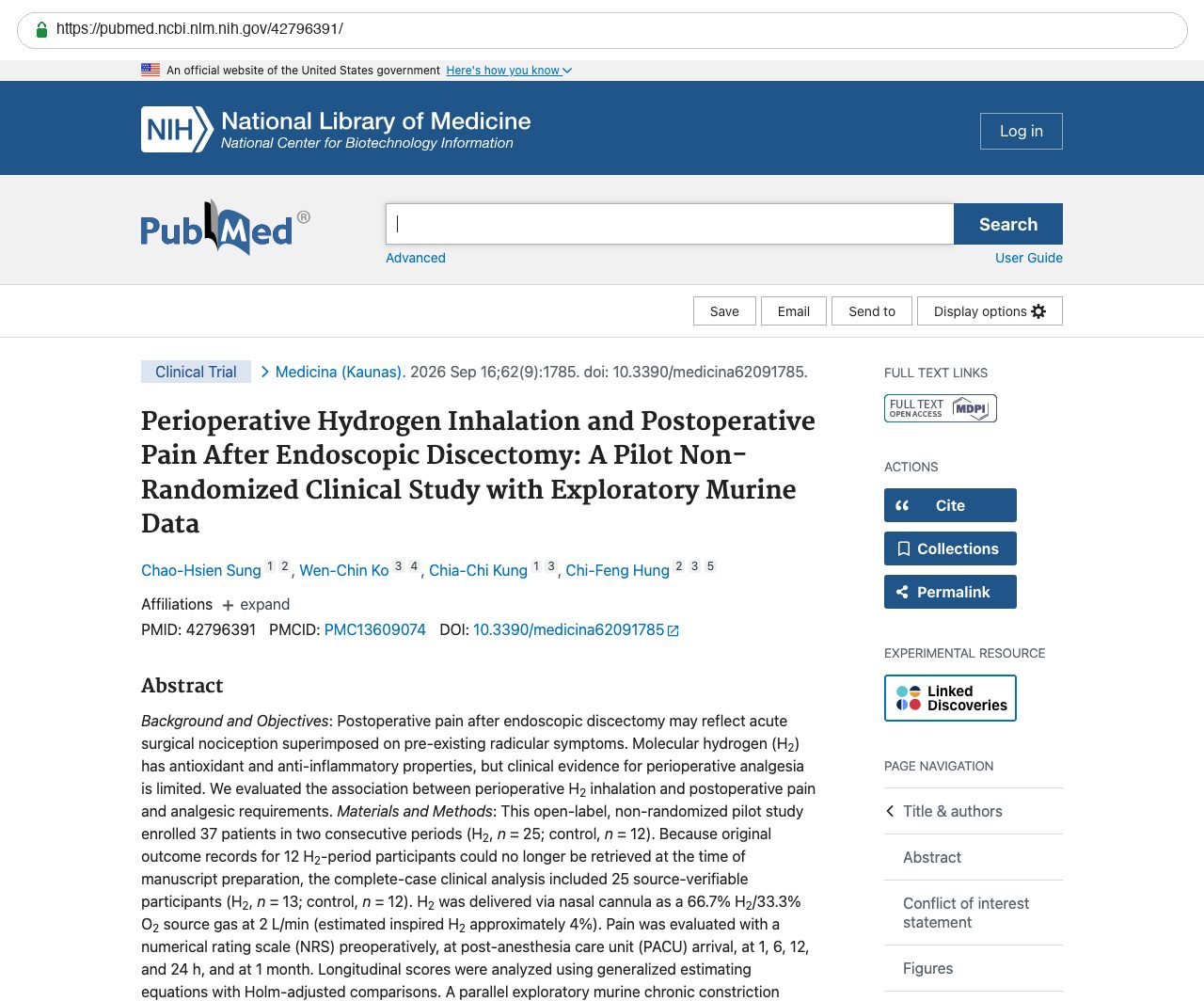
This page mirrors the published abstract (© the authors / publisher) for reference and citation. The canonical source is the PubMed record linked above. This is not medical advice.