2024 Alternative therapies in health and medicine RCT Human H₂ therapy Inhalation Cancer (adjunct)NeurologyOxidative stress
2024 · Li et al. — Effects of Hydrogen Inhalation on Neurological Function Indicators, Oxidative Stress Markers, and E-Cadherin Levels in Patients with Brain Glioma
Super-Abstract
In 100 patients with brain glioma, adding hydrogen inhalation to routine treatment for 2 weeks gave a higher overall effectiveness rating, with criteria not defined in the abstract, than routine treatment alone (90.00% compared with 72.00%, P = .022). Laboratory markers of nerve damage and oxidative stress were more favourable in the hydrogen group (P < .05), and stroke scale scores were lower, described as significant but without a reported p-value. Adverse reactions occurred at similar rates (64.00% compared with 68.00%, P = .673). Hydrogen was tested only as an add-on to routine care, and the abstract reports neither blinding, the hydrogen dose nor any effect on the tumour itself. (Alternative Therapies in Health and Medicine, 2024.)
Commentary
The authors asked whether hydrogen, given as a complementary treatment, changes nerve function and markers they link to tumour progression in glioma patients. 100 patients with glioma were assigned with a random number table to routine treatment alone (50) or hydrogen inhalation plus routine treatment (50). Treatment lasted 2 weeks. The abstract does not describe the routine treatment, the tumour grade, the hydrogen concentration, the daily inhalation time or whether patients and assessors were blinded. Values before and after treatment were compared for an overall effectiveness rating (called clinical curative effect), the National Institutes of Health Stroke Scale (NIHSS), the nerve damage markers S100β, neuron-specific enolase (NSE) and glial fibrillary acidic protein (GFAP), the oxidative stress markers malondialdehyde (MDA), superoxide dismutase (SOD) and catalase (CAT), and E-cadherin, which the authors treat as a tumour progression marker. Adverse reactions during treatment were also recorded. The abstract does not name a primary endpoint.
Key quotes
- „After treatment, the overall effect of the hydrogen inhalation group (90.00%) was significantly better than that of the conventional group (72.00%), which was statistically significant (P = .022).“ — the overall effectiveness rating, whose criteria the abstract does not define
- „The total incidence of adverse reactions was slightly lower in the hydrogen group (64.00%) compared to the routine group (68.00%), but this difference was not statistically significant (χ2=0.178, P = .673).“ — adverse reactions were frequent in both groups and did not differ
- „Hydrogen inhalation therapy significantly enhances nerve function, reduces local oxidative stress levels, and increases E-cadherin levels in patients with brain glioma, suggesting its potential as an adjunct treatment.“ — the authors' conclusion, which frames hydrogen as an add-on only
Our assessment
The trial assigned 100 patients by random number table and compared hydrogen added to routine treatment with routine treatment alone. After 2 weeks, the effectiveness rating and all reported nerve and oxidative stress markers favoured the hydrogen group. Hydrogen was studied only as an addition to routine care. Tumour size and survival were not reported, so the study says nothing about hydrogen as a cancer treatment. Limitations: the abstract mentions no blinding and no placebo gas, which matters for a clinician-rated scale such as the NIHSS and for the effectiveness rating. Hydrogen dose, daily inhalation time, routine treatment and tumour grade are not described. The criteria of the effectiveness rating are not given, no primary endpoint is named and many markers were compared. E-cadherin and NIHSS differences are reported without their own p-values. Follow-up lasted 2 weeks, and most outcomes are laboratory markers. Adverse reactions were common in both groups without a statistically significant difference.
Study design
- Type: randomised controlled trial (random number table), blinding not reported · n: 100 (50 hydrogen plus routine treatment, 50 routine treatment) · H₂ delivery: hydrogen inhalation added to routine treatment for 2 weeks, concentration and daily duration not given
- Comparator: routine treatment alone (not described in the abstract), no placebo gas mentioned
- Result: no primary endpoint named. Overall effectiveness rating (criteria not defined) 90.00% vs. 72.00% (P = .022). NIHSS 12.19 ± 2.08 vs. 16.92 ± 2.23 (described as significant, no p-value given). S100β 0.41 vs. 0.66 µg/L, NSE 8.24 vs. 10.67 ng/mL, GFAP 0.71 vs. 0.93 pg/mL, MDA 6.05 vs. 7.21 mmol/L (all P < .05). SOD 63.21 vs. 52.31 U/L and CAT 8.01 vs. 5.25 U/mL (P < .05). E-cadherin 0.84 vs. 0.72 ng/mL (no separate p-value). Adverse reactions 64.00% vs. 68.00% (P = .673, not significant)
Abstract
OBJECTIVE: This study aims to evaluate the effects of hydrogen therapy on nerve function and tumor progression markers in glioma patients, focusing on the modulation of oxidative stress and cadherin expression to establish its potential as a complementary treatment. METHODS: 100 glioma patients were enrolled and divided into two groups using the random number table: routine treatment (50) and hydrogen inhalation plus routine treatment (50). After 2 weeks of treatment, clinical curative effect, levels of nerve function indexes [national institute of health stroke scale (NIHSS), central nervous specific protein (S100β), neuron-specific enolase (NSE), glial fibrillary acidic protein (GFAP)], oxidative stress indexes [malondialdehyde (MDA), superoxide dismutase (SOD), catalase (CAT)] and E-cadherin before and after treatment, and occurrence of adverse reactions during treatment were compared between the two groups. RESULTS: After treatment, the overall effect of the hydrogen inhalation group (90.00%) was significantly better than that of the conventional group (72.00%), which was statistically significant (P = .022). In terms of specific biomarkers, post-treatment levels of E-cadherin were elevated to 0.84±0.05 ng/mL in the hydrogen group compared to 0.72±0.06 ng/mL in the routine group. SOD and CAT levels rose to 63.21±5.36 U/L and 8.01±0.54 U/mL, respectively, versus 52.31±5.24 U/L and 5.25±0.59 U/mL in the routine group (P < .05 for both). Conversely, the NIHSS scores decreased significantly to 12.19±2.08 in the hydrogen group, compared to 16.92±2.23 in the routine group. Similarly, S100β, NSE, GFAP, and MDA levels were found to be lower in the hydrogen group (0.41±0.09 µg/L, 8.24±1.64 ng/mL, 0.71±0.23 pg/mL, and 6.05±1.08 mmol/L respectively) than in the routine group (0.66±0.12 µg/L, 10.67±1.83 ng/mL, 0.93±0.29 pg/mL, and 7.21±1.12 mmol/L respectively) with P < .05 for all comparisons. The total incidence of adverse reactions was slightly lower in the hydrogen group (64.00%) compared to the routine group (68.00%), but this difference was not statistically significant (χ2=0.178, P = .673). CONCLUSION: Hydrogen inhalation therapy significantly enhances nerve function, reduces local oxidative stress levels, and increases E-cadherin levels in patients with brain glioma, suggesting its potential as an adjunct treatment. The findings underscore the therapy's role in enhancing patient recovery and guiding future research and treatment strategies.
Source & links
Screenshot of the PubMed page
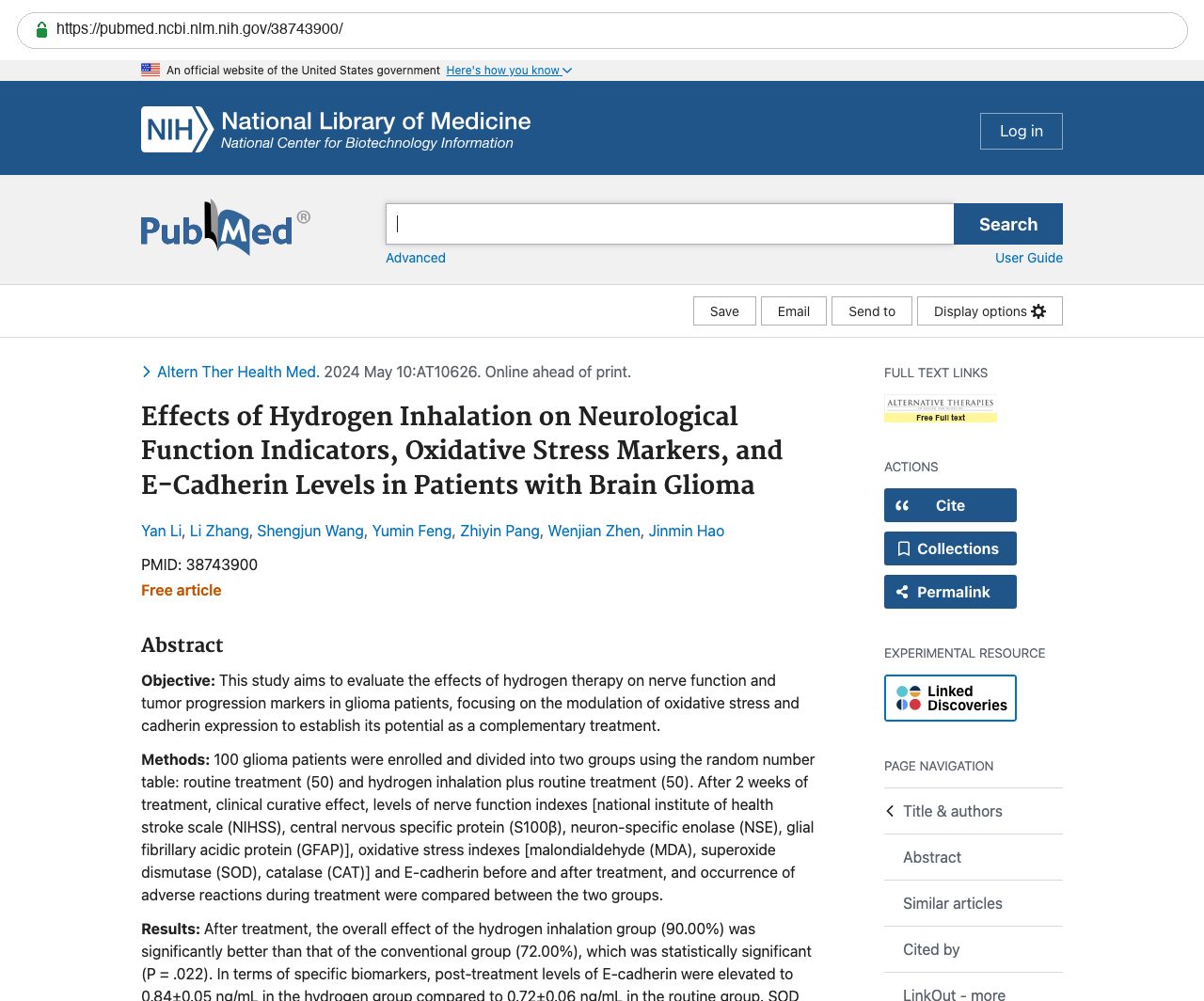
This page mirrors the published abstract (© the authors / publisher) for reference and citation. The canonical source is the PubMed record linked above. This is not medical advice.