2024 Frontiers in neurology RCT Human H₂ therapy Inhalation NeurologyCancer (adjunct)Surgery & Anesthesia
2024 · Wu et al. — Effects of Perioperative Hydrogen Inhalation on Brain Edema and Prognosis in Patients With Glioma: A Single-Center, Randomized Controlled Study
Super-Abstract
In patients undergoing glioma surgery, perioperative hydrogen inhalation was followed by a smaller brain edema volume before discharge and a higher edema regression rate than oxygen inhalation (both p < 0.05). Three days after surgery, the hydrogen group also had longer total sleep, better sleep efficiency, shorter sleep latency and lower numerical rating scale (NRS) scores. According to the full text, 75 of 89 randomised patients were analysed. No prognosis data are reported despite the title. (Frontiers in Neurology, 2024.)
Commentary
Brain edema is a life-threatening complication after glioma surgery, and the authors state that there are no noninvasive, specific treatments for it. They ran a single-centre, randomised controlled trial (ChiCTR-2300074362). The hydrogen (H) group inhaled hydrogen, described in the discussion as hydrogen/oxygen inhalation. The control (C) group inhaled oxygen. The abstract leaves out the key design details; the full text (PMC11294077) supplies them: 89 patients were randomised and 75 analysed (38 hydrogen, 37 control). The hydrogen group breathed 66.7% hydrogen with 33.3% oxygen through a nasal cannula for more than 2 hours a day from admission until discharge; the control group received 33.3% oxygen. The primary outcome was the change in brain edema volume on CT, measured by two radiologists who did not know the group allocation. Blinding of patients is not described. Reported outcomes are brain edema volume before discharge, the edema regression rate and, 3 days after surgery, total sleep duration, sleep efficiency, sleep latency and NRS scores. The abstract does not say what the NRS measured. The authors also aimed to explain the mechanism, but no mechanistic results are reported.
Key quotes
- „The volume of brain edema before discharge was significantly lower in the H group (p < 0.05).“ — the main result on edema volume, reported only as a p-value threshold
- „Furthermore, 3 days after surgery, the H group had longer total sleep duration, improved sleep efficiency, shorter sleep latency, and lower numerical rating scale (NRS) scores (p < 0.05).“ — secondary findings on sleep and NRS scores three days after surgery
- „In conclusion, hydrogen/oxygen inhalation effectively reduced postoperative brain edema in glioma patients.“ — the authors' conclusion; the abstract gives no sample size or effect sizes
Our assessment
This is a randomised trial at a single centre. Hydrogen inhalation was followed by smaller postoperative brain edema and faster edema regression than oxygen inhalation. How far this reaches is hard to judge, because the abstract omits the size of the differences. Limitations: the abstract leaves out sample size, dose and schedule (the full text gives 75 analysed patients and more than 2 hours a day of 66.7% H₂). Only the CT assessors were blinded, not the patients. Results are reported only as p < 0.05, without effect sizes or confidence intervals. Edema volume is an intermediate measure, and the prognosis named in the title is not reported in the abstract. Sleep and NRS scores can be influenced by expectations if patients knew their group. No adverse events are reported in the abstract. A single centre limits how well the results apply elsewhere.
Study design
- Type: single-centre randomised controlled trial, outcome assessors blinded (per full text) · n: 89 randomised, 75 analysed (38 H₂, 37 control; per full text) · H₂ delivery: inhaled 66.7% H₂ with 33.3% O₂ via nasal cannula, more than 2 hours a day from admission to discharge (per full text)
- Comparator: 33.3% oxygen via nasal cannula for the same duration
- Result: primary outcome (per full text): change in brain edema volume. Brain edema volume before discharge lower and edema regression rate higher in the hydrogen group (both p < 0.05). Three days after surgery: longer total sleep, better sleep efficiency, shorter sleep latency, lower NRS scores (p < 0.05). No prognosis data in the abstract
Abstract
INTRODUCTION: Brain edema is a life-threatening complication that occurs after glioma surgery. There are no noninvasive and specific treatment methods for brain edema. Hydrogen is an anti-inflammatory and antioxidant gas that has demonstrated therapeutic and preventative effects on several diseases, particularly in the nervous system. This study aimed to determine the therapeutic effects of hydrogen administration on brain edema following glioma surgery and elucidate its mechanism. METHODS: A single-center, randomized controlled clinical trial of hydrogen inhalation was conducted (China Clinical Trial Registry [ChiCTR-2300074362]). Participants in hydrogen (H) group that inhaled hydrogen experienced quicker alleviation of postoperative brain edema compared with participants in control (C) group that inhaled oxygen. RESULTS: The volume of brain edema before discharge was significantly lower in the H group (p < 0.05). Additionally, the regression rate of brain edema was higher in the H group than in the C group, which was statistically significant (p < 0.05). Furthermore, 3 days after surgery, the H group had longer total sleep duration, improved sleep efficiency, shorter sleep latency, and lower numerical rating scale (NRS) scores (p < 0.05). DISCUSSION: In conclusion, hydrogen/oxygen inhalation effectively reduced postoperative brain edema in glioma patients. Further research is necessary to understand the underlying mechanisms of hydrogen's therapeutic effects. Hydrogen is expected to become a new target for future adjuvant therapy for brain edema.
Source & links
Screenshot of the PubMed page
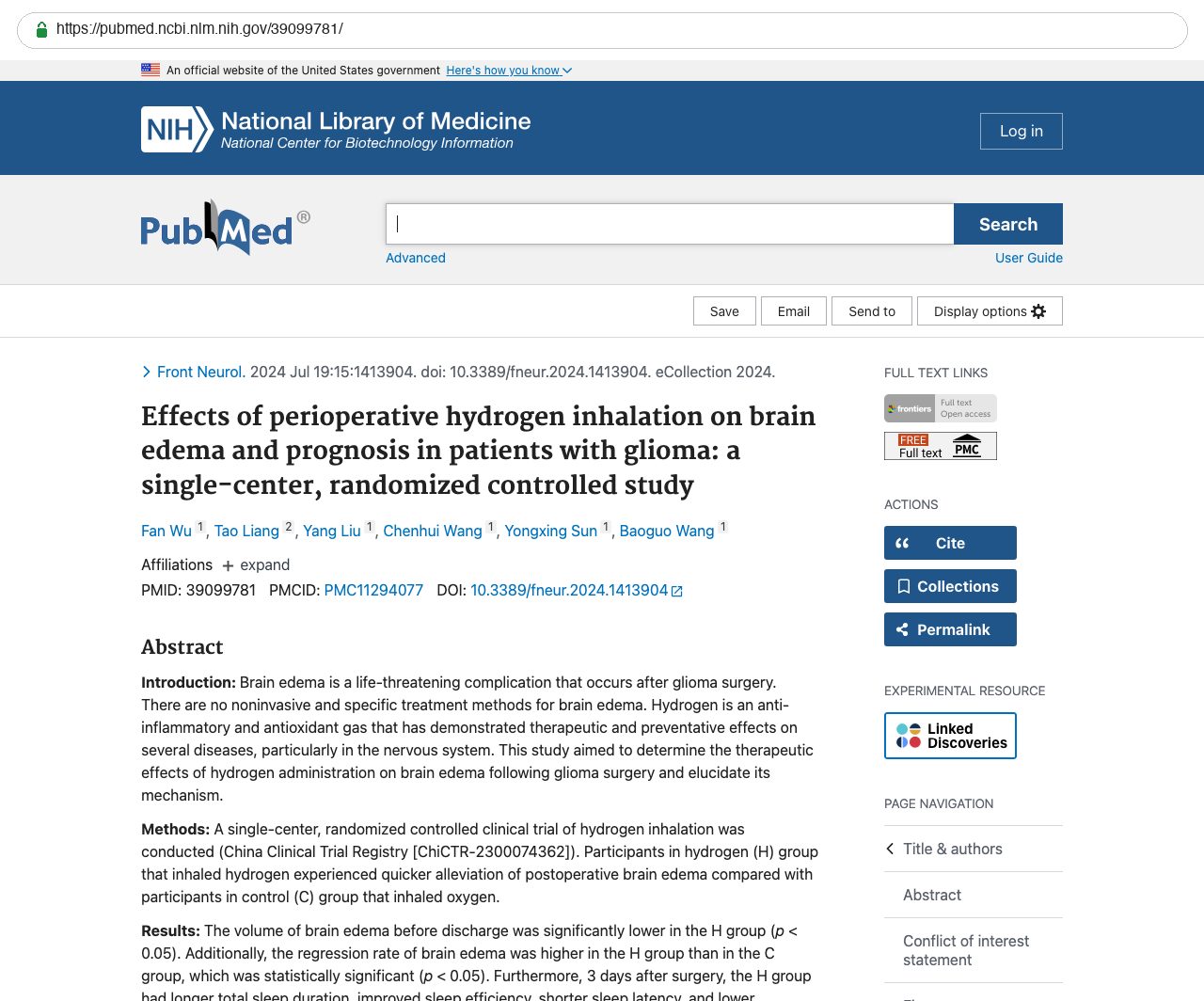
This page mirrors the published abstract (© the authors / publisher) for reference and citation. The canonical source is the PubMed record linked above. This is not medical advice.