1998 · Swart — ¹³C breath test in gastroenterological practice.
Super-Abstract
This review summarises the use of breath tests — including both hydrogen gas excretion and ¹³C-labelled carbon dioxide — in gastroenterological practice as non-invasive alternatives to invasive diagnostic procedures. Applications include gastric emptying, H. pylori detection, small bowel bacterial overgrowth, pancreatic function, and liver metabolic capacity. (Scandinavian Journal of Gastroenterology. Supplement, 1998.)
Commentary
This review by Swart and colleagues covers breath tests as diagnostic tools in gastroenterology. Two types of markers are discussed: exhaled hydrogen gas (produced by colonic bacteria fermenting unabsorbed substrates) and ¹³C-labelled CO₂ (produced by metabolism of isotopically labelled test substances). The paper explicitly discusses hydrogen breath tests as a clinical tool. However, the H₂ here is again a diagnostic marker generated by gut fermentation — not therapeutic molecular H₂. The review highlights breath tests as safer and simpler alternatives to invasive methods, providing only semi-quantitative data due to the indirect nature of the measurements.
Key quotes
- „Both hydrogen gas excretion and carbon dioxide appearance in breath can be studied.“ — two distinct breath test approaches in gastroenterology
- „The tests are nevertheless useful because they often replace invasive techniques with a simple procedure that is safe because there is no radioactivity involved.“ — clinical utility of breath tests: non-invasive, safe, radioactivity-free
- „BTs have been used to measure gastric emptying, the presence of Helicobacter pylori in the stomach, small-bowel bacterial overgrowth, exocrine pancreatic function as well as liver metabolic capacity.“ — the range of clinical applications for breath testing
Our assessment
This is a review of diagnostic breath-test methodology in gastroenterology. The hydrogen gas discussed is a diagnostic biomarker produced by gut bacteria during carbohydrate fermentation — it is not molecular H₂ as a therapeutic agent. The review provides a solid overview of clinical breath-test applications but has no relevance to H₂ supplementation, H₂ water, or H₂ inhalation therapy.
Study design
- Type: narrative review · Subject: ¹³C-labelled and hydrogen breath tests in gastroenterology · H₂ role: diagnostic biomarker (gut bacterial fermentation), not therapeutic
- Applications reviewed: gastric emptying, H. pylori, small bowel bacterial overgrowth, pancreatic exocrine function, liver metabolism · Measurement: exhaled H₂ gas (fermentation) and ¹³CO₂ (isotope metabolism) by mass spectrometry
Abstract
Breath tests (BTs) are used in gastroenterological practice to study (patho)physiological and metabolic processes in an indirect way. In these tests the appearance in breath of a metabolite of a specific test substance is studied. The assumption underlying each BT is that one step-the process of interest-in the absorption and metabolism of the tracer is rate-limiting. Both hydrogen gas excretion and carbon dioxide appearance in breath can be studied. When a carbon-labelled test substance is used. the stable isotope 13C is preferred to the radioactive isotope 14C. Measurements of 13C in expired air are performed by mass spectrometry. Because of the indirect nature of BTs, involving a sequence of reactions and metabolic pools, they usually supply semiquantitative data. The tests are nevertheless useful because they often replace invasive techniques with a simple procedure that is safe because there is no radioactivity involved. BTs have been used to measure gastric emptying, the presence of Helicobacter pylori in the stomach, small-bowel bacterial overgrowth, exocrine pancreatic function as well as liver metabolic capacity; other potential applications of BTs are being studied.
Source & links
Screenshot of the PubMed page
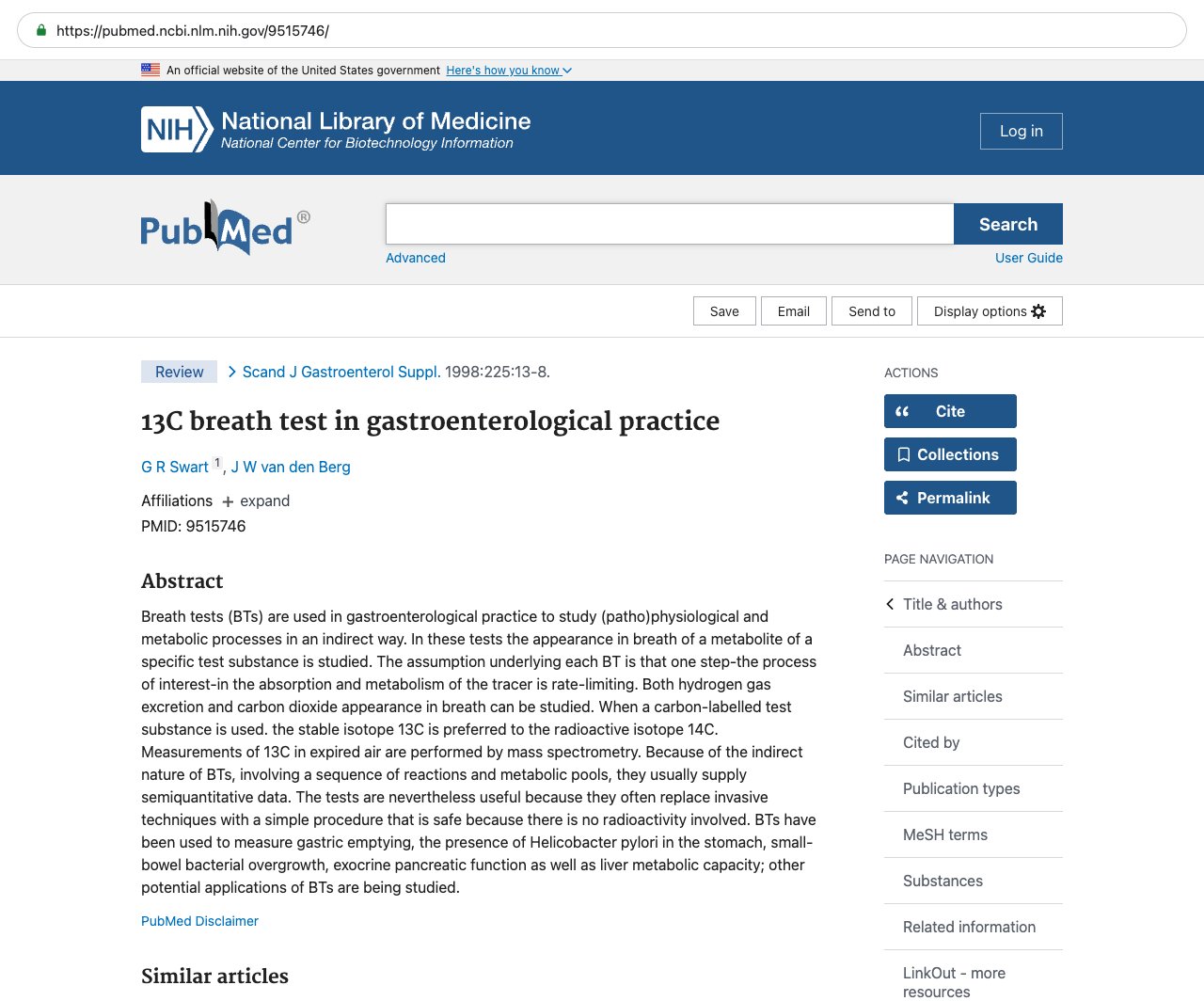
This page mirrors the published abstract (© the authors / publisher) for reference and citation. The canonical source is the PubMed record linked above. This is not medical advice.