2012 · Takeuchi et al. — Hydrogen may inhibit collagen-induced platelet aggregation: an ex vivo and in vivo study.
Super-Abstract
In this mixed-design study — combining human ex vivo blood tests and rat in vivo experiments — molecular hydrogen (via H₂ saline or H₂ inhalation) significantly inhibited collagen-induced platelet aggregation. Platelet aggregation is a key step in blood clot formation; reduced aggregation could, in principle, be relevant to cardiovascular protection. However, this is a preclinical and ex vivo study; clinical implications for humans remain unproven.
Commentary
Platelet aggregation triggered by collagen — a component of damaged vessel walls — is a central mechanism in arterial thrombosis. The hypothesis that H₂, by selectively scavenging hydroxyl radicals (•OH) and peroxynitrite (ONOO⁻), could modulate platelet activation is biochemically plausible, since ROS are known to promote platelet activation. The study has two components: (1) an ex vivo human component — blood from 6 healthy adults was mixed with H₂-rich saline and collagen added; platelet aggregation was significantly reduced vs. normal saline (p = 0.044). (2) Two rat in vivo components — H₂ gas inhalation (n = 9 vs. 8 controls) and H₂ saline i.v. (n = 6 vs. 7 controls) both produced significant reduction in collagen-induced platelet aggregation. The human ex vivo finding — though in only 6 subjects — adds a modest degree of translational relevance beyond pure rodent data. Limitations: tiny sample sizes, no clinical endpoints, no assessment of whether the anti-platelet effect persists or has adverse effects (bleeding risk), and the mechanism was not mechanistically dissected.
Key quotes
- „collagen (1 µg/mL)-induced platelet aggregation was significantly inhibited by hydrogen-rich saline compared with a normal saline group (p=0.044).“ — human ex vivo result: H₂ saline reduces platelet aggregation in human blood
- „Collagen-induced platelet aggregation was significantly decreased in H2 gas and HS group rats (p=0.042, 0.018, respectively).“ — in vivo rat result: both H₂ gas inhalation and H₂ saline reduce platelet aggregation
- „these data suggest that hydrogen may inhibit collagen-induced platelet aggregation.“ — cautious authorial conclusion — appropriately qualified with 'may'
Our assessment
An interesting preclinical and ex vivo study with a modest human blood component (n = 6 ex vivo). The finding that H₂ may reduce platelet aggregation is novel and mechanistically plausible — this has potential relevance for cardiovascular research. Honest limitations: the human component is ex vivo (outside the body, no clinical endpoints), the rat experiments use very small groups, and there is no assessment of safety (bleeding risk from reduced platelet aggregation). This remains an early-stage, hypothesis-generating study. Clinical translation would require randomised controlled trials with cardiovascular endpoints and safety monitoring.
Study design
- Type: ex vivo human study (n = 6 healthy adults) + in vivo animal study (rats, n = 8–9 per group) · H₂ delivery: H₂-rich saline (ex vivo + i.v. rat); H₂ gas inhalation (rat)
- Endpoint: collagen-induced platelet aggregation (1 µg/mL collagen ex vivo; 12 µg/mL collagen in vivo) · Measurement: platelet aggregation measured before and after H₂ treatment
- Result: H₂ saline significantly reduced platelet aggregation in human blood ex vivo (p = 0.044); H₂ gas and H₂ saline both reduced aggregation in rats (p = 0.042 and 0.018); no mechanistic pathway analysis
Abstract
OBJECTIVE: Hydrogen selectively reduces hydroxyl radicals and peroxynitrite, and numerous experimental and clinical studies suggest that hydrogen can exert potent cellular protective effects against a wide variety of diseases. Furthermore, there is increasing evidence that antioxidants can modulate platelet activation. The aim of the present study was to investigate the relationship between hydrogen and collagen-induced platelet aggregation. METHODS: For human ex vivo studies, we collected blood samples from six healthy humans and added normal saline or hydrogen-rich saline to blood and platelet-rich plasma. We found that collagen (1 µg/mL)-induced platelet aggregation was significantly inhibited by hydrogen-rich saline compared with a normal saline group (p=0.044). For rat in vivo studies, animals (n=17) were exposed to either nitrogen-based mixed gas with hydrogen (H2 gas group; n=9) or without hydrogen (non-H2 gas group; n=8). Additionally, another animals (n=13) administered either normal (NS group; n=7) or hydrogen-rich saline (HS group; n=6) (5 ml/kg) via intravenous infusion. Blood samples were drawn from the vena cava before treatment and from the right ventricle after treatment. Collagen (12 µg/mL)-induced platelet aggregation was then measured. RESULTS: Collagen-induced platelet aggregation was significantly decreased in H2 gas and HS group rats (p=0.042, 0.018, respectively), while there was no difference in non-H2 gas and NS group rats before and after treatment. CONCLUSION: In summary, these data suggest that hydrogen may inhibit collagen-induced platelet aggregation.
Source & links
Screenshot of the PubMed page
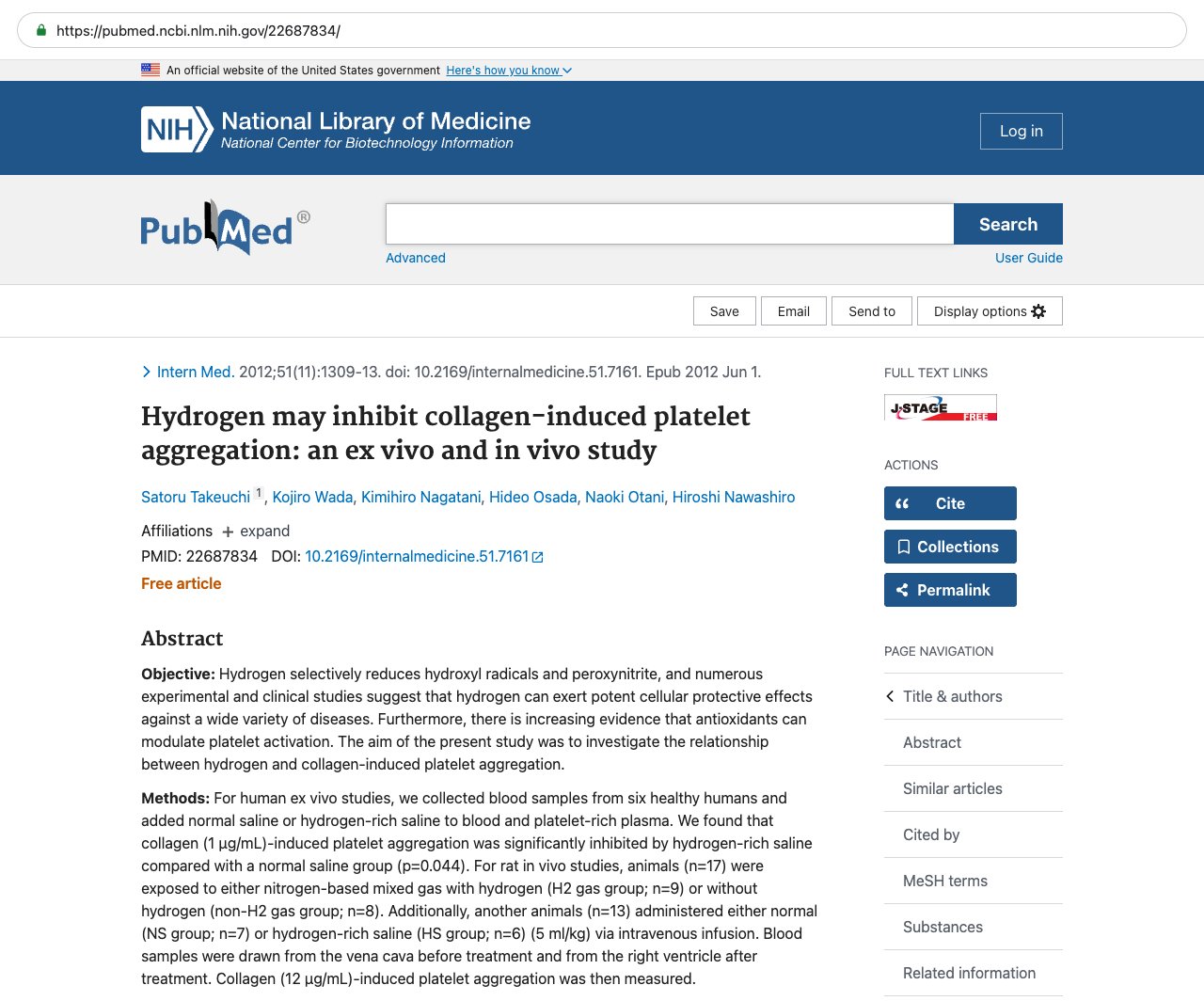
This page mirrors the published abstract (© the authors / publisher) for reference and citation. The canonical source is the PubMed record linked above. This is not medical advice.