2015 · Tamasawa et al. — Hydrogen gas production is associated with reduced interleukin-1β mRNA in peripheral blood after a single dose of acarbose in Japanese type 2 diabetic patients.
Super-Abstract
In 16 type 2 diabetic patients, a single dose of the glucose-lowering drug acarbose did not significantly increase breath H₂ compared to no treatment — but the individual change in H₂ production was inversely associated with the change in blood IL-1β mRNA, suggesting a link between gut-produced H₂ and anti-inflammatory signaling. (European Journal of Pharmacology, 2015.)
Commentary
Acarbose is an alpha-glucosidase inhibitor that delays carbohydrate absorption, causing increased colonic fermentation and therefore more endogenous H₂ production by gut bacteria. This study tests whether that acarbose-triggered H₂ translates into measurable anti-inflammatory effects (IL-1β mRNA in blood). The finding is intriguing but subtle: the primary comparison (day 1 vs. day 2 with acarbose) was not statistically significant — but the correlation between individual H₂ production changes and IL-1β mRNA changes was significant and inverse. This suggests that inter-individual variation in H₂ production capacity matters, and that even endogenous gut-produced H₂ may exert systemic anti-inflammatory effects. The study design is innovative but limited by very small n (16) and single-dose observation.
Key quotes
- „The induction of hydrogen gas production and the reduction in peripheral blood IL-1β mRNA after the test meal were not significant between days 1 and 2.“ — honest null result: primary group comparison was not significant
- „the changes in total hydrogen gas production from day 1 to day 2 were closely and inversely associated with the changes in peripheral blood IL-1β mRNA levels.“ — secondary finding: individual H₂ variation correlates inversely with inflammatory marker
- „an increase in hydrogen gas production is inversely associated with a reduction of the peripheral blood IL-1β mRNA level after a single dose of acarbose in Japanese type 2 diabetic patients.“ — mechanistic hypothesis: more H₂ from gut → less circulating IL-1β
Our assessment
A mechanistically innovative but methodologically limited pilot study. The primary endpoint was a null result, which the authors honestly report. The inverse correlation between H₂ production and IL-1β is hypothesis-generating but not proof of therapeutic effect. Limitations: n=16 is very small; single-dose, single-day design; no washout period; the indirect route (acarbose → gut bacteria → H₂ → blood IL-1β) has many confounders; the clinical significance of IL-1β mRNA changes from a single meal is uncertain. The study is interesting as a bridge between gut microbiome research, H₂ physiology, and metabolic inflammation.
Study design
- Type: Single-center crossover observation (2-day design, no washout) · n: 16 (14 men, 2 women; mean age 52.1 years; HbA1c 10.2%) · H₂ measurement: Breath H₂ at 0, 60, 120, 180, 300 min; acarbose as pharmacological H₂ inducer (not exogenous H₂ administration)
- Comparator: Same patient, day 1 (without acarbose) vs. day 2 (with acarbose) at test meal
- Result: Primary comparison not significant (p not specified). Inverse correlation between ΔH₂ production and ΔIL-1β mRNA: significant. Continuous glucose monitoring also performed.
Abstract
Acarbose, an α-glucosidase inhibitor, leads to the production of hydrogen gas, which reduces oxidative stress. In this study, we examined the effects of a single dose of acarbose immediately before a test meal on postprandial hydrogen gas in breath and peripheral blood interleukin (IL)-1β mRNA expression in Japanese type 2 diabetic patients. Sixteen Japanese patients (14 men, 2 women) participated in this study. The mean±standard deviation age, hemoglobin A1c and body mass index were 52.1±15.4 years, 10.2±2.0%, and 27.7±8.0kg/m(2), respectively. The patients were admitted into our hospital for 2 days and underwent test meals at breakfast without (day 1) or with acarbose (day 2). We performed continuous glucose monitoring and measured hydrogen gas levels in breath, and peripheral blood IL-1β mRNA levels before (0min) and after the test meal (hydrogen gas: 60, 120, 180, and 300min; IL-1β: 180min). The induction of hydrogen gas production and the reduction in peripheral blood IL-1β mRNA after the test meal were not significant between days 1 (without acarbose) and 2 (with acarbose). However, the changes in total hydrogen gas production from day 1 to day 2 were closely and inversely associated with the changes in peripheral blood IL-1β mRNA levels. Our results suggest that an increase in hydrogen gas production is inversely associated with a reduction of the peripheral blood IL-1β mRNA level after a single dose of acarbose in Japanese type 2 diabetic patients.
Source & links
Screenshot of the PubMed page
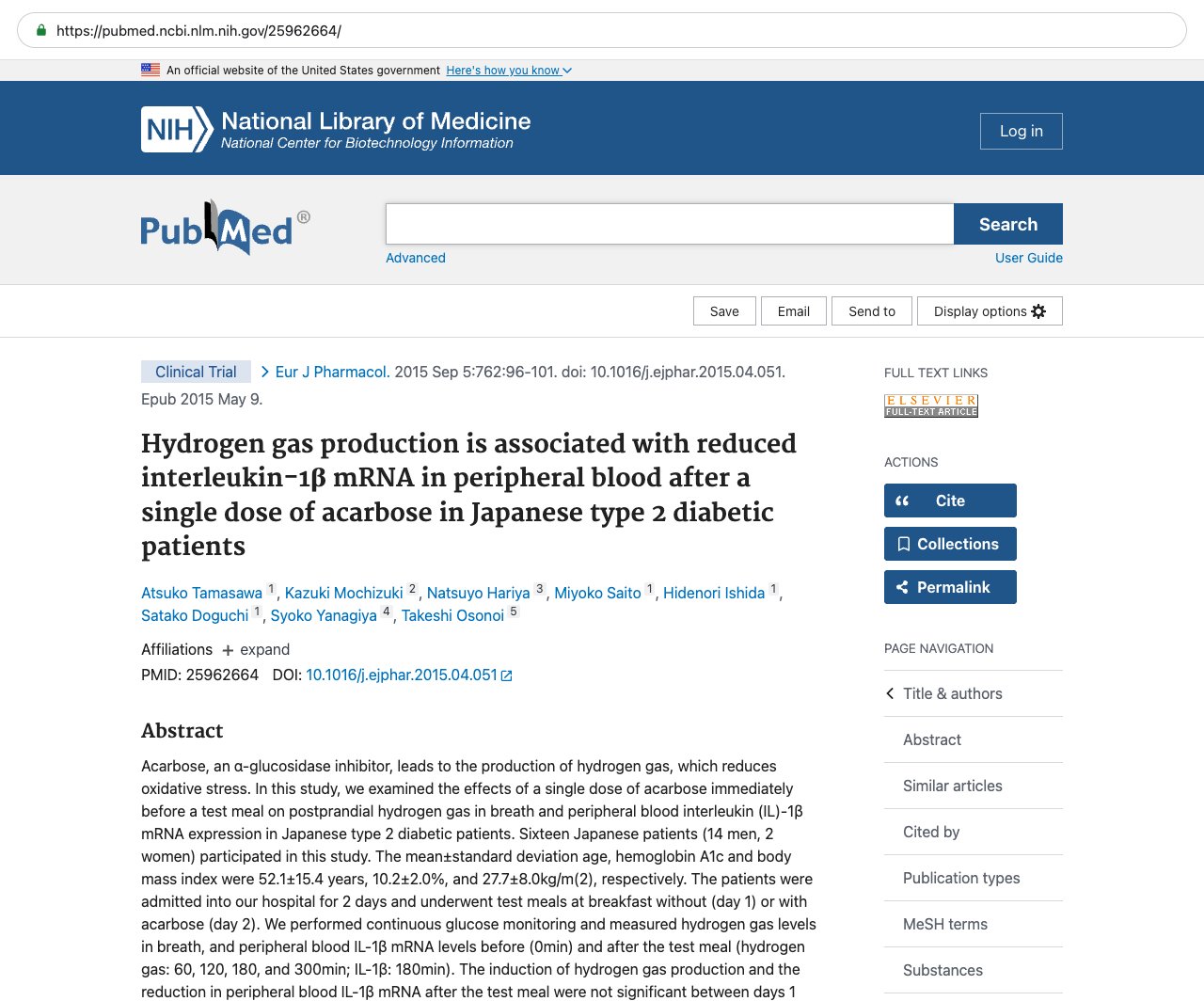
This page mirrors the published abstract (© the authors / publisher) for reference and citation. The canonical source is the PubMed record linked above. This is not medical advice.