2019 · Meng — Hyperoxygenated Hydrogen-Rich Solution Suppresses Lung Injury Induced by Hemorrhagic Shock in Rats.
Super-Abstract
In rats with hemorrhagic-shock-induced acute lung injury (ALI), intravenous infusion of a solution combining both extra oxygen and dissolved hydrogen (HOHS) outperformed standard resuscitation fluid and each component alone in protecting lung tissue. HOHS significantly reduced oxidative stress markers, inflammatory cytokines, and cell death in lung tissue. This rodent study suggests a synergistic benefit of combining both gases in a resuscitation fluid. (The Journal of Surgical Research, 2019.)
Commentary
Hemorrhagic shock is a leading cause of preventable death in trauma, and ALI is a frequent and life-threatening complication. Standard resuscitation with Ringer's lactate restores volume but does not address the ischemia-reperfusion injury and oxidative burst that damage lung tissue. This study tests whether combining two approaches — hyperoxygenation (to address tissue hypoxia) and H₂ (as an anti-oxidative and anti-inflammatory agent) — in a single intravenous fluid produces additive or synergistic lung protection. The four-group design (LRS, oxygenated, H₂-rich, and combined) is logical. The results consistently favor the combined HOHS on all measured endpoints with statistical significance (p<0.01 for most). Limitations: the study uses only 6 rats per group per time point, all male SD rats, a very specific hemorrhagic shock protocol, and only short-term observation. The jump to clinical trauma resuscitation is substantial — solution stability, storage, and delivery in trauma settings present major practical challenges.
Key quotes
- „PaO2, PaCO2, and T-SOD increased in the three treatment groups (P < 0.05), most significantly in the HOHS group (P < 0.01) compared with the LRS group.“ — lung oxygenation and antioxidant capacity improved most with the combined solution
- „The levels of lactate, MDA, TNF-α and IL-6, cell count, protein content, caspase-3 and TUNEL-positive cells as well as ALI score decreased … most significantly in the HOHS group.“ — injury and inflammation markers were reduced most strongly by HOHS
- „These findings demonstrate that HOHS can protect the lung against ALI induced by hemorrhagic shock.“ — authors' conclusion: combined oxyhydrogen solution offers best lung protection in this rat model
Our assessment
A well-designed preclinical rat study with a logical four-arm comparison — not clinical evidence. All animals were male rats under a highly controlled hemorrhagic shock protocol; no human data exist for this specific formulation. The practical challenges of manufacturing, stabilizing, and clinically deploying a solution with both elevated dissolved O₂ and H₂ are not addressed. The results are promising as a concept but need larger animal studies and eventually clinical trials before any conclusions about human benefit can be drawn.
Study design
- Type: preclinical randomized animal study · Model: male SD rats, hemorrhagic-shock-induced ALI (n = 6 per group per time point, 5 groups) · H₂ delivery: intravenous hydrogen-rich solution (HS) and hyperoxygenated hydrogen-rich solution (HOHS); comparators: lactated Ringer's solution (LRS), hyperoxygenated solution (HOS)
- Result: HOHS outperformed all comparators on PaO₂, T-SOD (antioxidant), MDA (oxidative stress marker), TNF-α and IL-6 (inflammation), bronchoalveolar lavage cell count and protein, caspase-3 and TUNEL-positive cell counts, and lung injury score (p<0.01 vs. LRS for most parameters)
Abstract
BACKGROUND: Hemorrhagic shock could induce acute lung injury (ALI), which is associated with cell hypoxia, lung tissue inflammation, free radical damage, and excessive cell apoptosis. Our previous studies demonstrated that hyperoxygenated solution could alleviate cell hypoxia. Furthermore, hydrogen-rich solution (HS) could relieve lung tissue inflammation, free radical damage and excessive cell apoptosis. Therefore we hypothesize that Hyperoxygenated Hydrogen-rich solution (HOHS) can protect the lung against ALI. MATERIALS AND METHODS: SD rats were randomly divided into five groups (n = 6 at each time point in each group) and were exposed to Hemorrhagic shock induced ALI, and then treated with lactated Ringer's solution (LRS), hyperoxygenated solution, HS, and HOHS, respectively. The protective effects of these solutions were assessed using methods as follows: arterial blood samples were collected for blood gas analysis; Bronchoalveolar lavage fluid was collected for cell count and protein quantification; lung tissue samples were collected to measure wet/dry ratio, as well as levels of T-SOD, MDA, TNF-α, and IL-6; Caspase-3 and TUNEL-positive cells, and pathological changes were observed under light microscope; ALI was scored using the Smith scoring method; ultrastructural changes of lung tissues were further observed with transmission electron microscopy. RESULTS: The results indicated that PaO2, PaCO2, and T-SOD increased in the three treatment groups (P < 0.05), most significantly in the HOHS group (P < 0.01) compared with the LRS group; and conversely that the levels of lactate, MDA, TNF-α and IL-6, cell count, protein content, caspase-3 and TUNEL-positive cells as well as ALI score decreased in the three treatment groups (P < 0.05), most significantly in the HOHS group (P < 0.01) compared with the LRS group. Morphological observation with optical microscope and electron microscopy showed that compared with the LRS group, cell damage in the three treatment groups improved to a varying extent, especially evident in the HOHS group. CONCLUSIONS: These findings demonstrate that HOHS can protect the lung against ALI induced by hemorrhagic shock.
Source & links
Screenshot of the PubMed page
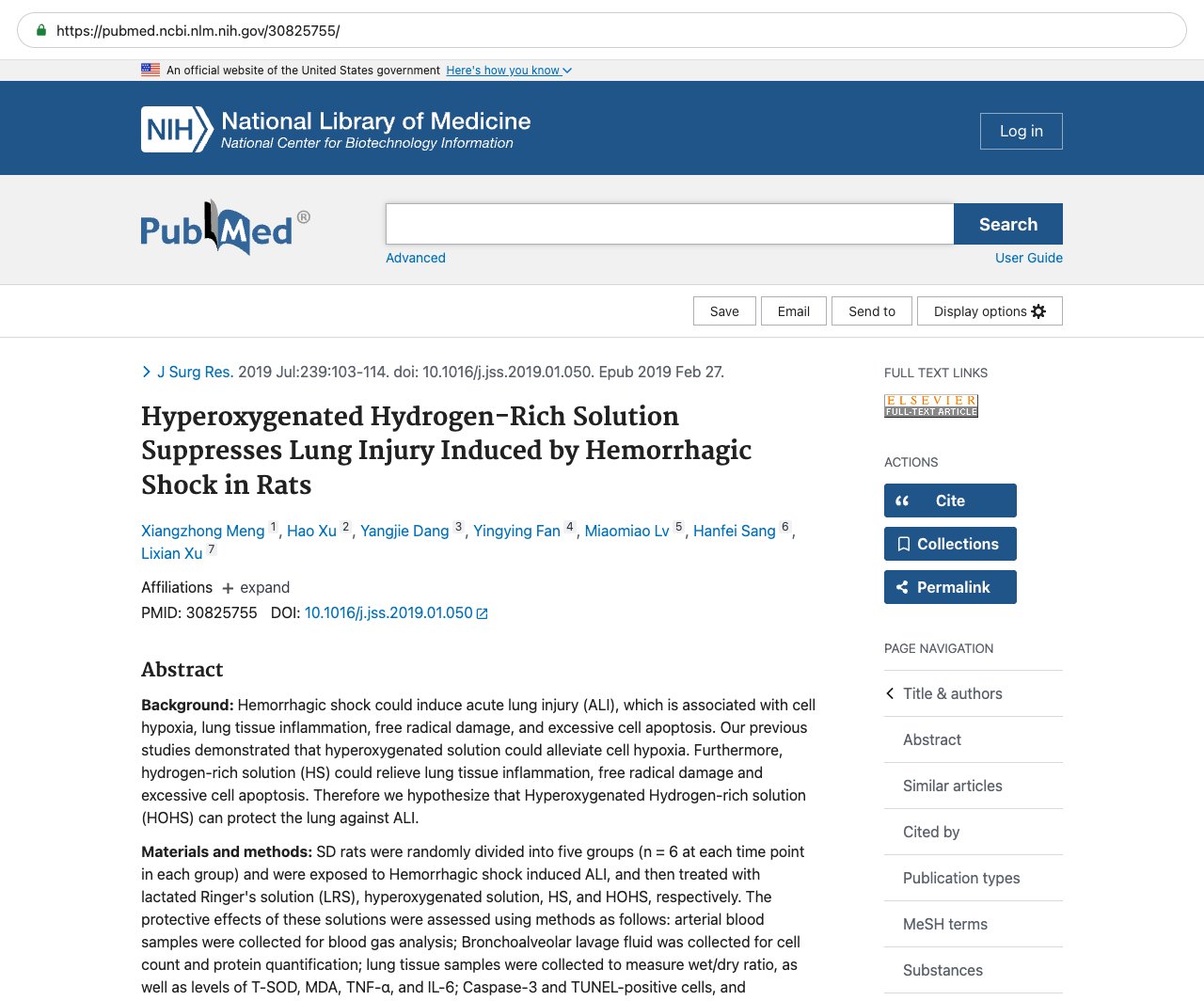
This page mirrors the published abstract (© the authors / publisher) for reference and citation. The canonical source is the PubMed record linked above. This is not medical advice.