2022 · Tao — A randomized, placebo-controlled clinical trial of hydrogen/oxygen inhalation for non-alcoholic fatty liver disease
Super-Abstract
Hydrogen/oxygen inhalation improves blood lipid and liver values in non-alcoholic fatty liver — and measurably lowers liver fat content in moderate-to-severe cases. In a randomized, placebo-controlled trial (43 patients, 13 weeks), serum lipids and liver enzymes improved; ultrasound and CT showed less liver fat. Animal experiments point to increased hepatic autophagy as the mechanism. (J Cell Mol Med, 2022.)
Commentary
Non-alcoholic fatty liver disease (NAFLD) is the most common chronic liver disease worldwide and is closely linked to obesity, type-2 diabetes and cardiovascular disease — and so far there is no approved medication for it. That is exactly why this study is interesting. It is a randomized, placebo-controlled trial with 43 patients over 13 weeks in which participants inhaled hydrogen/oxygen gas. The results in humans: serum lipids (blood fats) and liver enzymes improved. Especially in the moderate-to-severe cases, ultrasound and CT scans showed a markedly reduced liver fat content. To understand the mechanism, the researchers added animal experiments: in a mouse model (MCD-diet-induced fatty liver inflammation, NASH), H₂/O₂ inhalation improved systemic inflammation and liver tissue — apparently by promoting autophagy, the cellular „self-cleaning programme“. When they blocked autophagy pharmacologically (with chloroquine), the benefit disappeared. In liver cells, too, H₂ reduced fat accumulation via this autophagy pathway. The overall message: H₂/O₂ inhalation alleviated fatty liver in moderately to severely affected patients, probably via activated hepatic autophagy. To be honest: a moderate sample (43 patients), single-center, China; the robust imaging effects appeared mainly in the more severe cases.
Key quotes
- „We found that inhalation of hydrogen/oxygen improved serum lipid and liver enzymes.“ — improved blood-fat and liver values in humans
- „Significantly improved liver fat content detected by ultrasound and CT scans after hydrogen/oxygen inhalation was observed in moderate-severe cases.“ — less liver fat (imaging) in moderate-to-severe cases
- „hydrogen/oxygen inhalation alleviated NAFLD in moderate-severe patients. This protective effect of hydrogen was possibly by activating hepatic autophagy.“ — conclusion plus presumed mechanism (autophagy)
Our assessment
A human study (RCT) plus mechanistic animal/cell evidence in one — a strong combination, because it not only shows an effect but also provides a plausible explanation (autophagy) and secures it with a blockade experiment. Relevant because NAFLD is a huge, growing health topic with no approved medication and H₂ was tested here in a real clinical indication. Important for honest communication: inhaled H₂/O₂ gas was used here, not H₂ drinking water — and the clearest imaging effects occurred in the more severe cases. This is no licence for general health claims, but a promising clinical signal. Limitation, stated honestly: moderate sample (n = 43), single-center, no active-comparator, China study; transfer to drinking-water products is not proven.
Study design
- Type: RCT, randomized/placebo-controlled (+ supplementary animal/cell experiments) · n: 43 patients (NAFLD) · Duration: 13 weeks · H₂ delivery: hydrogen/oxygen inhalation
- Result: serum lipids and liver enzymes improved; liver fat content (ultrasound + CT) significantly reduced in moderate-to-severe cases; in the mouse model (MCD-NASH) systemic inflammation and liver histology improved, autophagy promoted (effect blockable by chloroquine/3-MA)
Abstract
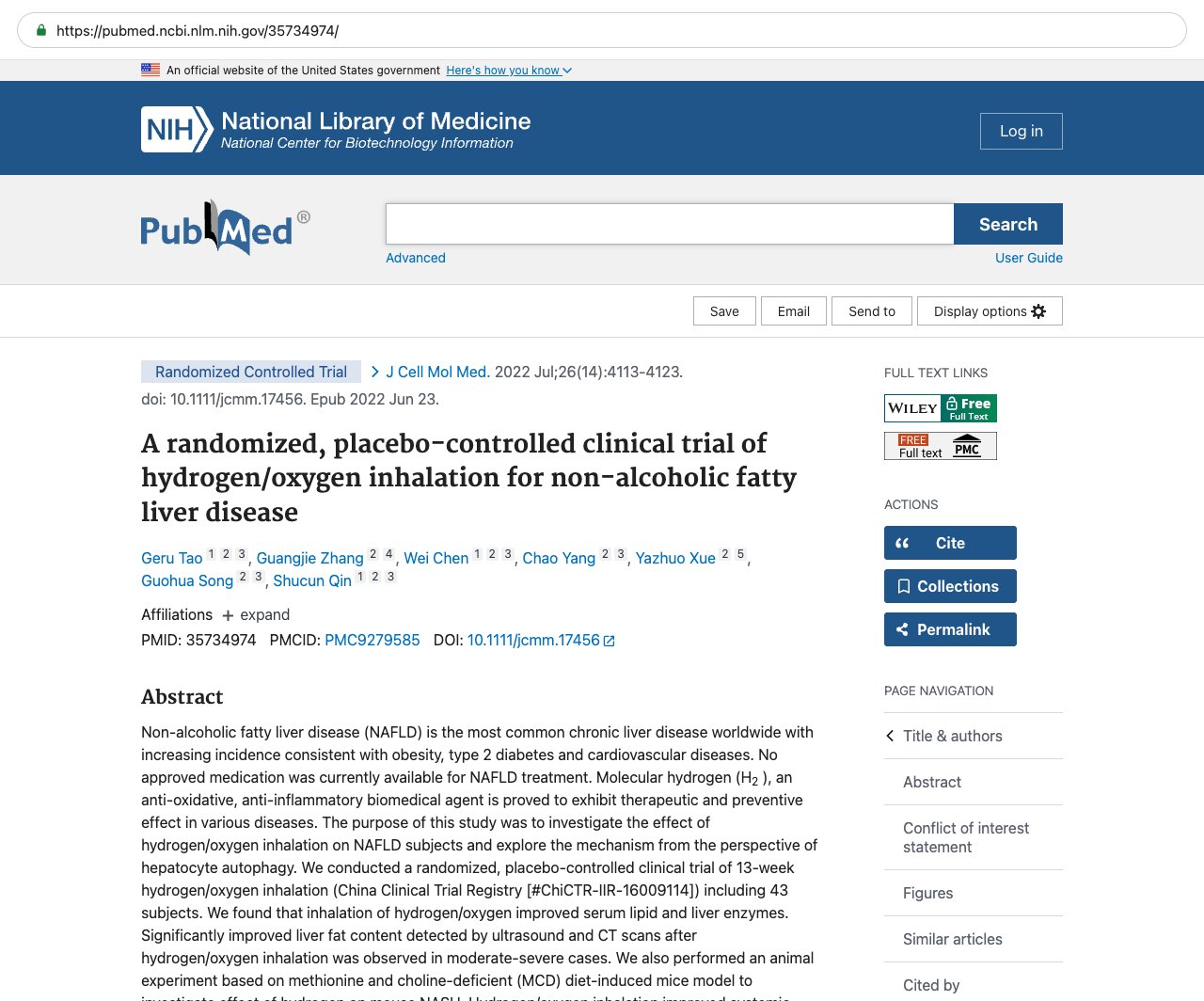
Non-alcoholic fatty liver disease (NAFLD) is the most common chronic liver disease worldwide with increasing incidence consistent with obesity, type 2 diabetes and cardiovascular diseases. No approved medication was currently available for NAFLD treatment. Molecular hydrogen (H2 ), an anti-oxidative, anti-inflammatory biomedical agent is proved to exhibit therapeutic and preventive effect in various diseases. The purpose of this study was to investigate the effect of hydrogen/oxygen inhalation on NAFLD subjects and explore the mechanism from the perspective of hepatocyte autophagy. We conducted a randomized, placebo-controlled clinical trial of 13-week hydrogen/oxygen inhalation (China Clinical Trial Registry [#ChiCTR-IIR-16009114]) including 43 subjects. We found that inhalation of hydrogen/oxygen improved serum lipid and liver enzymes. Significantly improved liver fat content detected by ultrasound and CT scans after hydrogen/oxygen inhalation was observed in moderate-severe cases. We also performed an animal experiment based on methionine and choline-deficient (MCD) diet-induced mice model to investigate effect of hydrogen on mouse NASH. Hydrogen/oxygen inhalation improved systemic inflammation and liver histology. Promoted autophagy was observed in mice inhaled hydrogen/oxygen and treatment with chloroquine blocked the beneficial effect of hydrogen. Moreover, molecular hydrogen inhibited lipid accumulation in AML-12 cells. Autophagy induced by palmitic acid (PA) incubation was further promoted by 20% hydrogen incubation. Addition of 3-methyladenine (3-MA) partially blocked the inhibitory effect of hydrogen on intracellular lipid accumulation. Collectively, hydrogen/oxygen inhalation alleviated NAFLD in moderate-severe patients. This protective effect of hydrogen was possibly by activating hepatic autophagy.
Source & links
Screenshot of the PubMed page
This page mirrors the published abstract (© the authors / publisher) for reference and citation. The canonical source is the PubMed record linked above. This is not medical advice.