2020 · Hori et al. — Inhalation of molecular hydrogen increases breath acetone excretion during submaximal exercise: a randomized, single-blinded, placebo-controlled study.
Super-Abstract
Inhaling 1 % H₂ gas during moderate-intensity cycling significantly increased breath acetone levels and oxygen uptake in ten healthy men — suggesting that H₂ promotes hepatic lipid metabolism during aerobic exercise. At rest, however, H₂ inhalation had no effect on these parameters, and oxidative stress markers were unchanged throughout. (Medical Gas Research, 2020.)
Commentary
This neatly designed crossover study tests a specific and mechanistically interesting hypothesis: if H₂ stimulates mitochondrial oxidative phosphorylation, does it increase fat burning during exercise? Breath acetone — a validated non-invasive proxy for hepatic lipid oxidation — was chosen as the primary readout. The positive signal (significant increase in breath acetone and VO₂ during exercise) is intriguing, and the null result at rest adds plausibility to an exercise-specific mechanism rather than a global metabolic effect. The study is small (n = 10 exercise; n = 6 rest) and single-blinded, which limits confidence. Notably, oxidative stress and antioxidant markers were not significantly altered — an important negative finding that separates the potential metabolic effect from H₂'s well-known antioxidant role.
Key quotes
- „H2 significantly augmented breath acetone and enhanced oxygen uptake during exercise (P < 0.01).“ — the key positive finding — increased lipid metabolism signal under exercise
- „it did not significantly change oxidative stress or antioxidant activity responses to exercise, nor did it significantly alter the breath acetone or oxygen uptake during prolonged resting states.“ — important null results: no antioxidant effect here, and no resting-state metabolic effect
- „These results suggest that inhaling H2 gas promotes an exercise-induced increase in hepatic lipid metabolism.“ — authors' interpretation — cautiously stated as suggestion, not proven mechanism
Our assessment
The study is a well-designed small pilot with a clear hypothesis and an interesting positive result. Breath acetone as a lipid-metabolism proxy is methodologically sound. The limitations are significant: single-blinded (participants knew whether they received H₂), very small sample, and no direct measurement of fat oxidation or hepatic markers. The null result for oxidative stress is honest and reported transparently. The exercise-specific effect (no resting effect) is biologically plausible but requires replication in larger, double-blinded trials before clinical conclusions can be drawn.
Study design
- Type: randomized, single-blinded, placebo-controlled, crossover · n: 10 (exercise arm); 6 (rest arm) — healthy males · H₂ delivery: inhalation of 1 % H₂ gas during 20-min cycling at 60 % peak VO₂
- Result: breath acetone and VO₂ significantly increased during H₂ inhalation vs. control (P < 0.01); no significant changes in oxidative stress markers; no effect at rest
- Interpretation: H₂ may promote exercise-induced hepatic lipid oxidation — mechanism not yet established; replication in larger double-blind trials needed
Abstract
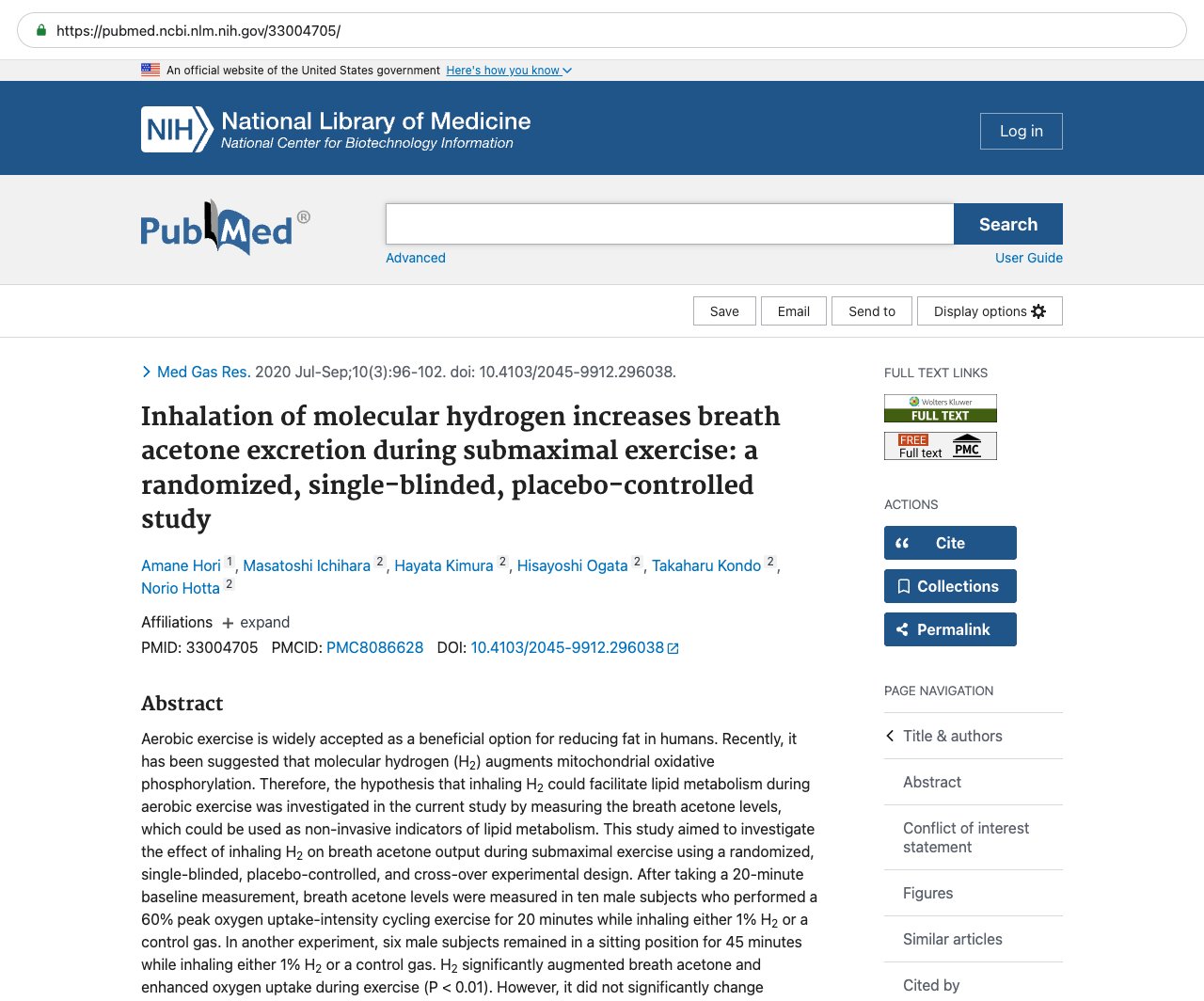
Aerobic exercise is widely accepted as a beneficial option for reducing fat in humans. Recently, it has been suggested that molecular hydrogen (H2) augments mitochondrial oxidative phosphorylation. Therefore, the hypothesis that inhaling H2 could facilitate lipid metabolism during aerobic exercise was investigated in the current study by measuring the breath acetone levels, which could be used as non-invasive indicators of lipid metabolism. This study aimed to investigate the effect of inhaling H2 on breath acetone output during submaximal exercise using a randomized, single-blinded, placebo-controlled, and cross-over experimental design. After taking a 20-minute baseline measurement, breath acetone levels were measured in ten male subjects who performed a 60% peak oxygen uptake-intensity cycling exercise for 20 minutes while inhaling either 1% H2 or a control gas. In another experiment, six male subjects remained in a sitting position for 45 minutes while inhaling either 1% H2 or a control gas. H2 significantly augmented breath acetone and enhanced oxygen uptake during exercise (P < 0.01). However, it did not significantly change oxidative stress or antioxidant activity responses to exercise, nor did it significantly alter the breath acetone or oxygen uptake during prolonged resting states. These results suggest that inhaling H2 gas promotes an exercise-induced increase in hepatic lipid metabolism. The study was approved by the Ethical Committee of Chubu University, Japan (approved No. 260086-2) on March 29, 2018.
Source & links
Screenshot of the PubMed page
This page mirrors the published abstract (© the authors / publisher) for reference and citation. The canonical source is the PubMed record linked above. This is not medical advice.