1988 · Toma et al. — Effect of Endocrine Treatment on Prostatic Blood Flow in Patients with Prostatic Adenocarcinoma
Super-Abstract
In 19 patients with prostatic adenocarcinoma, hydrogen gas clearance measurements showed that endocrine (hormone) therapy significantly increased blood flow to the prostate while reducing tumour volume — a finding suggesting that enhanced perfusion accompanies tumour cell deterioration under hormonal treatment. This is a diagnostic blood-flow measurement study, not an H₂ therapy study. (The Journal of Urology, 1988.)
Commentary
This study uses the hydrogen gas clearance technique as a diagnostic measurement tool to monitor prostatic blood flow before and during endocrine treatment for prostate cancer. H₂ is inhaled as a tracer; its clearance from prostatic tissue measured via electrode reflects tissue perfusion. The therapeutic intervention is hormonal treatment (endocrine therapy), not H₂. The key finding — that prostate blood flow increases as hormone therapy reduces tumour volume, and that histology shows tumour cell deterioration — contributes to understanding of how endocrine treatment affects the tumour microenvironment. For the H₂ medicine context: this paper documents that the H₂ gas clearance method can be applied to prostate tissue in a clinical oncology setting, confirming H₂'s inertness and tissue distribution capability.
Key quotes
- „Prostatic blood flow was remarkably depressed in patients who had never had any treatment of the prostatic carcinoma (22.2 +/- 8.3 ml. per minute per 100 gm.), while prostatic blood flow increased significantly after endocrine treatment (56.3 +/- 21.8 ml. per minute per 100 gm.).“ — blood flow data before and after endocrine treatment
- „Our study indicated that endocrine treatment caused a growth-inhibitory effect that was accompanied by increased blood flow in the prostatic carcinoma.“ — the main conclusion linking tumour response to perfusion change
Our assessment
Important note on scope: This is a diagnostic blood-flow monitoring study, not a therapeutic H₂ study. H₂ is used solely as an inert tracer gas via the clearance technique. The therapeutic intervention studied is endocrine (hormonal) treatment for prostate cancer. The paper provides no data on H₂ as an antioxidant, anti-inflammatory, or cancer therapy agent. Limitations: small n (19 patients); no control group; H₂ clearance is only the measurement tool; no H₂ therapy relevance.
Study design
- Type: prospective observational study with H₂ clearance as diagnostic measurement tool · n: 19 patients with prostatic adenocarcinoma · H₂ delivery: inhalation as diagnostic tracer only
- Intervention studied: endocrine (hormonal) treatment, not H₂ · Result: prostatic blood flow increased from 22.2 to 56.3 ml/min/100g after endocrine treatment; prostate volume reduced to 70 % of baseline; tumour cell deterioration on histology · H₂ therapy relevance: none
Abstract
Prostatic blood flow in 19 patients with prostatic adenocarcinoma was measured by the hydrogen gas clearance method before and during endocrine treatment. Prostatic volume was reduced to 70 per cent of the pre-treatment volume by 3 months after the beginning of treatment. Prostatic blood flow was remarkably depressed in patients who had never had any treatment of the prostatic carcinoma (22.2 +/- 8.3 ml. per minute per 100 gm.), while prostatic blood flow increased significantly after endocrine treatment (56.3 +/- 21.8 ml. per minute per 100 gm.). It was likely that prostatic blood flow increased as the prostate volume decreased. Final histology of serial prostatic biopsy specimens after endocrine treatment, revealed distinct deterioration of tumor cells and slight stromal hyperplasia compared to the initial pre-treatment biopsy. The stromal-epithelial ratio, which was calculated by computer-assisted image analysis, was markedly increased after endocrine treatment. Our study indicated that endocrine treatment caused a growth-inhibitory effect that was accompanied by increased blood flow in the prostatic carcinoma.
Source & links
Screenshot of the PubMed page
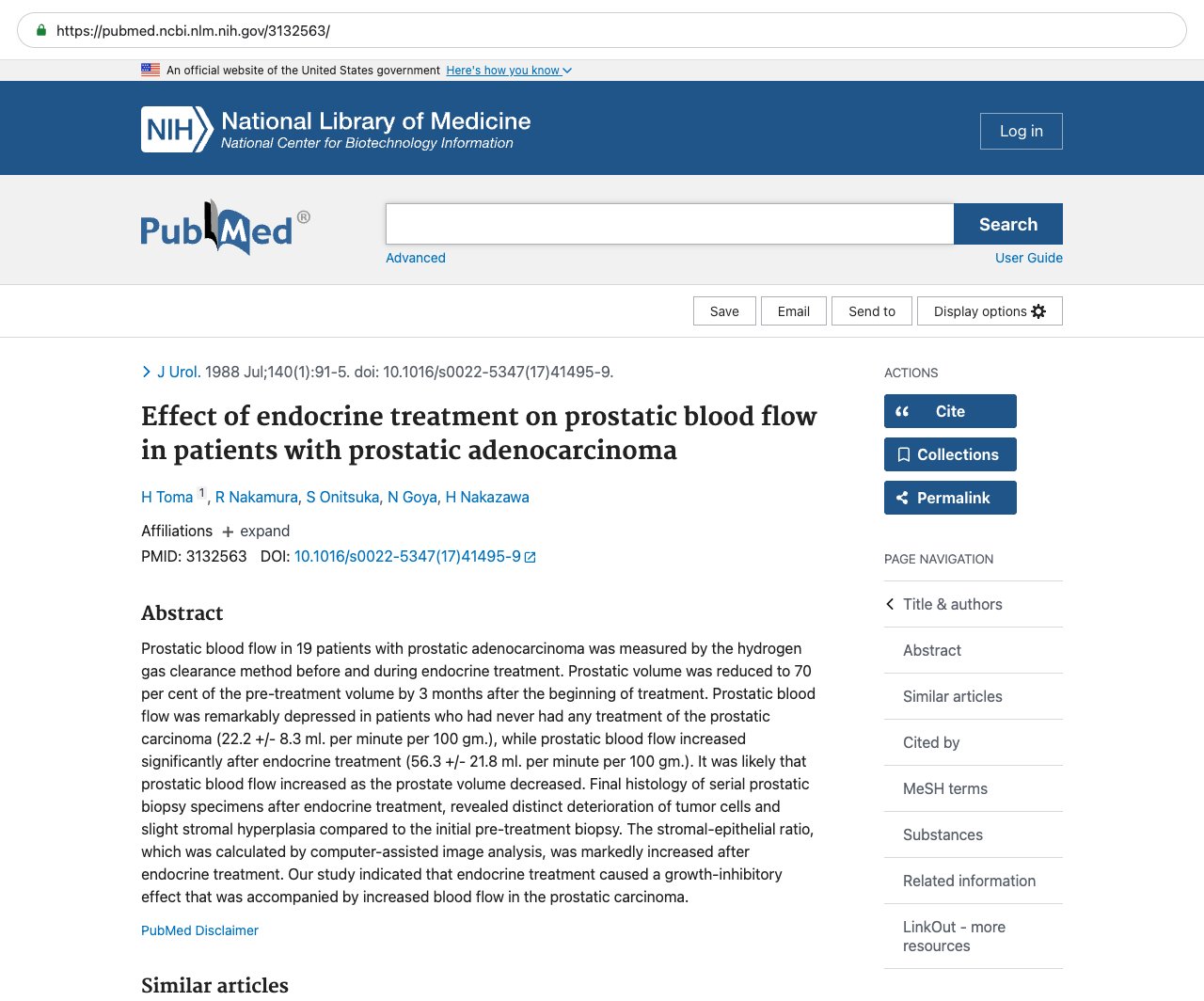
This page mirrors the published abstract (© the authors / publisher) for reference and citation. The canonical source is the PubMed record linked above. This is not medical advice.