2015 · Torzillo et al. — Advances in the biotechnology of hydrogen production with the microalga Chlamydomonas reinhardtii.
Super-Abstract
The green microalga Chlamydomonas reinhardtii can produce hydrogen gas from sunlight and water — a clean energy prospect, but one still far from industrial viability. This review covers a decade of progress in algal biohydrogen production following the key discovery of sulfur-deprivation as a trigger for sustained H₂ output. (Critical Reviews in Biotechnology, 2015.)
Commentary
This paper is entirely about biotechnological hydrogen production for use as a fuel — not about molecular hydrogen as a medical agent. The connection to H₂ medicine is indirect: the same H₂ molecule being studied as a clean fuel is also studied for biological effects in cells and organisms. The review is scientifically thorough on the algal biology, photobioreactor design, and the fundamental limits of photobiological efficiency. It is included in the H₂ medicine dataset for breadth, but should be read as energy biotechnology research, not as health science.
Key quotes
- „Biological hydrogen production is being evaluated for use as a fuel, since it is a promising substitute for carbonaceous fuels owing to its high conversion efficiency and high specific energy content.“ — the energy case for biohydrogen — distinct from the medical H₂ field
- „Of these, the microalga Chlamydomonas reinhardtii is considered one of the most promising eukaryotic H2 producers.“ — the model organism at the center of this line of research
- „Both the scientific and technical barriers that need to be overcome before H2 photoproduction can be scaled up to an industrial level are examined.“ — honest framing: significant barriers remain before this becomes practical
Our assessment
This review has no direct relevance to molecular hydrogen as a medical or therapeutic agent. It is energy biotechnology research focused on green H₂ fuel production via photosynthetic microalgae. Its scientific quality is not in question — but readers looking for evidence on H₂ health effects will find nothing applicable here. The review is thorough about both the promise and the significant remaining barriers to industrial-scale algal hydrogen production.
Study design
- Type: narrative review of biotechnology research · n: n/a (literature synthesis) · H₂ context: hydrogen as biofuel produced by microalgae — not as a medical agent
- Result: sulfur-deprivation protocol (Melis discovery) identified as key enabling technology; theoretical efficiency limits analyzed; photobioreactor design discussed; significant scientific and technical barriers to industrial scaling remain
Abstract
Biological hydrogen production is being evaluated for use as a fuel, since it is a promising substitute for carbonaceous fuels owing to its high conversion efficiency and high specific energy content. The basic advantages of biological hydrogen production over other "green" energy sources are that it does not compete for agricultural land use, and it does not pollute, as water is the only by-product of the combustion. These characteristics make hydrogen a suitable fuel for the future. Among several biotechnological approaches, photobiological hydrogen production carried out by green microalgae has been intensively investigated in recent years. A select group of photosynthetic organisms has evolved the ability to harness light energy to drive hydrogen gas production from water. Of these, the microalga Chlamydomonas reinhardtii is considered one of the most promising eukaryotic H2 producers. In this model microorganism, light energy, H2O and H2 are linked by two excellent catalysts, the photosystem 2 (PSII) and the [FeFe]-hydrogenase, in a pathway usually referred to as direct biophotolysis. This review summarizes the main advances made over the past decade as an outcome of the discovery of the sulfur-deprivation process. Both the scientific and technical barriers that need to be overcome before H2 photoproduction can be scaled up to an industrial level are examined. Actual and theoretical limits of the efficiency of the process are also discussed. Particular emphasis is placed on algal biohydrogen production outdoors, and guidelines for an optimal photobioreactor design are suggested.
Source & links
Screenshot of the PubMed page
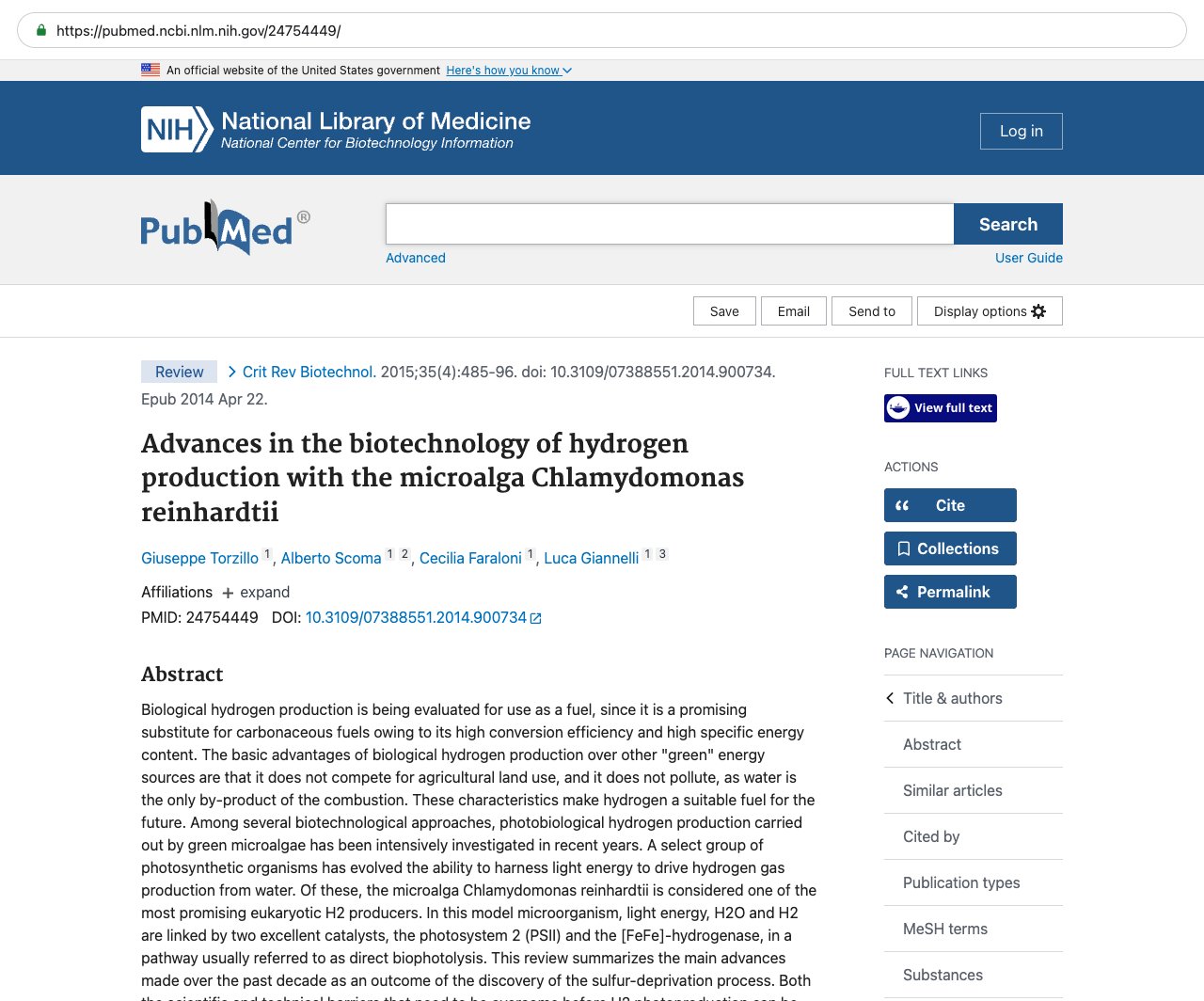
This page mirrors the published abstract (© the authors / publisher) for reference and citation. The canonical source is the PubMed record linked above. This is not medical advice.