2022 · Valenta — Acute pre-exercise hydrogen rich water intake does not improve running performance at maximal aerobic speed in trained track and field runners: A randomized, double-blind, placebo-controlled crossover study
Super-Abstract
Hydrogen-rich water immediately before running gives trained runners no performance advantage. In this randomized double-blind placebo crossover study (24 trained runners), the acute intake of 1260 ml of HRW had no effect whatsoever on time to exhaustion, lactate, heart rate or oxygen uptake. (PLoS ONE, 2022 — an honest null finding for acute intake.)
Commentary
We deliberately include this finding because it shows that our database is not whitewashed. Here, acute intake produced nothing. The design is high quality — randomized, double-blind, placebo-controlled, crossover — with 24 trained track and field runners (average 17.5 years, good VO2max of 55 ml/kg/min). Before exertion they drank 1260 ml of H₂ water split into four doses (120, 60, 30 and 10 minutes before the test). Then they ran at their individual maximal aerobic speed to exhaustion. The result is clearly negative: time to exhaustion did not differ (217 vs. 227 seconds, p = 0.20), neither did lactate (p = 0.42), maximal heart rate (p = 0.80) or oxygen uptake (p = 0.33). Not a single moderator factor correlated with performance. The message for honest advice: a single dose of H₂ water shortly before a maximal aerobic run does not act as an instant performance booster. This does not contradict the positive studies on regular intake over weeks — there the focus is on muscle protection and recovery over time, not an acute ergogenic effect. So: acute ≠ chronic.
Key quotes
- „HRW had no significant effects on the following variables: time to exhaustion (217 ± 49 and 227 ± 53 s, p = 0.20)“ — no effect on the central endurance performance
- „post-exercise blood lactate concentration (9.9 ± 2.2 and 10.1 ± 2.0 mmol⋅L-1, p = 0.42)“ — no effect on lactate
- „Pre-exercise administration of 1260 ml of HRW showed no ergogenic effect on running performance to exhaustion at maximal aerobic speed in trained track and field runners.“ — clear conclusion: no acute performance effect
Our assessment
An important counterweight in the database: this cleanly designed null finding guards against overreach. For us this means being honest in the sport context — H₂ water is not an acute „energy shot“ before competition. The benefit other studies show (less muscle damage, better recovery) tends to arise with regular use and concerns endpoints other than pure immediate endurance performance. It is exactly this distinction that makes the communication credible. Limitation, stated honestly: it examines only the acute single dose before one specific, very short maximal test (~3.5 min); young male runners; says nothing about chronic intake or other exertion profiles.
Study design
- Type: RCT, randomized/double-blind/placebo-controlled/crossover · n: 24 trained male runners (17.5 ± 1.8 yrs, VO2max 55.0 ± 4.6 ml/kg/min) · Duration: acute intake before a running test · H₂ delivery: 1260 ml HRW in 4 doses (420/420/210/210 ml) at 120/60/30/10 min before exertion
- Result: time to exhaustion 217 ± 49 vs. 227 ± 53 s (p = 0.20); lactate 9.9 ± 2.2 vs. 10.1 ± 2.0 mmol/L (p = 0.42); max heart rate 186 ± 9 vs. 186 ± 9 (p = 0.80); VO2 53.1 ± 4.5 vs. 52.2 ± 4.7 ml/kg/min (p = 0.33); no moderator correlated (all p ≥ 0.16)
Abstract
PURPOSE: This study investigated the effects of acute, pre-exercise, hydrogen rich water (HRW) ingestion on running time to exhaustion at maximal aerobic speed in trained track and field runners. METHODS: Twenty-four, male runners aged 17.5 ± 1.8 years, with body mass index = 21.0 ± 1.3 kg⋅m-2, and maximal oxygen uptake = 55.0 ± 4.6 ml⋅kg-1⋅min-1 (mean ± standard deviation) participated in this randomized, double-blind, placebo-controlled crossover study. All runners ingested 1260 ml of HRW which was divided into four doses and taken at 120 min (420 ml), 60 min (420 ml), 30 min (210 ml), and 10 min (210 ml) prior to exercise. The running protocol consisted of three phases: warm-up performed at 10 km⋅h-1 for 3 min, followed by a transition phase performed at an individually determined speed (10 km⋅h-1 + maximal aerobic speed)/2 for 1 min, and finally the third phase performed at individual maximal aerobic speed until exhaustion. Time to exhaustion, cardiorespiratory variables, and post-exercise blood lactate concentration were measured. RESULTS: When running to exhaustion at maximal aerobic speed, compared with placebo, HRW had no significant effects on the following variables: time to exhaustion (217 ± 49 and 227 ± 53 s, p = 0.20), post-exercise blood lactate concentration (9.9 ± 2.2 and 10.1 ± 2.0 mmol⋅L-1, p = 0.42), maximal heart rate (186 ± 9 and 186 ± 9 beats⋅min-1, p = 0.80), and oxygen uptake (53.1 ± 4.5 and 52.2 ± 4.7 ml⋅kg-1⋅min-1, p = 0.33). No variable assessed as a candidate moderator was significantly correlated with time to exhaustion (Spearman's correlation coefficients ranged from -0.28 to 0.30, all p ≥ 0.16). CONCLUSIONS: Pre-exercise administration of 1260 ml of HRW showed no ergogenic effect on running performance to exhaustion at maximal aerobic speed in trained track and field runners.
Source & links
Screenshot of the PubMed page
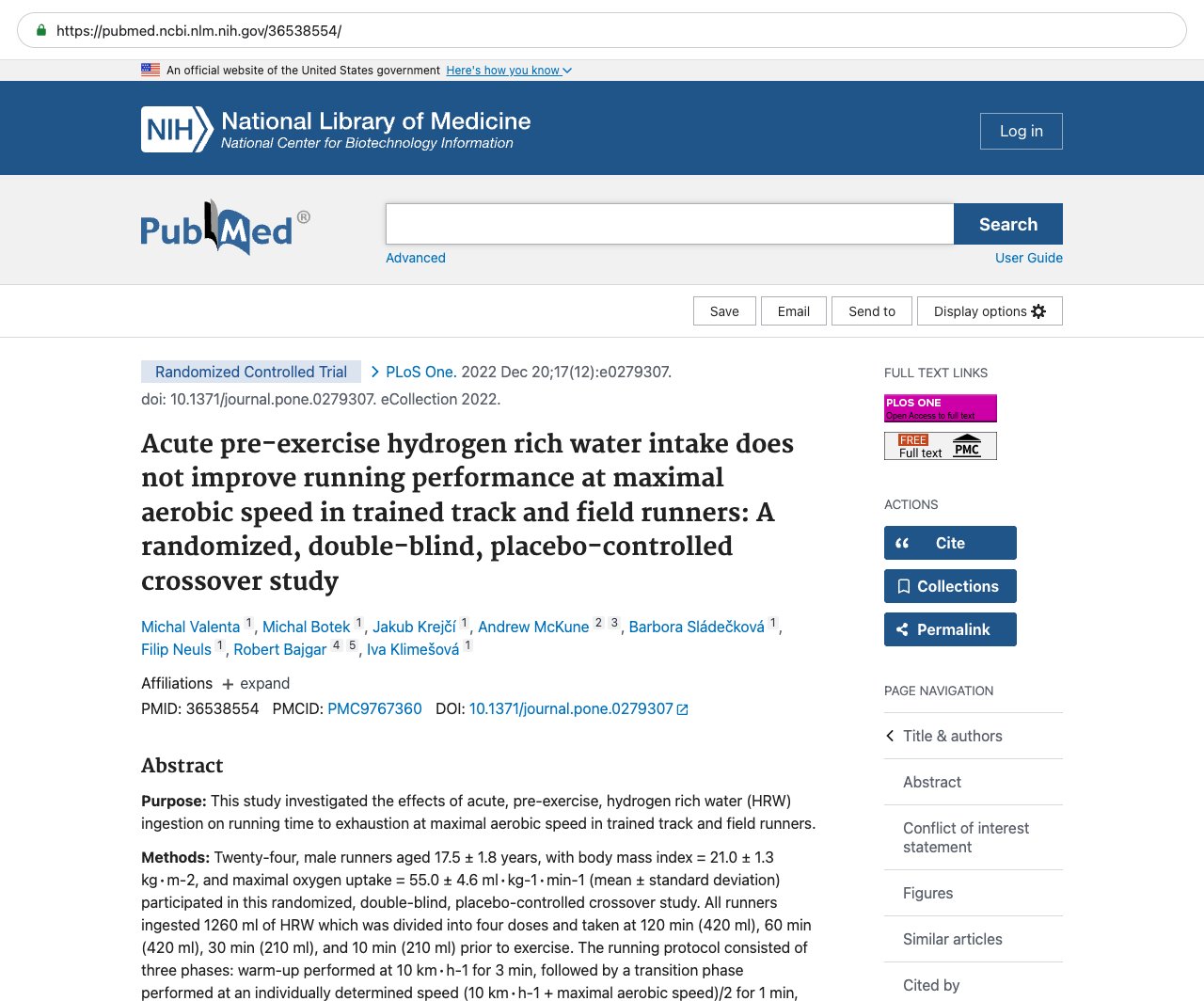
This page mirrors the published abstract (© the authors / publisher) for reference and citation. The canonical source is the PubMed record linked above. This is not medical advice.