2025 · Valizadeh — Integrating QSAR modeling, ADMET screening, molecular docking, and molecular dynamics simulations to identify potential MCF-7 inhibitors.
Super-Abstract
This computational study used mathematical models to predict which of 2,435 naphthoquinone chemical compounds might inhibit breast cancer cells — and used hydrogen-suppressed molecular graphs as part of the mathematical descriptor framework. Sixteen promising candidates were selected for virtual docking simulations against a cancer target protein, with one compound showing particularly strong binding. This is a purely in-silico (computer-based) study; no biological experiments with hydrogen gas or hydrogen-rich water were performed. (Computers in Biology and Medicine, 2025.)
Commentary
This paper is a computational chemistry study — its connection to molecular hydrogen (H₂) as a therapeutic agent is indirect and methodological rather than therapeutic. The „hydrogen“ appearing in this study refers to hydrogen-suppressed graphs (HSG), a mathematical representation technique for describing molecular structures in QSAR (quantitative structure-activity relationship) modelling — not to hydrogen gas medicine. QSAR models are used to predict biological activity from chemical structure without performing experiments. The study predicts anti-breast-cancer activity for naphthoquinone derivatives using Monte Carlo optimisation and then uses ADMET filtering (absorption, distribution, metabolism, excretion, toxicity) and molecular docking to narrow candidates. This is standard drug-discovery computational workflow. No cell culture, no animal experiment, no clinical data. The identified compound A14 may or may not show real biological activity — experimental validation is the essential next step.
Key quotes
- „an optimal hybrid descriptor derived from the integration of the Simplified Molecular Input Line Entry System (SMILES) and molecular hydrogen-suppressed graphs (HSG), was used.“ — the role of „hydrogen“ in this study: a mathematical graph descriptor, not therapeutic hydrogen
- „Compound A14, which exhibited the highest binding affinity, underwent molecular dynamics simulations for 300 ns, demonstrating stable interactions with the target protein.“ — best candidate identified computationally — still requires experimental validation
- „Doxorubicin served as a reference control to validate the efficacy of compound A14.“ — comparison to a known anti-cancer drug — in-silico only
Our assessment
This study has no direct relevance to hydrogen gas therapy or hydrogen-rich water. The word „hydrogen“ in the title refers to a mathematical graph-theory concept used in cheminformatics. The study is a standard computational drug-discovery workflow for breast cancer, identifying potential naphthoquinone-based inhibitors via QSAR modelling and docking — with no experimental validation yet. Completely in-silico: no cells, no animals, no humans. The identified compound A14 is a theoretical candidate requiring laboratory confirmation before any biological claims can be made. Included here for completeness; its relevance to H₂ medicine is negligible.
Study design
- Type: in-silico / computational study · n: 2,435 naphthoquinone derivatives modelled computationally · H₂ role: hydrogen-suppressed graphs (HSG) as mathematical descriptor in QSAR model — not therapeutic hydrogen gas
- Methods: Monte Carlo QSAR modelling (IIC + CII correlation), ADMET filtering, molecular docking at topoisomerase IIα (PDB ID: 1ZXM), molecular dynamics simulation 300 ns
- Result: 67 compounds with predicted pIC50 > 6; 16 selected after ADMET; compound A14 highest binding affinity in docking; no experimental biological validation performed
Abstract
In this study, quantitative structure-activity relationship (QSAR) models were developed by the Monte Carlo technique to predict the anti-breast cancer activity of 144 novel 1,2-naphthoquinone and 1,4-naphthoquinone derivatives against MCF-7 breast cancer cells. To establish QSAR models, a balance of correlation techniques involving the index of ideality of correlation (IIC) and the correlation intensity index (CII), as well as an optimal hybrid descriptor derived from the integration of the Simplified Molecular Input Line Entry System (SMILES) and molecular hydrogen-suppressed graphs (HSG), was used. The resulting models provided valuable information about identifying molecular fragments that enhance or reduce biological activity. The pIC50 values of 2435 naphthoquinone derivatives, including newly synthesized compounds, were predicted using the best QSAR model. Among them, 67 compounds showed pIC50 values greater than 6. After applying the absorption, distribution, metabolism, excretion, and toxicity (ADMET) filter, 16 promising compounds were selected for docking studies. The candidate inhibitors were docked at the binding site of topoisomerase IIα (PDB ID: 1ZXM) to assess their binding affinity. Compound A14, which exhibited the highest binding affinity, underwent molecular dynamics simulations for 300 ns, demonstrating stable interactions with the target protein. Doxorubicin served as a reference control to validate the efficacy of compound A14. These findings offer valuable insights for designing potent inhibitors against breast cancer.
Source & links
Screenshot of the PubMed page
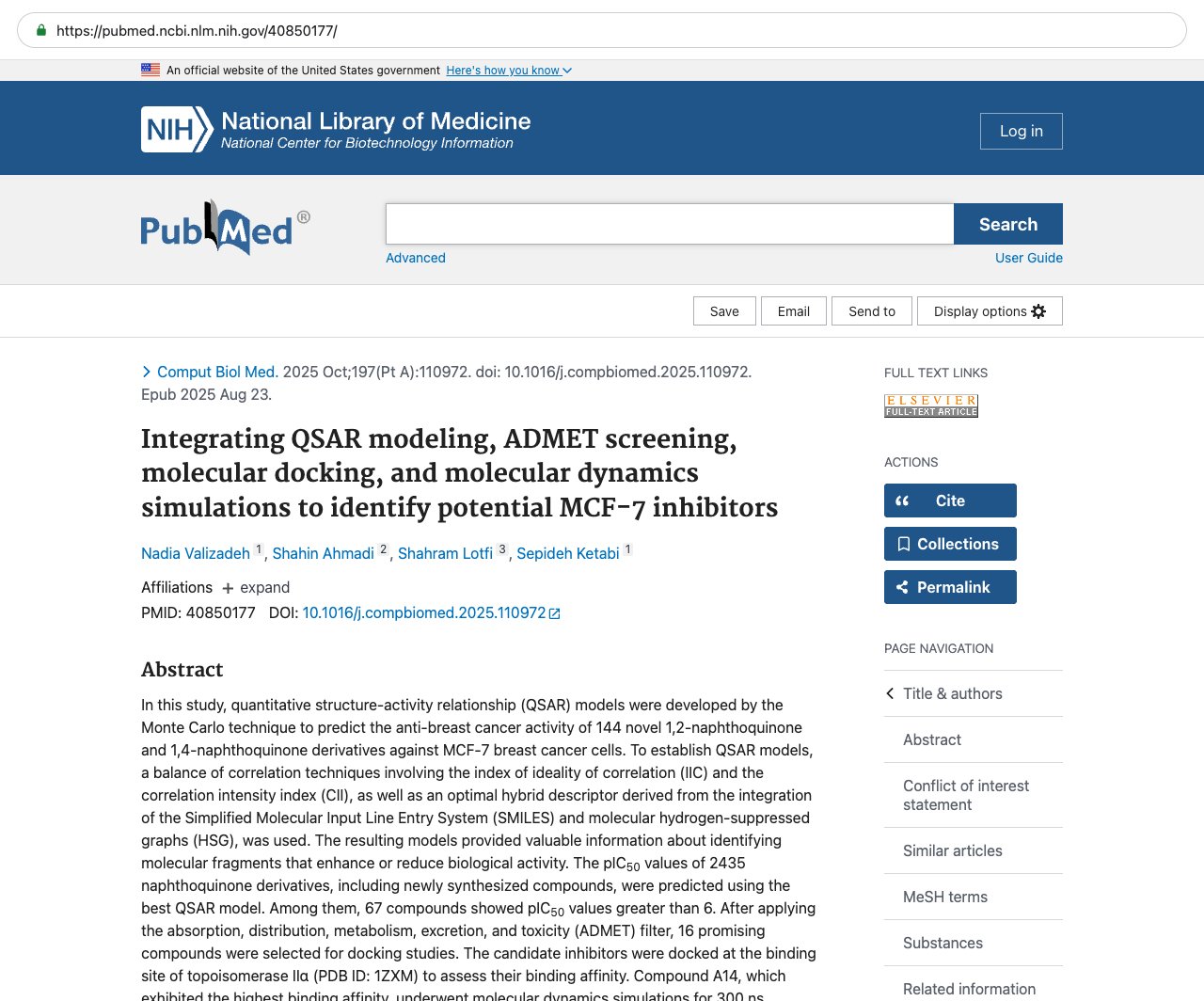
This page mirrors the published abstract (© the authors / publisher) for reference and citation. The canonical source is the PubMed record linked above. This is not medical advice.